1. A Bold Daylight Caper
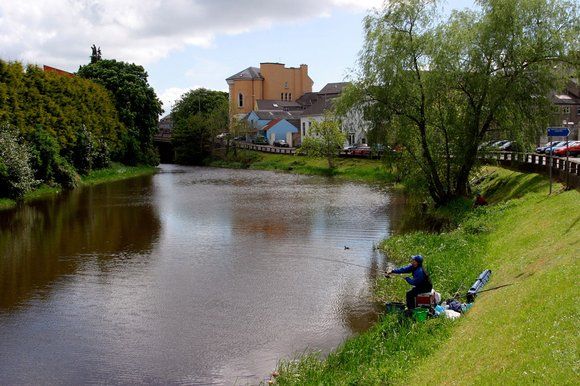
Picture a crisp June morning in 1925, the sun spilling golden light across the River Erne in Co. Donegal.
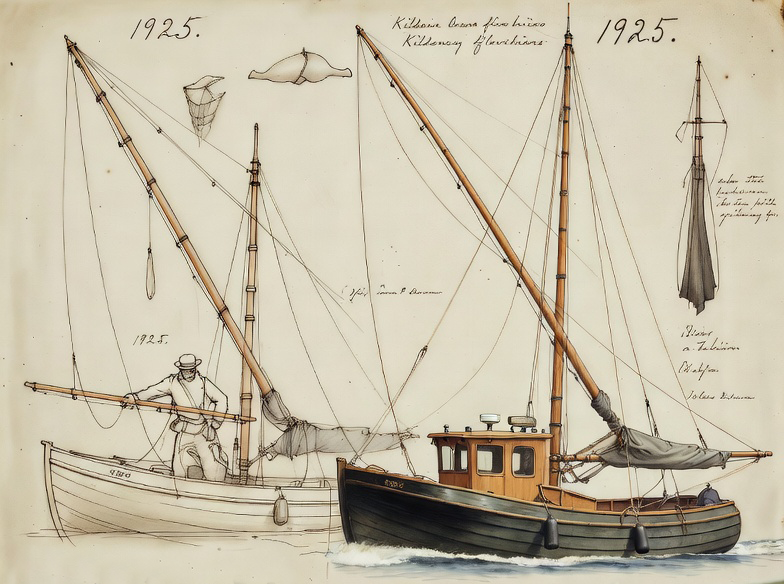
A crew of six fishermen from Kildoney shove off in a rickety tar-and-canvas boat, not skulking under the shroud of night but laughing and shouting as they paddle into the tidal estuary.
Their target?
The salmon-rich waters claimed by the Erne Fishery Company, a Protestant-run outfit that locals had long viewed with a mix of envy and disdain.
This wasn’t your typical poaching gig—no hushed whispers or furtive glances.
Instead, they’d invited a crowd to the riverbank, including a couple of Garda Síochána officers, to witness the spectacle.
The company’s motorboat soon roared into view, slicing through the water like a predator.
It didn’t hesitate—crashing into the fishermen’s frail craft, splintering it apart.
As the boat sank, the conservators snatched the empty net, then grudgingly fished out the soggy poachers.
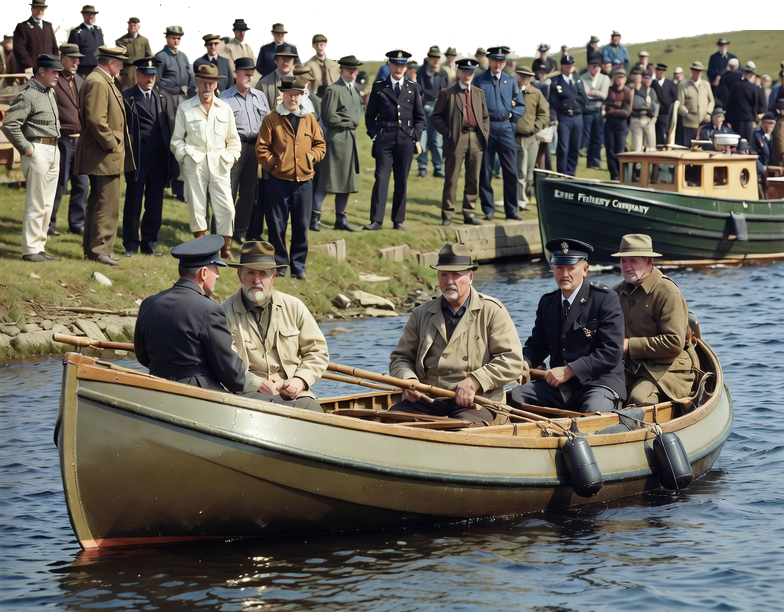
One of them, William Morrow, put on a theatrical show, bellowing he’d rather go down with his ship, only to be hauled aboard against his will.
When the bedraggled six landed at Mall Quay, the onlookers erupted in cheers, as if they’d just watched a triumphant play unfold.
What was this bizarre stunt all about?
It wasn’t about the fish—they didn’t catch a single one.
This was a gambit, a spark to ignite a much bigger fire.
The event was witnessed not only by a general crowd but also by specific Garda Síochána officers, Sergeant O’Connor and Garda Dan Linehan, who had been notified in advance.
The plan for this provocative act was hatched in a secret meeting at a Kildoney cottage, drawing on a tradition of local resistance to the company’s monopoly, which dated back to the 17th-century Plantation of Ulster and even earlier monastic fishing rights held by Cistercian monks at Abbey Assaroe.
2. The Mastermind and the Mission
The Erne Fishery Company’s grip on these waters stretched back to the Plantation of Ulster, its title now held by Major Robert Lyon Moore and his kin.
For the Catholic fishermen of Kildoney, that ownership was a festering sore, a relic of colonial overreach.
But this daylight raid wasn’t a random act of defiance—it was a calculated move, likely hatched by Francis Gallagher, a sharp-witted local solicitor with a grudge and a plan.
Frank Gallagher (also referred to as Francis Gallagher in some accounts) was a Ballyshannon solicitor who not only defended the poachers but also strategically orchestrated the 1925 protest to ensure it occurred beyond the half-mile limit from the shore, avoiding the pitfalls of the previous year’s failed case.
The six initial protesters were soon joined by forty more local fishermen, expanding the defendants to a total of forty-six, including individuals such as Alex Duncan, Frank McNeely, and Tommy McNeely, representing communities from Ballyshannon, Kildoney, Creevy, St. John’s Point, and Inver.
A year earlier, Gallagher had defended a batch of Kildoney poachers in court, aiming to topple the company’s legal claim to the fishery.
That effort floundered when the fishermen were nabbed too close to shore, within a forbidden zone that muddied the case.
This time, Gallagher played it smarter.
He picked six men, made sure they fished beyond the restricted half-mile limit, and tipped off the Garda and the crowd.
The goal?
Force the company to sue, setting the stage for a legal showdown that could unravel their centuries-old rights.
It was a trap, baited with audacity, and the company took it hook, line, and sinker.
3. Magna Carta Meets Gaelic Roots
Gallagher’s weapon wasn’t just bravado—it was history.
He leaned on a dusty clause from the Magna Carta, that medieval cornerstone of English law, which, loosely translated, barred the Crown from carving out exclusive fisheries on tidal waters after 1189 unless they’d existed before King Henry II’s death.
Donegal, a wild Gaelic stronghold unconquered in 1189, couldn’t have had such fisheries—or so Gallagher argued—because the old Brehon Law, Ireland’s ancient legal code, didn’t play that game.
Under Brehon rules, he claimed, fishing was a shared right, not a private prize.
The case involved not just Gallagher but also solicitor James McLoone, and it progressed from Ballyshannon District Court to higher jurisdictions after the district judge deferred the trespass charge pending resolution of the title’s validity.
The Magna Carta argument specifically invoked Chapter 33 (originally 23 in the 1215 version), which prohibited the creation of new weirs on rivers, interpreted in this context to challenge post-1189 exclusive fisheries in unconquered Gaelic areas like Donegal, where native chieftains like the O’Donnells, known as “the kings of the fishe,” held communal rights under Brehon Law.
Formally dubbed Moore v. Attorney General, but it’s better known as the Erne Fishery Case, kicked off in Ballyshannon’s District Court. Gallagher painted the company’s title as a Stuart-era theft, a fraud the Magna Carta wouldn’t tolerate.
The district judge, swept up in the drama, refused to hear the trespass charge, insisting a higher court first settle the title’s legitimacy.
The company fought back, demanding the case proceed, but when that failed, they went big—suing for a declaration of their rights and damages from the Irish state.
4. Scholars, Salmon, and a Showdown
What followed was a legal odyssey that plunged deep into Ireland’s past.
In the High Court, the company leaned on their unbroken hold since the 1600s, bolstered by a presumption of legality: prove long possession, and the burden flips to the challengers to disprove ancient origins.
They pointed to medieval monastery fishing rights on the Erne, hinting some Gaelic VIP might’ve owned the whole river first.
Gallagher countered with heavy hitters—Eoin MacNeill and Daniel Binchy, titans of Irish scholarship, particularly experts on the Brehon laws of early Ireland.
MacNeill spun a vision of Brehon Ireland where every villager had a stake in the salmon, citing texts like “the salmon of the place” from a tract called Of the Confirmation of Right and Law from the Senchas Már.
Private weirs existed, he admitted, but they were small fries next to the communal haul.
Binchy nodded along—at least for now.
High Court Judge Johnston wasn’t sold.
He saw the weirs as proof of private rights, not public perks, and ruled for the company in 1929.
But the tide turned in the Supreme Court by 1933.
MacNeill’s testimony swayed the majority—Chief Justice Kennedy and Justice Murnaghan—who declared Brehon Law knew no exclusive fisheries like the company’s.
The title crumbled, three centuries of ownership washed away.
The Kildoney crew celebrated like national heroes, with bonfires blazing on Mall Quay.
5. London’s Last Word
The story didn’t end there.
The Moores took their fight to the Judicial Committee of the Privy Council in London—a move that lit a political fuse.
Ireland’s Free State, under Eamon de Valera, was clawing back sovereignty, axing the Privy Council appeal as a colonial shackle.
Nationalists fumed, while Southern Protestants saw it as their last shield.
The case ballooned into a test of Ireland’s judicial freedom, but the Privy Council dodged the Brehon debate, ruling de Valera’s reforms legal.
The Erne stayed common ground—though not without ripples.
The Privy Council appeal, heard in 1935 as Moore v Attorney-General for the Irish Free State [1935] AC 484, ultimately upheld the Irish Free State’s constitutional amendments under de Valera, effectively ending the appeal process and confirming the Supreme Court’s decision without addressing the substantive fishery rights.
6. The Moy Twist
Three years later, the Moy River in Co. Mayo became the next battleground.
Poachers swarmed its fishery post-Erne, and the “owners” sued.
Binchy flipped the script, now arguing Brehon Law did bless private fisheries, bolstered by new digs into old texts.
Weirs weren’t just tolerated—they were owned, he said, and glosses shrunk “salmon of the place” to a pittance, a relic of a bygone era.
MacNeill stuck to his guns, painting a communal paradise.
Johnston, back on the bench, sided with Binchy, upholding the Moy title in 1936, citing Norman sway in Mayo centuries before Donegal’s fall.
It settled quietly, leaving the Erne precedent wobbly.
7. Foyle’s Final Echo
The 1940s brought the Foyle and Bann Fisheries Case, another Donegal dust-up.
Binchy doubled down, torching “salmon of the place” as a mistranslation—maybe it was a plant, not a fish, he mused.
Without MacNeill, who’d passed in 1945, the defence leaned on new voices like James Henchy, clinging to common rights.
Judge Gavan Duffy had enough, calling Brehon Law a tangle of guesses too shaky for court.
He ruled on other grounds, leaving the fishery debate adrift.
8. Legacy in the Nets
These cases weren’t just about fish—they were time machines, hauling Brehon Law into the 20th century with MacNeill and Binchy as rival guides.
The Erne victory’s legacy is commemorated by the Kildoney Fishermen Memorial at the Mall Quay, unveiled on August 4, 2013, listing all forty-six fishermen and key supporters, with annual events including a traditional music gathering planned for August 3, 2025, to mark the centenary.
However, the triumph was undermined by the 1950s hydroelectric dam at Assaroe Falls, which destroyed the salmon leap and, due to a faulty fish pass, redirected stocks to the Moy Estuary, exacerbating the decline in local fisheries.
The Erne win freed the river, but joy soured as overfishing gutted stocks, leaving Kildoney’s crew cursing their “victory.”
Gallagher, ever the fox, later brokered a deal for the state to buy out the Moores’ upstream scraps—a tidy twist of fate.
Modern challenges include a drastic reduction in fishing families—from 40 in the 1980s to about six today in areas like Bundoran—driven by EU-influenced salmon closures and practices like pair trawling for sprat, prompting calls for sustainable artisan fisheries to preserve generational ties.
Historians still bicker.
Was Magna Carta misread?
Did Brehon Law ever truly bar private rivers?
The answers lurk in muddy texts, but one thing’s clear: for a fleeting moment, Ireland’s ancient soul reshaped its modern waters, proving the past, and Brehon law, isn’t as dead as it seems.
Further Reading and Sources:
- Moore v. Attorney-General, IR [1934] I. R. 44. Accessed at: https://ie.vlex.com/vid/moore-v-attorney-general-805147017 on January 19, 2026.
See also: https://www.casemine.com/judgement/in/56b49624607dba348f016ef3, accessed on January 19, 2026. - Moore v. Attorney-General for the Irish Free State. Annual Digest and Reports of Public International Law Cases. Accessed at: https://www.cambridge.org/core/journals/annual-digest-and-report-of-public-international-law-cases/article/abs/moore-v-attorneygeneral-for-the-irish-free-state/8EE882E9C707696F6FBAD6616A9F3A12 on January 19, 2026.
- Ó Caoineachán, É. Irish Central, “Erne Go Bragh: Irish fishermen’s fight for fishing freedom.” By Éamon Ó Caoineachán. June 13, 2025. Accessed at: https://www.irishcentral.com/opinion/others/irish-fishermen-fight-fishing-freedom, on January 19, 2026.
- Ó Caoineachán, É. Donegal Live, “Earning back the Erne: The Ballyshannon fishermen’s boat protest 100 years ago.” May 28, 2025. Accessed at: https://www.donegallive.ie/news/donegal-md/1812322/earning-back-the-erne-the-ballyshannon-fishermens-boat-protest-100-years-ago.html on January 18, 2026
- Mohr, T. “Law without loyalty: The abolition of the Irish Appeal to the Privy Council”, Thomson Reuters – Roundhall (2002). Available from our members’ library here: https://brehonacademy.org/docs/law-without-loyalty-the-abolition-of-the-irish-appeal-to-the-privy-council-thomas-mohr/
- Mohr, T. “Brehon Law Before Twentieth Century Courts.” Peritia: Journal of the Medieval Academy of Ireland 17–18 (2003): 326–342. Available from our members’ library here: https://brehonacademy.org/docs/brehon-law-before-twentieth-century-courts/
- Begley, A. Ballyshannon Musings. “Remembering the Most Successful Peaceful Protest in Ballyshannon.” April 9, 2020. Accessed at: https://ballyshannon-musings.blogspot.com/2020/04/kildoney-fishermens-famous-victory.html on January 19, 2026
- Begley, A. Ballyshannon Musings. “Kildoney Fishermen’s Victory.” 14 July, 2013. Accessed at: https://ballyshannon-musings.blogspot.com/2013/07/kildoney-fishermens-victory.html on January 19, 2026
- Fisheries (Tidal Waters) Bill, 1934—Second Stage. Dáil Éireann debate – Friday, 25 May 1934 Vol. 52 No. 14. Accessed at: https://www.oireachtas.ie/en/debates/debate/dail/1934-05-25/3/ on January 19, 2026.
- Fishing & Sporting Rights, Irish Legal Guide (Irish Law Explained). Accessed at: https://legalguide.ie/fishing-sporting-rights/2/ on January 19, 2026.
- MacBride Conaghan Solicitors. “Erne Fishery Case 1927“
Accessed at: https://donegallaw.ie/erne-fishery-case-1927/ on January 19, 2026. - O’Neill, T. P. History Ireland. “Fish, historians and the law: the Foyle Fishery case.” Issue 6 (Nov/Dec 2009), Volume 17. Accessed at: https://historyireland.com/fish-historians-and-the-law-the-foyle-fishery-case/ on January 19, 2026.
- McCutcheon, W.A. “The Foyle Fishery Case.” The Guildhall Miscellany 19 (1988): 1–12.
(Hosted in PDF format by the Guildhall Historical Association, 2017). Accessed at: https://guildhallhistoricalassociation.wordpress.com/wp-content/uploads/2017/01/19-the-foyle-fishery-case.pdf on January 19, 2026.