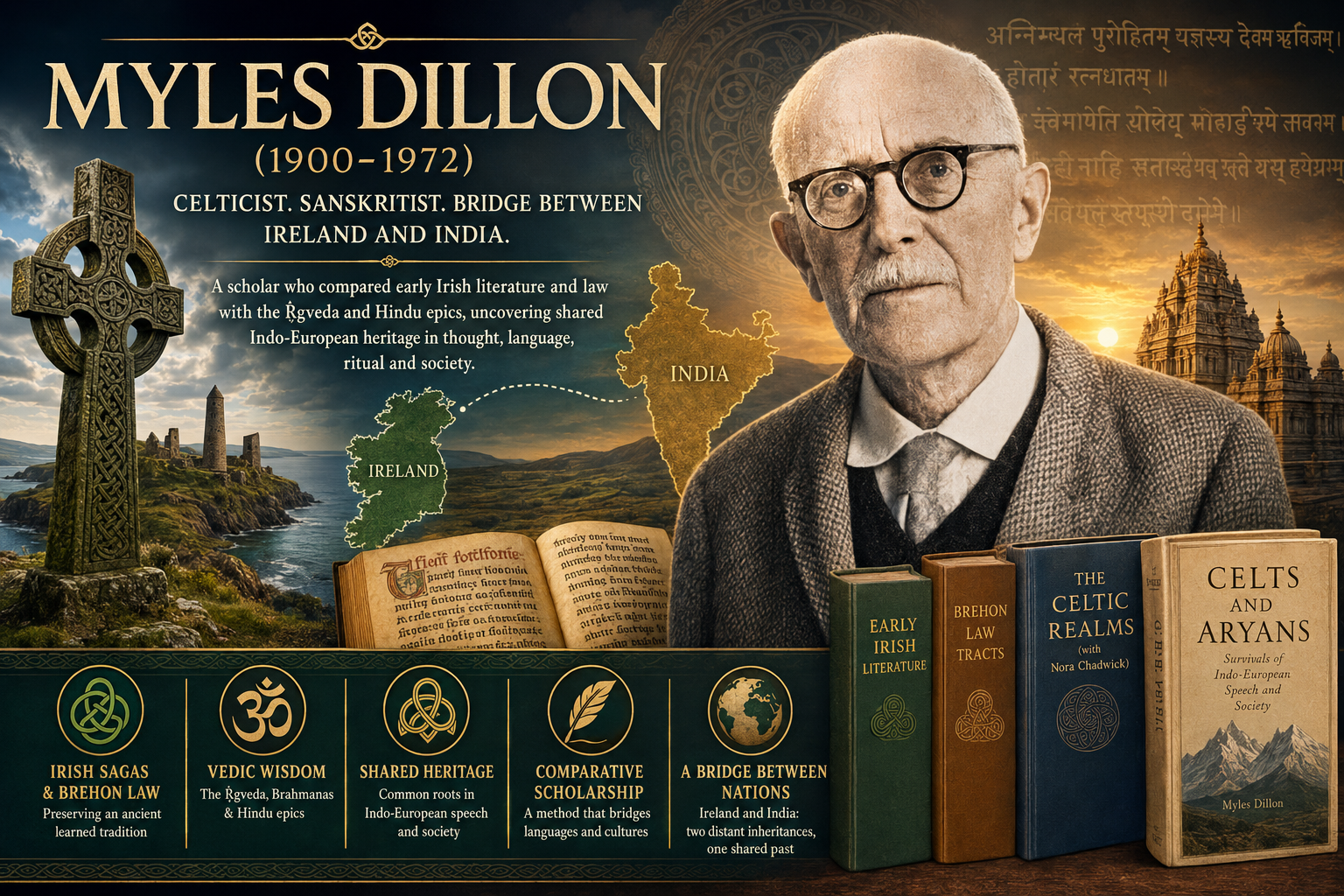
Myles Dillon (1900–1972) spent fifty years arguing that early Ireland and ancient India
were more than distant ancestors — this is his story, and his case.
Introduction
Myles Dillon is remembered, when he is remembered at all outside specialist circles, as a Celticist: an editor of Celtic sagas, a translator of Brehon law tracts, a co-author of the widely read survey The Celtic Realms.
That reputation is accurate but incomplete, and the missing piece is the more interesting half of the man.
Dillon trained first as a Sanskritist, taught Sanskrit for most of a decade before he ever held a post in Irish, and spent his entire career reading early Irish literature and law with a second text open beside it — the Ṛgveda, the Brahmanas, the Hindu (or Vedic) epics.
He believed, and tried patiently to demonstrate, that Ireland’s medieval literature preserved habits of thought, verbal formulas, and social institutions that Sanskrit sources preserved independently on the other side of the Indo-European world.
Where most Celticists of his generation compared Irish tradition with Welsh, Gaulish, Brythonic, or classical comparanda, Dillon kept reaching for India.
This is not a fringe or eccentric footnote to his career — it is arguably its organising idea, present from his student days under Osborn Bergin in the 1910s to the book he was still preparing for the press when he died in 1972 (Celts and Aryans: Survivals of Indo-European Speech and Society [LINK] (1975)).
Yet it is the part of his output most likely to have been forgotten, partly because his single dedicated monograph on the subject appeared posthumously from a press in Simla that few Western libraries carry, and partly because comparative Indo-European “mythology and society” work of this kind fell out of academic fashion in the decades after his death.
This piece tries to restore the balance: it treats the Sanskrit–Irish comparison as the centre of the story, and treats his more famous purely-Irish philological and literary work as the necessary background against which that comparison makes sense.
1. A Formation Between Two Languages
1.1 Family and early life
Myles Patrick Dillon was born in Dublin on 11 April 1900, the third of six children of John Dillon, the last leader of the Irish Parliamentary Party, and Elizabeth Mathew, eldest daughter of Sir James Charles Mathew.
His younger brother James Dillon later led Fine Gael, so the household combined constitutional nationalist politics with the intellectual seriousness of a family that expected its children to read widely and think independently.
Myles was educated at Belvedere College in Dublin and at Mount St Benedict in Gorey, County Wexford, before entering University College Dublin in 1917, initially reading classical languages.
1.2 The turn to Sanskrit — and to Irish, together
The pivotal moment of Dillon’s intellectual life happened at UCD, where he switched from classics to Celtic studies and came under the supervision of Osborn Bergin — the scholar who, remarkably, is the one who first introduced him to Sanskrit.
This detail deserves to be dwelt on, because it inverts the story a casual reader might expect.
Dillon did not come to Irish studies first and later decide, as an outside enthusiasm, to dabble in Sanskrit for comparative colour.
His teacher in Irish was the person who put Sanskrit grammar in front of him.
From the outset, the two languages were presented to him as a single field of inquiry: the comparative philology of Indo-European, in which Old Irish and Vedic Sanskrit were simply two of the more archaic and useful witnesses.
He took his Bachelor of Arts in 1921 and Master of Arts in 1922, both with first-class honours. A travelling studentship in Celtic studies from the National University of Ireland then sent him, between 1922 and 1927, to Berlin, Bonn, Heidelberg, and Paris, where he studied comparative philology with particular emphasis on Sanskrit and Celtic.
He earned his doctorate from Bonn in 1925 under Rudolf Thurneysen, the towering figure of Old Irish philology in that generation, and in Paris he also studied under Joseph Vendryes.
His letters home to his father during these German years survive and were published in 1999 as The Correspondence of Myles Dillon, 1922–1925: Irish–German Relations and Celtic Studies — a rare window onto how a young Irish scholar experienced Weimar-era German philology from the inside.
1.3 A Sanskrit lectureship before an Irish one
It is worth pausing on the shape of his early academic appointments, because it is often reversed in casual retellings.
In 1928 Dillon was appointed lecturer in Sanskrit and comparative philology at Trinity College Dublin — not in Irish.
Two years later he moved to a similar post at UCD, where he stayed until 1937.
For nearly a decade, in other words, “Sanskrit lecturer” was Dillon’s actual job title — the Irish-studies career that made him famous came afterwards and alongside it.
The Dictionary of Irish Biography records that his failure to succeed Douglas Hyde in the chair of Irish at UCD in 1932 is thought to owe something to his public opposition to compulsory Irish in schools — a reminder that Dillon’s love of the Irish language and its literature was scholarly rather than doctrinaire, and that he was capable of holding unpopular positions on the politics of language revival even while devoting his working life to Irish texts.
1.4 America, and the road back to Sanskrit’s homeland
In 1937 Dillon moved to the United States, teaching Irish at the University of Wisconsin (where his son, the classicist and Platonist John M. Dillon, was born) and later, in 1946–47, at the University of Chicago.
On his return to Ireland he joined the School of Celtic Studies at the Dublin Institute for Advanced Studies (DIAS), becoming Senior Professor there from 1949 and serving as the School’s Director from 1960 to 1968; he also edited the journal Celtica for many years.
In the last phase of his career, this Irish-studies eminence gave him something he had wanted since his student days: an invitation to India itself.
He served as a Visiting Research Professor at the Indian Institute of Advanced Study in Simla, where he was asked to produce a companion volume to S. K. Chatterji’s Balts and Aryans (1968), itself based on lectures Chatterji had delivered at the same institute — a parallel study, from the opposite edge of the Indo-European world, of what survived of a shared inheritance.
He died in Monkstown, Dublin, on 18 June 1972, aged 72, with the typescript of that book only just delivered to his Indian collaborator, Chatterji, for publication. The book, Celts and Aryans, appeared posthumously in 1975 — the culmination, quite literally the last work, of a comparative project Bergin had set in motion for him more than fifty years earlier.
2. Why Compare Ireland with India at All?
Before turning to the specific arguments, it is worth explaining the intellectual logic behind the comparison, because to a modern reader it can look like an arbitrary pairing of two unconnected cultures.
Sanskrit and the Old Irish/early Welsh languages both belong to the Indo-European language family, whose speakers spread from a homeland somewhere in the Pontic–Caspian steppe (on the currently dominant view) across most of Europe and into Iran, Afghanistan, and northern India, beginning in the third millennium BC.
Comparative philologists in the nineteenth century established the family relationship through systematic sound-correspondences — the same method that let scholars reconstruct fragments of the ancestral Proto-Indo-European vocabulary.
Dillon’s innovation was to push this method past vocabulary and grammar into social institutions and modes of thought: law, kingship ritual, the poet’s social role, and inherited turns of phrase that seem to preserve not just cognate words but cognate ideas.
The comparison works, when it works, precisely because Ireland and India sit at the two most conservative extremities of the Indo-European-speaking world.
Continental Europe was Romanised, Christianised, and administratively reorganised early, repeatedly, and thoroughly, erasing much of what had gone before.
Ireland, by contrast, was never conquered by Rome, and its post-conversion literate class — the filid and the jurists — wrote down pre-Christian material with comparatively little pressure to disguise it.
India’s Brahmanical tradition, meanwhile, preserved the Vedic hymns and their surrounding ritual literature with an almost obsessive concern for verbatim accuracy of recitation, precisely because getting the sacred sound wrong was thought to be dangerous.
Dillon’s argument, in essence, was that these two unusually conservative traditions — separated by thousands of miles and over a thousand years of independent development — sometimes rhyme with each other in ways too specific to be coincidence, and that where they do rhyme, we may be looking at genuine survivals from the common Indo-European past rather than parallel but unrelated inventions.
He was careful, in his more considered writing, to allow for the second possibility too — parallel development, or convergence, rather than shared inheritance — and much of his method consists precisely in trying to tell the two apart.
3. The Comparative Corpus: Dillon’s Key Sanskrit–Irish Studies
3.1 “The Archaism of Irish Tradition” (1947)
Dillon’s single most influential statement of the comparative programme was his Sir John Rhŷs Memorial Lecture to the British Academy, published as “The Archaism of Irish Tradition” in the Proceedings of the British Academy, volume 33 (1947), pages 245–264.
The lecture’s argument, restated many times since by other scholars, is that heroic-age Irish saga and law preserve a strikingly archaic layer of Indo-European material — closer, in certain respects, to Vedic India than to anything in the classical Mediterranean world, because Ireland’s conversion to Christianity did not require the wholesale destruction of the older learned class the way Rome’s conquests did elsewhere.
It was published as a short standalone pamphlet by Oxford University Press the same year and remains the most-cited single item in his bibliography.
3.2 “The Hindu Act of Truth in Celtic Tradition” (1947)
The same year Dillon published what is probably his most quoted specific comparison, a short article in Modern Philology (vol. 44, no. 3, February 1947, pages 137–140) titled “The Hindu Act of Truth in Celtic Tradition.”
The “Act of Truth” (Sanskrit satyakriyā) is a recurring device in Indian narrative literature in which a person of unimpeachable virtue makes a solemn declaration of some fact — often about their own conduct — and the very truth of the statement produces a supernatural effect: fire fails to burn, water parts, poison loses its power.
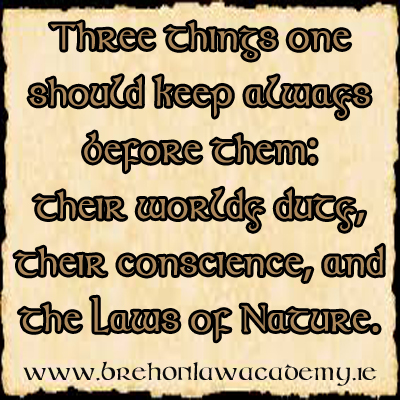
Dillon showed that early Irish literature and law contain a remarkably close structural parallel, most famously in the idea of fír flathemon, “the ruler’s truth” or “prince’s truth”: the doctrine, stated explicitly in the wisdom-text Audacht Morainn (“The Testament of Morann”), that a just king’s truthful, righteous rule directly and magically secures good weather, abundant harvests, calm seas, and the fertility of the land, while a false or unjust king brings blight and disorder on his people almost mechanically, as a natural consequence of his falsehood.
Scholars have continued to draw the same line Dillon drew. Modern reference summaries of this “advice for kings” literature note that its central theme is fír flathemon, the ruler’s truth, by which a king who acts in accordance with it secures peace, stability, and prosperity for himself and his people, since his justice and righteousness correlate with the welfare of his country — and that this idea has been directly compared with related concepts in the Indo-Iranian world, such as Vedic ṛta (right order) and Avestan asha (rightness).
This is precisely the comparative move Dillon had proposed. The Audacht Morainn passages that catalogue the beneficial effects of a truthful ruler (“It is through the ruler’s truth that…”) read, out of context, uncannily like passages from Vedic hymns on Varuṇa and Mitra, the guardian deities of cosmic and social order (ṛta), of whom it is said that by their embrace of Truth the sky and the earth themselves are held up.
3.3 “Celt and Hindu” (the Bergin Lecture, 1973)
Fittingly, given that it was Bergin who had started him on Sanskrit half a century before, Dillon’s late-career synthesis of the comparison was delivered as the third Osborn Bergin Memorial Lecture at UCD, published posthumously as Celt and Hindu (Dublin: University College Dublin, 1973, 19 pp.).
This slim lecture functions as a kind of trailer for the fuller argument of Celts and Aryans, gathering together his favourite comparanda — kingship ritual, the social position of the learned poet, the ancient laws, formulaic diction — into a single accessible statement, delivered in memory of the very teacher who had set him on this path.
3.4 Celts and Aryans: Survivals of Indo-European Speech and Society (1975)
This is the book that most fully deserves to be called Dillon’s Sanskrit–Irish testament, and the one that is hardest to find.
It was published posthumously by the Indian Institute of Advanced Study in Simla in 1975, as a direct companion to S. K. Chatterji’s earlier Balts and Aryans, itself the fruit of a research fellowship in the same Himalayan institute.
Its table of contents alone signals the ambition of the project, moving from the Celts as a people, through a chapter explicitly titled “Sanskrit and Irish,” to court poetry and heroic literature and on to social institutions and kingship.
A historian of Irish intellectual life who has studied the book describes its central claim plainly: Dillon detailed the similarities between ancient India and Ireland, ranging from linguistics to epic poetry to social customs.
The same account notes that Dillon expressed the hope that Ireland and India’s shared modern legacy of British imperial rule would lead scholars to explore further the similarities between their cultures and histories, closing the book on the note that the common heritage India and Ireland share should be a bond between them.
That closing sentiment is worth sitting with: Dillon was not merely doing dry historical linguistics. He saw the comparison as something two postcolonial nations could use to understand each other and themselves — a use of scholarship that reaches well beyond the seminar room.
Celts and Aryans is out of print and scarce in physical form, but a scanned copy has been made freely available in Brehon Academy’s Members’ Library.
3.5 Related comparative essays
Several of Dillon’s more narrowly philological papers also carry the comparative thread, even when Sanskrit is not in the title:
- “The Consecration of Irish Kings”, Celtica 10 (1973), pp. 1–8, one of his last publications, which draws directly on Vedic material, noting that the recitation of poems in praise of a king’s ancestors on the occasion of his consecration follows a pattern also found in Vedic tradition.
- “The Taboos of the Kings of Ireland”, Proceedings of the Royal Irish Academy 54 C (1951–1952), pp. 1–36, an edition and study of the gessi (ritual prohibitions) binding on Irish kings, a subject with obvious anthropological affinities to the taboo-systems surrounding Indian and other Indo-European sacral kingship.
- “Celtic and Other Indo-European Languages”, Transactions of the Philological Society 46 (1947–48), pp. 15–24, a more strictly linguistic piece situating Celtic within the wider comparative family.
- His introduction to and translation work on the Nāṭyaśāstra tradition — he co-translated the Nāṭakalakṣaṇaratnakośa of Sāgaranandin, a thirteenth-century Sanskrit treatise on Hindu dramatic theory, together with Murray Fowler and V. Raghavan (Philadelphia: American Philosophical Society, 1960) — a reminder that his competence in Sanskrit was not limited to Vedic religious material but extended into classical Sanskrit poetics and theatre as well.
4. What the Comparison Actually Claimed: Themes in Detail
It is worth drawing out, theme by theme, the specific parallels Dillon and those working in his tradition identified, since these are the substantive content behind the general claim of “shared heritage.”
4.1 The king’s truth and cosmic order
Already discussed above (§3.2), this is Dillon’s signature comparison: the Irish doctrine of fír flathemon against the Vedic doctrine of ṛta, the cosmic-and-moral order upheld by the truth of the gods Mitra and Varuṇa and, by extension, of the righteous human king. Both traditions link a ruler’s moral truthfulness directly to the physical fertility and stability of the land he rules — not as poetic metaphor but as a stated causal doctrine within native legal and wisdom literature.
4.2 The poet’s inherited sacred authority
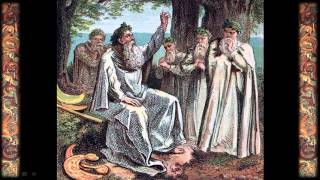
Dillon, in The Celtic Realms (written with Nora Chadwick), describes the early Irish fili — the professional poet-jurist, as distinct from the lower-grade praise-singer — as a figure who seems to have inherited much of the prestige of the druid of pagan times: his duty was first of all to praise his patron, but also to preserve his genealogy, to be learned in history and literature, and to be a master of the craft of poetry, a training that in the law tracts is said to require a course of study lasting some twelve years. This description maps closely onto the position of the Brahmin priest-scholar and the court poet (kavi) in early India: a hereditary, highly trained, ritually significant specialist in sacred and praise language, supported by aristocratic patronage and capable, in both traditions, of using poetry itself as a weapon (the Irish poet’s satire, áer, being feared as almost physically dangerous, much as curses pronounced by Brahmins were held to be efficacious).
4.3 Kingship, horses, and inauguration ritual
One of the more striking and frequently retold comparisons concerns royal inauguration rites involving horses. Medieval Irish tradition, recorded with evident distaste by the twelfth-century Anglo-Norman chronicler Gerald of Wales (Giraldus Cambrensis), describes an inauguration ritual in parts of Ulster in which the new king undergoes a symbolic union with a white mare, who is then killed and whose broth the king bathes in and shares with his people. India’s Vedic aśvamedha (“horse sacrifice”) is a far grander royal ritual, but it likewise centres on a horse’s ritual death and a symbolic union — in the Vedic case, the chief queen’s — as the sanctifying act that confirms a king’s sovereignty. Both cases have been read as survivals of a single inherited kingship rite involving the symbolic union of horse and ruler: the Irish version recorded by Giraldus Cambrensis, and its Indian counterpart reflected in the myth of Saranyu in the Rig Veda. Scholars remain divided on how much weight to put on this parallel (later writers have also connected it to a broader Indo-European “sacred marriage” pattern found well beyond Ireland and India), but Dillon treated it as one of the clearer surviving traces of a shared inheritance rather than mere coincidence.
4.4 Ordeal, and the “truth-test” of objects
Related to the Act of Truth is a cluster of Irish stories about magical test-objects that respond to lies: an axe that burns a liar but not an honest man, an iron bar with the same property, a drinking cup that shatters at three lies and reassembles at three truths. These “truth-ordeal” motifs, again, sit comfortably alongside the broader Indo-European and specifically Vedic pattern in which cosmic Truth (ṛta/satya) is treated as a real physical force rather than a purely ethical abstraction — a force that can be invoked, tested, and that acts on the material world.
4.5 A shared divine name-world? Danu and the river-goddesses
Dillon’s comparative eye extended to mythological onomastics as well as law and kingship. The Irish mother-goddess Danu (Anu), whose name is cognate with the Welsh Dôn, has long been compared to the goddess-name embedded in the Vedic term for “the waters” and, further afield, in Iranian and other Indo-European river-goddess traditions; several major European rivers (the Danube foremost among them) carry names built on the same root, as, arguably, do Irish rivers such as the Boyne (from the goddess Boann) and the Shannon (from Sionan). India’s Ganges, tied similarly to the goddess Ganga, offered Dillon a suggestive — though carefully hedged — structural parallel: an Indo-European habit of naming great rivers after female divinities associated with fertilising, life-giving water, surviving independently at both ends of the language family’s range.
4.6 The Sanskrit root and the Irish god-name
Dillon was also willing to venture etymological suggestions that were provocative even by his own admission. He proposed, for instance, that the Sanskrit paśupati (“lord of cattle,” an epithet of Śiva) descends from an inherited compound that in Irish would surface as Eochaid — the name borne by numerous legendary Irish kings and also used as an epithet of the Dagda, one of the chief gods of the pre-Christian Irish pantheon. Proposals of this kind sit at the more speculative edge of comparative philology — they depend on reconstructing a shared root and then tracing its independent development through two very different sound systems over three thousand years — and specialists continue to debate individual cases like this one. But the method itself, applying rigorous comparative phonology to divine names and not just to everyday vocabulary, is characteristic of how seriously Dillon took the linguistic side of the comparison.
5. Ireland Without India: Dillon’s Wider Celtic and Irish Scholarship
Because this piece foregrounds the Sanskrit comparison, it is worth briefly situating that work within the rest of Dillon’s very substantial output in Irish studies proper — not as a digression, but because the comparative claims only carry weight because Dillon was simultaneously one of the leading editors and interpreters of the primary Irish material itself.
- The Cycles of the Kings (Oxford University Press, 1946; reprinted Four Courts Press, 1994) — a study and retelling of the historical-legendary cycle of tales about Irish kings.
- Early Irish Literature (University of Chicago Press, 1948) — long a standard English-language introduction to the sagas, still reprinted.
- Early Irish Society (editor; Dublin, 1954) — a collaborative survey of law, kinship, and social structure.
- Serglige Con Culainn (Dublin Institute for Advanced Studies, 1953) — a scholarly edition of the Old Irish tale “The Wasting Sickness of Cú Chulainn,” based on the Lebor na hUidre text.
- Irish Sagas (editor; Thomas Davis Lectures, Dublin, 1959; several reprints) — an accessible essay collection aimed at a broad public, showing Dillon’s continuing commitment to popular education about Irish tradition alongside his technical philology.
- Lebor na Cert: The Book of Rights (Irish Texts Society, 1962) — his edition and translation of the medieval tract on the tributes and stipends due between the King of Cashel and the other kings of Munster, a central document for early Irish political theory.
- The Celtic Realms (with Nora K. Chadwick; Weidenfeld and Nicolson, 1967) — his best-known book for general readers, surveying the whole sweep of Celtic history and culture from the continental Celts to the medieval Irish and Welsh kingdoms.
- His English translation of Marie-Louise Sjoestedt’s French study Dieux et héros des Celtes, published as Gods and Heroes of the Celts (Methuen, 1949), which brought an important work of French Celtic scholarship to English readers.
- Numerous journal articles on Old Irish grammar and syntax (e.g. on the sigmatic verb forms, and on verb syntax), on individual saga texts, and manuscript studies, including work on the Catalogue of Irish Manuscripts in the British Museum (with Standish Hayes O’Grady and Robin Flower).
This body of purely Irish philological work is what gave Dillon the authority — and the primary-source command — to make his comparative claims responsibly. He was not an outsider projecting Sanskrit patterns onto Irish material he knew only secondhand; he was one of the people who had actually edited the Irish texts from manuscript, and he read them with Sanskrit permanently in the other hand.
6. How the Comparison Has Aged: Reception and Caution
No responsible introduction to this material should present it as settled consensus. Dillon wrote in a scholarly tradition — associated also with figures like Georges Dumézil and, in the Irish context, D. A. Binchy — that looked for “archaic,” pre-Christian, quasi-Indo-European survivals underneath medieval Irish texts, and treated resemblances to Vedic India as good evidence for a shared and very ancient common inheritance.
This approach was later challenged by a “revisionist” current in early Irish studies, which argued that medieval Irish law and kingship texts are better explained as products of their own early medieval, Christian, and broadly European intellectual context, and that scholars including Binchy and Dillon had overstated the “archaism” of the material by comparing it too readily and too directly with Vedic sources separated from Old Irish by well over a thousand years and enormous geographic and cultural distance.
One scholarly overview of this debate puts the objection sharply: Vedic Sanskrit dates to roughly 1000 BC and Old Irish to roughly 650 AD, and there is no question of mutual comprehension between the two; one can hardly apply the insights of dialectal geography to two languages and cultures so separated in both space and time, especially since the Celts only emerge into recorded history from the melting-pot of central Europe and may not have reached Ireland more than two or three centuries BC.
This newer line of criticism holds that the early medieval Irish institution of kingship, far from being archaic as Binchy, Dillon and others argued, is better explained within the context of medieval European political doctrine.
This is a genuine and still-live scholarly disagreement, not a case of Dillon simply having been debunked. Later specialists such as Tomás Ó Cathasaigh have continued to build directly on Dillon’s core concept of fír flathemon and the “Act of Truth” even while refining and narrowing its application — Ó Cathasaigh’s own study of the “Heroic Biography of Cormac mac Airt” treats true judgement as an example of the Act of Truth as identified by Dillon, while choosing to focus more narrowly on royal expressions of it than Dillon himself had.
In other words: the specific comparative categories Dillon named — the Act of Truth, fír flathemon, the archaic poet-priest — remain productive and are still used by working scholars, even where the broader claim of direct, continuous Indo-European inheritance stretching all the way back to a common prehistoric source is treated with more caution than Dillon allowed himself.
The fair summary for a general reader is this: Dillon’s comparisons between early Ireland and Vedic India are taken seriously as a starting point and a source of genuinely illuminating parallels by many scholars of early Irish literature and law, but the causal explanation for those parallels — direct shared Indo-European inheritance, as opposed to independent development of broadly similar ideas about kingship and truth-telling that are common to many early agrarian societies — remains debated, and Dillon’s own confidence in the inheritance explanation was somewhat greater than most specialists would now express.
7. Why This Work Deserves Wider Attention Today
A few reasons this strand of Dillon’s career is worth actively rediscovering, rather than leaving as a curiosity for specialists:
- It models genuinely global scholarship from an Irish base. Dillon did not treat Irish studies as a purely local, inward-looking discipline. He assumed from his student days that understanding Ireland’s oldest literature required looking outward — as far outward as northern India — and he backed that assumption with the hard linguistic training (a Bonn doctorate, fluent Sanskrit, direct fieldwork in Simla) to make the comparison credible rather than impressionistic.
- It offers Irish-heritage readers an unusually vivid way into Vedic material. For someone starting from Irish mythology, Brehon law, or the sagas, Dillon’s paired examples — the king’s truth and ṛta, the fili and the kavi, the horse-rites, the truth-testing objects — are a far more inviting doorway into Vedic religion and Sanskrit poetics than a cold introduction to the Ṛgveda on its own terms would be.
- It is, in its own quiet way, a piece of postcolonial intellectual history. Dillon’s closing hope in Celts and Aryans — that the shared modern experience of British rule might make Irish and Indian scholars natural partners in exploring their ancient common heritage — situates the whole comparative project inside twentieth-century decolonisation, not just inside nineteenth-century philology. That is a dimension of his work rarely discussed.
- The primary texts are now genuinely accessible. Thanks to the Internet Archive scan of Celts and Aryans, and the continued availability of The Celtic Realms and Early Irish Literature in reprint, a curious general reader can now go directly to Dillon’s own words rather than relying only on secondhand summaries — including this one.
The invitation, in the end, is Dillon’s own: to treat Ireland and India not as two unconnected corners of the world that happen to share a distant linguistic ancestor, but as two ends of a single very long conversation, still worth listening to on both sides.
Further Reading
Dillon’s own works discussed above:
- Dillon, Myles. Celts and Aryans: Survivals of Indo-European Speech and Society. Simla: Indian Institute of Advanced Study, 1975. Freely available in full: archive.org/details/dillon-celts-and-aryans
- Dillon, Myles. “The Archaism of Irish Tradition” (Sir John Rhŷs Memorial Lecture). Proceedings of the British Academy 33 (1947): 245–264. Also issued as a separate pamphlet, London: Geoffrey Cumberlege, 1947. Catalogue record: codecs.vanhamel.nl/Dillon_(Myles)_1947a
- Dillon, Myles. “The Hindu Act of Truth in Celtic Tradition.” Modern Philology 44, no. 3 (February 1947): 137–140. Publisher page: journals.uchicago.edu/doi/10.1086/388717
- Dillon, Myles. Celt and Hindu (Osborn Bergin Memorial Lecture, no. 3). Dublin: University College Dublin, 1973.
- Dillon, Myles. “The Consecration of Irish Kings.” Celtica 10 (1973): 1–8.
- Dillon, Myles. “The Taboos of the Kings of Ireland.” Proceedings of the Royal Irish Academy 54 C (1951–52): 1–36.
- Dillon, Myles. “Celtic and Other Indo-European Languages.” Transactions of the Philological Society 46 (1947–48): 15–24.
- Dillon, Myles, Murray Fowler, and V. Raghavan (trans.). The Nāṭakalakṣaṇaratnakośa of Sāgaranandin. Philadelphia: American Philosophical Society, 1960.
- Dillon, Myles. The Cycles of the Kings. London: Oxford University Press, 1946; repr. Four Courts Press, 1994.
- Dillon, Myles. Early Irish Literature. Chicago: University of Chicago Press, 1948; repr. Four Courts Press, 1994.
- Dillon, Myles, ed. Early Irish Society. Dublin: Cultural Relations Committee of Ireland, 1954.
- Dillon, Myles, ed. Irish Sagas. Thomas Davis Lectures. Dublin, 1959.
- Dillon, Myles, ed. and trans. Lebor na Cert: The Book of Rights. Dublin: Irish Texts Society, 1962.
- Dillon, Myles, and Nora K. Chadwick. The Celtic Realms. London: Weidenfeld and Nicolson, 1967.
- Sjoestedt, Marie-Louise. Gods and Heroes of the Celts, translated by Myles Dillon. London: Methuen, 1949.
- Fisher, Joachim, and John Dillon, eds. The Correspondence of Myles Dillon, 1922–1925: Irish–German Relations and Celtic Studies. Dublin: Four Courts Press, 1999.
Secondary sources and scholarly context used for this piece:
- Dictionary of Irish Biography (Cambridge University Press), entry “Dillon, Myles Patrick (1900–72)”: https://www.dib.cambridge.org/viewReadPage.do?articleId=a2611
- Wikipedia, “Myles Dillon”: https://www.en.wikipedia.org/wiki/Myles_Dillon
- CODECS: Online Database and e-Resources for Celtic Studies, bibliography of Myles Dillon: https://www.codecs.vanhamel.nl/Dillon_(Myles)?sort=date
- Bibliography of Irish Linguistics and Literature, DIAS, author page for Myles Dillon: https://www.bill.celt.dias.ie/vol4/author.php?AuthorID=209
- Karttunen, Klaus. “Dillon, Myles,” in Who Was Who in Indology (biographical database): https://www.whowaswho-indology.info/1597/dillon-myles
- Mac Cana, Proinsias. Obituary of Myles Dillon, reprinted at Ricorso.net: https://www.ricorso.net/rx/az-data/authors/d/Dillon_M1/xtras/xtra1.htm
- Silvestri, Michael. Review of Joseph Lennon, Irish Orientalism: A Literary and Intellectual History, in H-Albion, H-Net Reviews, January 2006 (discusses Celts and Aryans directly): https://www.h-net.org/reviews/showrev.php?id=11378
- McQuaid, Sarah. “Advice for Kings: An Investigation into a Subdivision of Early Irish Wisdom Literature.” PhD thesis, University of Glasgow, 2017 (extensive discussion of Dillon’s fír flathemon/Act of Truth thesis and its reception): https://www.theses.gla.ac.uk/8519/1/2017McQuaidPhD.pdf
- “Wisdom Texts (Medieval Ireland),” reference overview of tecosca and fír flathemon: https://www.what-when-how.com/medieval-ireland/wisdom-texts-medieval-ireland
- Ulster University, comparative overview of Russian and Western Celticist debates on Irish/Vedic kingship parallels (contains the revisionist critique discussed in §6): https://www.ulster.ac.uk/__data/assets/pdf_file/0009/929763/0117.pdf
- Dillon, Myles, and Nora K. Chadwick, on the fili, as quoted in “Representing Kin(g)ship in Medieval Irish Literature” (ResearchGate): https://www.researchgate.net/publication/335640566
- Edwards, Eric. “Irish Tales and Indian Vedas,” notes on the horse-ritual and Act of Truth comparisons: https://www.ericwedwards.wordpress.com/2014/06/29/notes-and-queries-irish-tales-and-indian-vedas
- Metro Gael blog, “The Celts and the Hindus: The Cognate Cultures of Ireland and India,” discussion of Dillon’s paśupati/Echoid etymology: https://www.metrogael.blogspot.com/2008/11/celts-and-hindus-cognate-cultures-of.html
A note for readers wanting to go further: the most rewarding way into this material is to read Dillon’s short 1947 pieces first — “The Archaism of Irish Tradition” and “The Hindu Act of Truth in Celtic Tradition” are both compact enough to read in an evening — before tackling the fuller and harder-to-find Celts and Aryans.
Reading any of the three alongside (even a short modern translation of) the Ṛgveda’s hymns to Mitra and Varuṇa, or alongside Audacht Morainn in translation, lets the comparison speak for itself far better than any summary can.