Kill the wrong dog in early medieval Ireland and it could cost you ten cows and a replacement hound.
Let your own dog foul a neighbour’s land and you might owe the landowner butter, curds, and dough, the staples of the early Irish table.
Borrow a friend’s dog for a deer hunt and let it die chasing something else, and the law will want to know exactly what you promised to hunt.
The Brehon law-tracts did not treat dogs as scenery.
Dogs were working members of the household, each with a job, a rank, and a price on its head. A champion’s hound could be worth as much as a man.
According to legal commentary, a lady’s lapdog had the duty of guarding her from the fairies during childbirth.

Source: Let’s Go Ireland
And a hound named Ailbe was so famous that a bidding war for him ended in bloodshed.
The partnership between people and dogs is ancient.
Fergus Kelly, whose Early Irish Farming and A Guide to Early Irish Law underpin much of this article, dates it to at least 10,000 BC, and some researchers would push it back further still.
Roman writers sorted dogs into four broad types: guard-dogs, hunting dogs, herd dogs, and lap-dogs. Early Irish sources attest all four, in the law, in the sagas, and in the landscape itself.
From Wolf to Watchdog
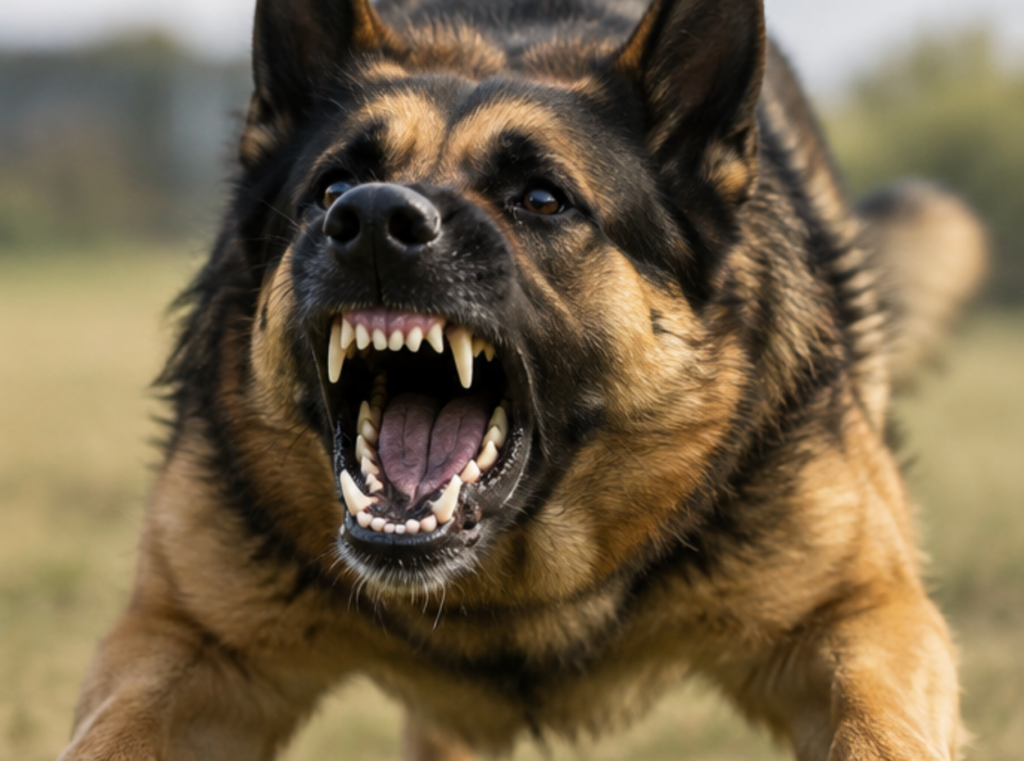
The wolf, ancestor of every dog, is a poor barker. Despite their fierce reputation, wolves rarely bark, relying instead on howls, growls, and body language. Barking is a trait that people bred into their dogs, in effect installing a living alarm system in every household.
Guarding depends on two weapons, a dog’s bark and its bite, and early farmers valued both.
A small dog with no fearsome bite could still rouse the entire household when a wolf, a stranger, or a thief came prowling at night.
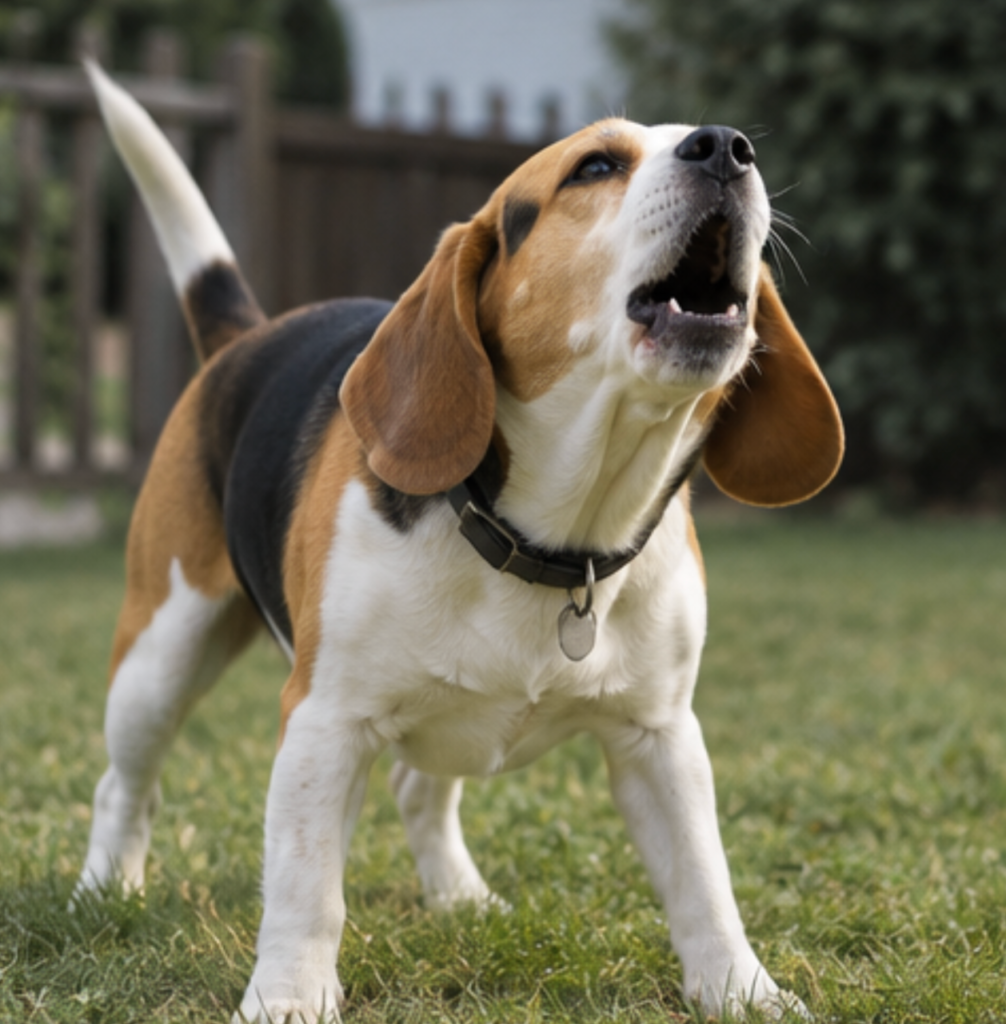
Early Irish law, though, reserved its greatest attention for the other kind of guard, the big, fierce dog whose job was not to warn but to attack. We’ll meet him shortly, but first the law itself.
The key legal source is Conslechta*, the ‘dog-sections’ of early Irish (Brehon) law. Like its feline counterpart, Catslechta, it belonged to the great compilation known as the Senchas Már. In Kelly’s reconstruction of that compilation, the two texts stand back to back.
You can read about the Catslechta in our companion article on cats in early Irish society.
Conslechta survives only in fragments: quotations buried in layers of glosses and commentary in manuscripts such as Rawlinson B 506 and in later law collections.
O’Davoren’s Glossary refers to it as Bretha conslechta a senchus, ‘judgements of dog-sections from the Senchas [Már]‘.
A Latin text in the Irish canon collection, De canibus sinodus sapientium (‘a synod of wise men: concerning dogs’), may also draw on native dog-law.
Even poisoning another person’s dog was a recognised offence, listed in an Old Irish text on distraint (the legal seizure of property).
[Note: Kelly uses “ṡ” for the legal manuscripts e.g. Conṡlechta, Catṡlechta, etc.]
The Law’s Ladder of Dogs
Every free person had an honour-price fixed by rank and, just like people, animals in early Irish law were graded into a hierarchy based on their value and responsibilities.
Dogs, as extensions of their owners’ households, were priced accordingly: the more vital the dog’s job, and the more powerful its owner, the steeper the compensation.
Compensation usually had two parts: restitution (aithgein), meaning a replacement of equal quality, and a much larger penalty-fine (díre).
| Dog | Irish term | What the sources say |
|---|---|---|
| Guardian of the whole homestead, the ‘dog of four doors’ | cú chethardoruis | Killing it: 10 cows plus a dog of the same breed |
| Guardian of the flocks | Killing it: 5 cows, a replacement, and payment for livestock lost to wild animals until year’s end | |
| Champion’s hound | árchú ánruith | Valued as a man: 7 cumals (a cumal is conventionally counted as three cows) |
| Herd dogs | conbúachaill | Graded by charge: large livestock (2½ cows), calves (8 scruples), sheep (6½ scruples) |
| Lord’s hunting hound | mílchú | Penalty-fine of 2 séts, one milch cow. Accidental killing of a higher-grade lord’s hound: a seventh of the owner’s honour-price |
| Pet dog | messán, orcae | Often valued like a hunting hound (2 séts). A lapdog killed deliberately: a third of its owner’s honour-price; accidentally, a sixth |
| Farmyard cur | cú otraig, aithechmatad | The bottom rung, described with open contempt |
The law also graded dogs by conduct, and this is where it gets inventive:
| Dog | Irish term | Legal consequence |
|---|---|---|
| Known aggressor | cú foilmnech | Must wear a bell or rattle |
| Dog of first offence | cú chétchintach | By one commentary, the owner owes only medical care and compensation. Other texts make the dog the victim’s property |
| Bitch in heat | cú sodaig | The owner must warn his four nearest neighbours; if she can’t be confined, she may be killed |
| Wandering dog | cú seichill | If you feed it for six days, you inherit its offences, unless you drove it off three times and gave public notice |
| Wandering thieving dog | táidchú foindil | Not to be sheltered by anyone, however high-ranking |
Beyond the ladder stood the wolf, whom Irish called the cú allta, the ‘wild hound’.
The law even asked what happens when your dog teams up with a wolf and commentary wrestles with the case of a domestic dog and a wolf jointly killing a young sheep.
Slaughter-Hounds: The Árchú
At the top of the ladder stood the árchú, the ‘slaughter-hound’, a large, fierce guard-dog bred to kill intruders.
It belonged to the homes of nobles and powerful men.
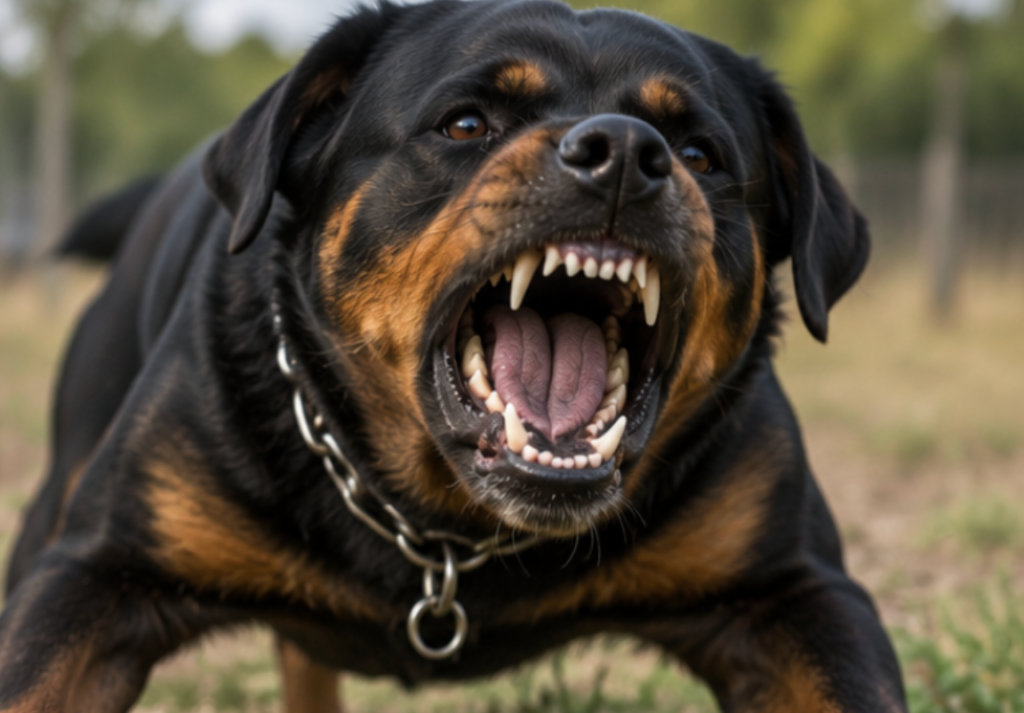
The most famous slaughter-hound belonged to the smith Culann in the Táin Bó Cúailnge. It was so strong that three men held each of its three chains, and in one version it came from Spain.
On the night of a feast, when Culann thought all his guests had arrived, the hound was let loose.
Then the boy Sétantae turned up late.
Everyone in the house assumed he was dead.
Instead, in Kelly’s summary, the boy smashed the hound against a pillar. Culann mourned it as ‘a man of his household’ who protected his goods and herds, and the boy offered to guard in its place until a new pup could be raised.
From then on he was called Cú Chulainn, ‘hound of Culann’.
Some scholars note that árchú is often translated ‘war-hound’, but that they were actually war-dogs is far from certain. The term may be a literary flourish borrowed to describe fierce warriors.
An unedited law text on clientship describes how a young árchú was trained to take on a larger territory each year:
- Year one: the doorway and the cleared ground in front of it
- Year two: the plank leading to the door
- Year three: the bridge of access to the fortified dwelling
Hence the ‘dog of four doors’: the dog that guarded (1) the dwelling, (2) the sheep-fold, and (3) the pens for calves and (4) cattle.
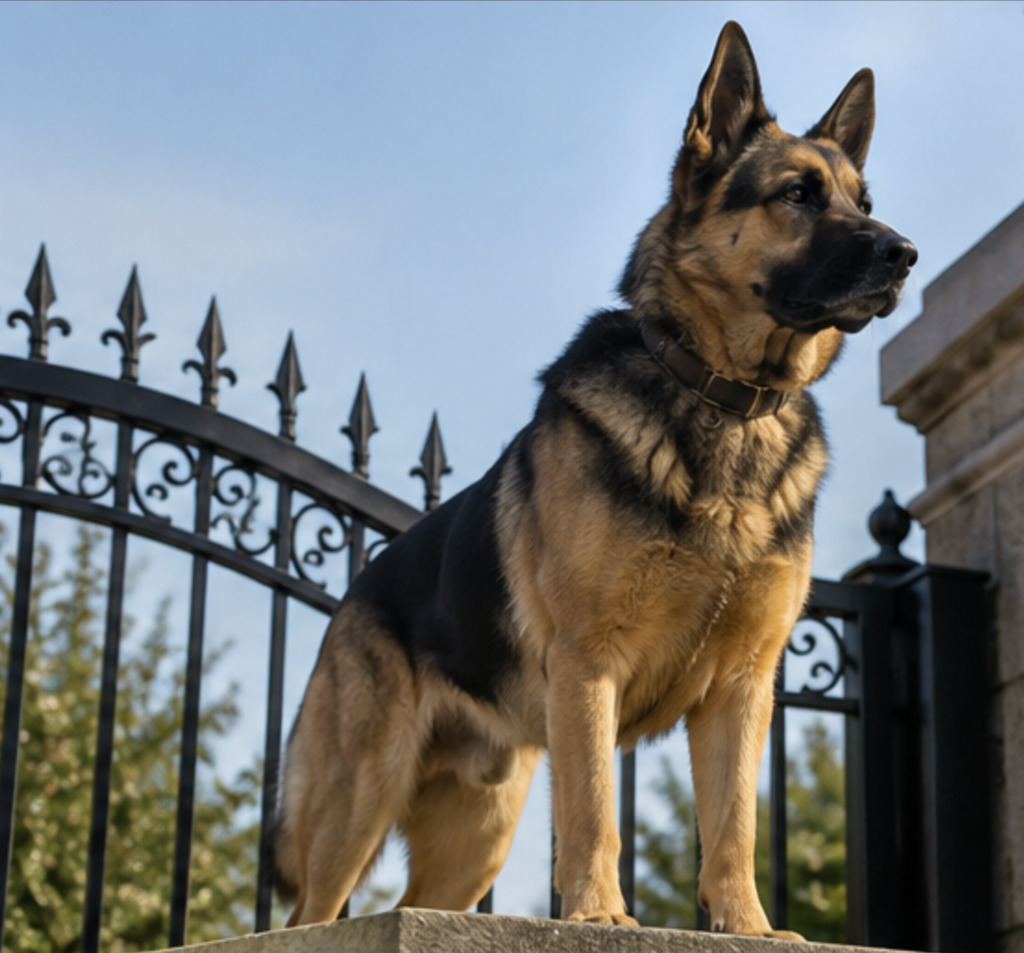
The árchú was also a legal instrument. The aire échta, ‘lord of blood-vengeance’, was expected to keep one. His duty was to avenge grave crimes, from rape to murder, committed against his kingdom by outsiders, by leading an avenging party across the border if no reparation was made.
The champion’s hound had to be a ‘dog of three accomplishments’:
- tracking a blood trail,
- seizing,
- and defending a man attacked by two warrior-bands.
At the other end of the ladder were the farmyard dogs. The law-texts call them the ‘dunghill dog’ (cú otraig) and the ‘dog of the maggot-heap’ (cú chrumdumai), and the Táin sets the cú mór, the ‘great hound’, against the aithechmatad, the ‘peasant cur’.
Hounds of Legend and Landscape
Ailbe: The Hound Two Kingdoms Wanted
The hound Ailbe belonged to Mac Dathó, king of Leinster, and guarded the whole province.
His fame spread across Ireland, and messengers came from both Connacht and Ulster to buy him.
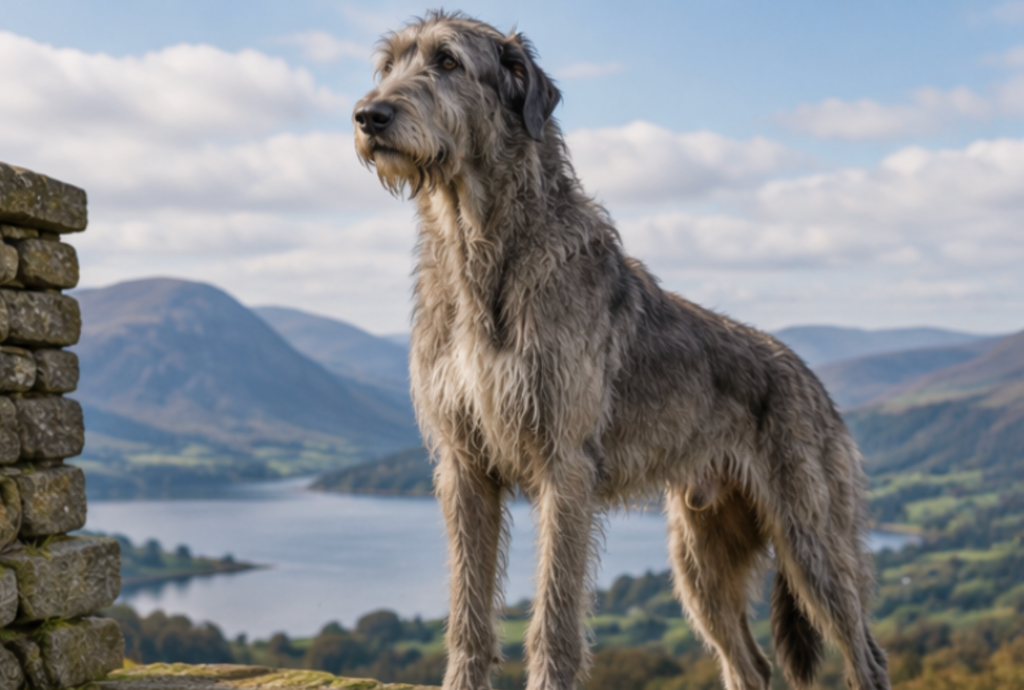
his Master’s Domain
Connacht’s envoys offered three score hundred milch cows (six thousand), a chariot and two of Connacht’s best horses, and an equivalent payment a year later.
Mac Dathó promised the hound to both sides.
At the feast that followed, the rival hosts came to blows, Ailbe sided with the Ulstermen, and he died in the battle. In one retelling, after Ailbe seized a chariot he was beheaded, and his head still hung on.
Bran and Sceoláng: Hounds Who Were Family
In the Fenian tales, Fionn mac Cumhaill’s hounds Bran (‘raven’) and Sceólang (‘survivor’) were his cousins.
Their mother had been enchanted into a hound while pregnant, and although she was restored to human form after the birth, her offspring remained canine.

Bran and Sceoláng
In one tale, Fionn strikes Bran with the metal-ringed leash and the ring lodges in the hound’s head. Bran gazes at him in astonishment, weeps, and disappears into a lake.
The Landscape Remembers
As with the cats of Roscommon and Westmeath, Ireland’s landscape still remembers its dogs. In Co. Fermanagh, twin hills called Sliabh Dá Chon, ‘mountain of the two hounds’, are said to be Bran and Sceolang, turned to stone by a witch. English speakers came to call them ‘Big Dog’ and ‘Little Dog’.
Elsewhere, Coolnaconarty (Cúil na Conairte) in Co. Cork means ‘the nook/recess/corner of the hound-pack’.
Dogs are also remembered in Gleann na Madadh, Glenamaddy, the ‘valley of the dogs,’ in Co. Galway.
And, in Derry, Limavady, from Léim an Mhadaidh, the ‘leap of the dog’. According to local tradition, the O’Cahans, lords of the Roe Valley, were threatened by enemies when one of their dogs, often said to have been a wolfhound, leapt across the gorge of the River Roe carrying a message that saved the clan’s castle. Accounts differ on the details: some say the dog carried a call for reinforcements, others that it raced to warn its master of an approaching attack.
Not every ‘dog’ in a place name was necessarily a dog, however. The words madadh and madra (‘dog’) and cú (‘hound’) may sometimes refer indirectly to wolves.
Logainm points to Coolamaddra (Cúil an Mhadra, ‘nook/recess/corner of the dog’, in Co. Wicklow. In the sixteenth and seventeenth centuries, English records wrote the name as ‘Wolf-ys-hole’, ‘Wolfeshoal’ and ‘Wolfesden’, so the English-speaking recorders evidently took the ‘dog’ to be a wolf. That does not prove the original Irish namers meant a wolf, or even that local Irish speakers understood it that way; and online sources are careful to note that.
The word cú is also a favourite element in Irish personal names, and the hunting dog’s title míolchú appears as a personal name. Place-names such as Kilmeelchon in Co. Offaly seem to preserve a kin-group, the Uí Mhíolchon, ‘descendants of Míolchú’, though scholars caution that some of these names are ambiguous.
Hunters, Herders, and Lapdogs
Hunting Hounds
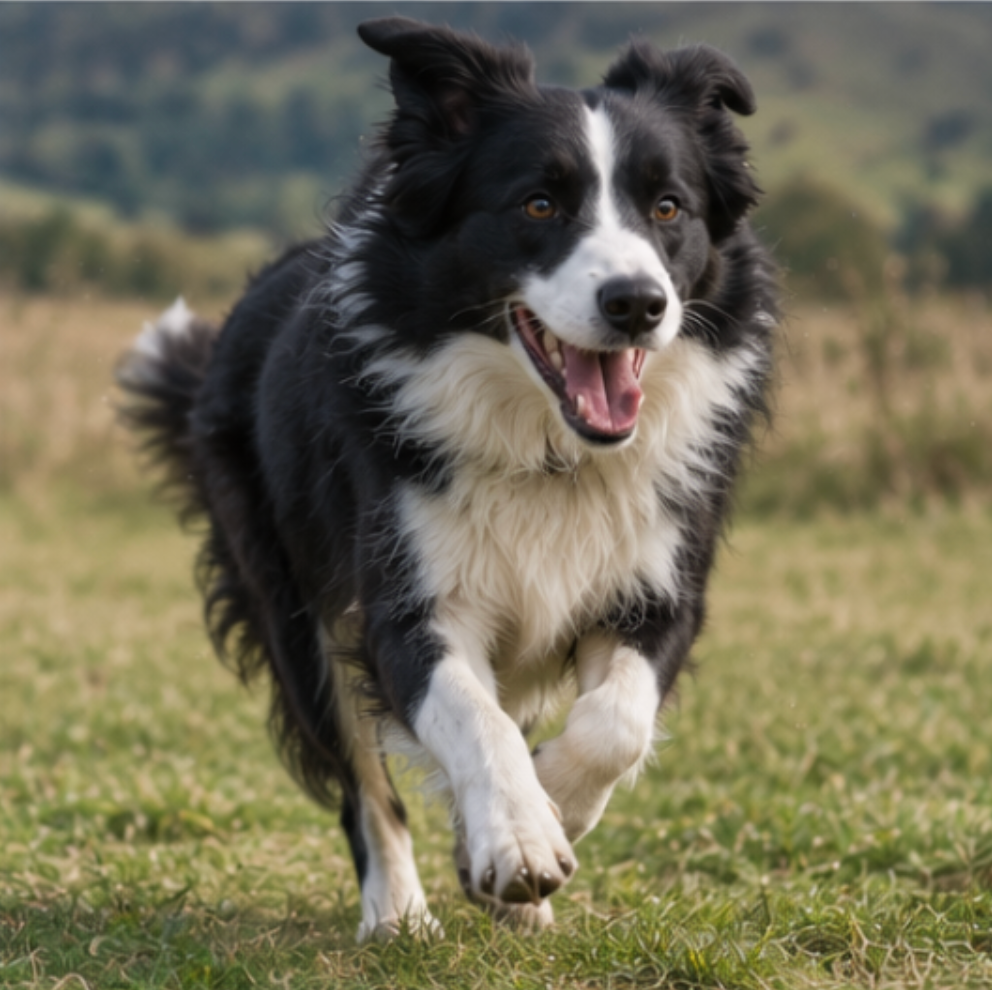
The usual word for a hunting dog was the aforementioned mílchú, ‘animal-hound’, bred for speed and ability to detect prey.
Hounds were a badge of aristocracy.
One law-text says a lord should own one, the Book of Rights lists hounds among the tribute due to kings, and another text says the king’s weekly routine included a day spent watching his dogs hunt.
Three legendary dogs in a Middle Irish text are named for the tactics of the chase:
- Aig (‘drive hither!’),
- Taig (‘drive thither!’), and
- Tairchell (‘hem in!’).
Other words, such as gadar and archocaid, suggest more than one hunting breed. One theory holds that the gadar tracked the prey by scent, then the larger, swifter mílchú was unleashed to bring it down.
Irish Hounds Abroad
Irish dogs were exported early.
In the late fourth century the Roman consul Symmachus received seven canes Scotici, ‘Scotic hounds’, for games in Rome, and reported that all Rome viewed them with wonder and thought they must have been brought in iron cages. The Romans used Scoti for the Irish, though we cannot be certain of the breed.
Norse sources have their own Irish hounds. In Njáls saga, Sámr, a great hound from Ireland, is given to the hero Gunnarr. He was said to bark at his master’s enemies but never at his friends, and he died defending Gunnarr’s house. In Snorri’s Heimskringla, an Irish dog separates a mixed herd of cattle by their markings and is given to King Óláfr Tryggvason, who names him Vígi.
The Myth of the Early Irish Wolfhound
Notably, Kelly found no reference in the early sources to dogs hunting wolves, though the tale Táin Bó Fraích mentions hunting foxes.
The earliest descriptions of the massive Irish wolfhound date from the sixteenth century, and early Christian dog bones are no larger than those of a modern Alsatian.
The wolfhound seems to be a later breed.
That does not make it less Irish, only younger than the legends suggest.
Herd Dogs and Pet Dogs
Herd dogs are mentioned frequently in the law-texts, with separate grades for large livestock, calves, and sheep.
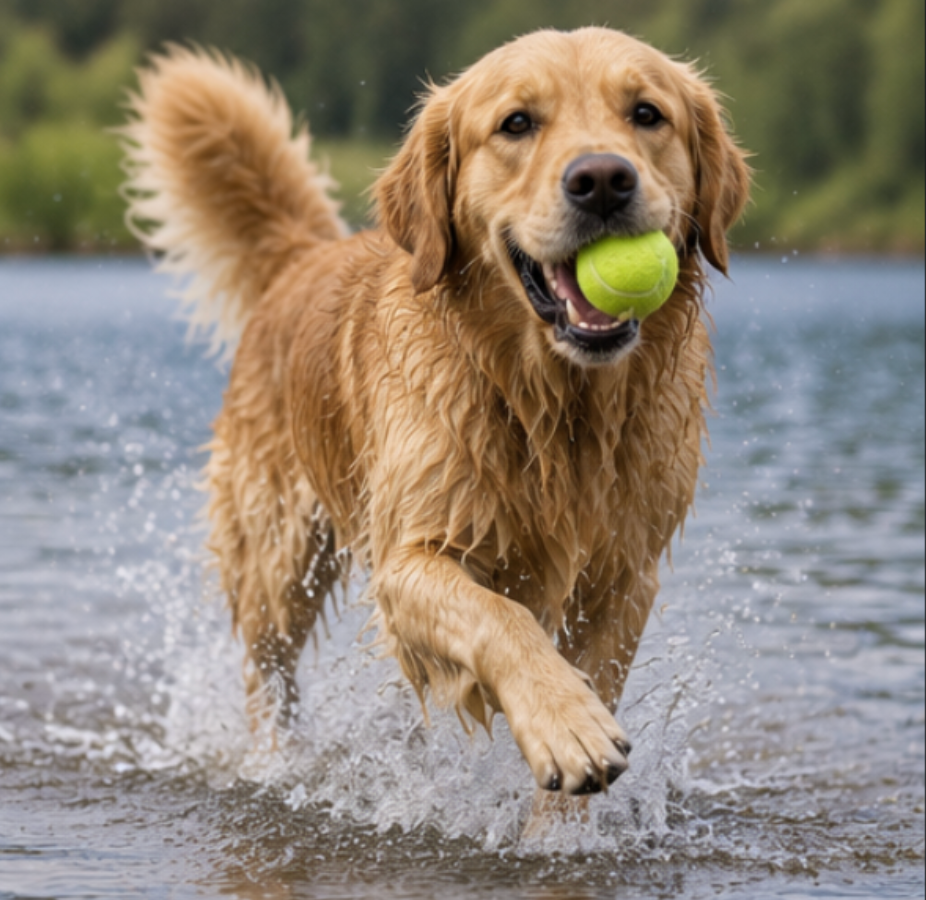
One cryptic line seems to say that a herdsman ‘does not require a monster’, meaning a mastiff or very large dog.
Pet dogs were associated with noble women.
Críth Gablach says a lord should have a hunting hound and his wife a pet dog.
In a Middle Irish poem, Bóand, wife of Nechtain, owns a pet dog named Dabilla.
The law also says a pet dog is proper for a physician, a harpist, a queen, and a hospitaller (briugu), and one triad names a pet dog among the three entertainments of a gathering.
Legal commentary gives the pet dog a supernatural duty as well: protecting a woman from the fairies (túaithgeinti) while she gives birth. Kill the dog at that moment, and the fine is three séts, and you must also supply a priest to read scripture by her side day and night.
When Dogs Break the Law
One law-text lists four offences of dogs:
- Attacking livestock
- ‘Human offences’ (caused by human malice or carelessness)
- Digging under a house
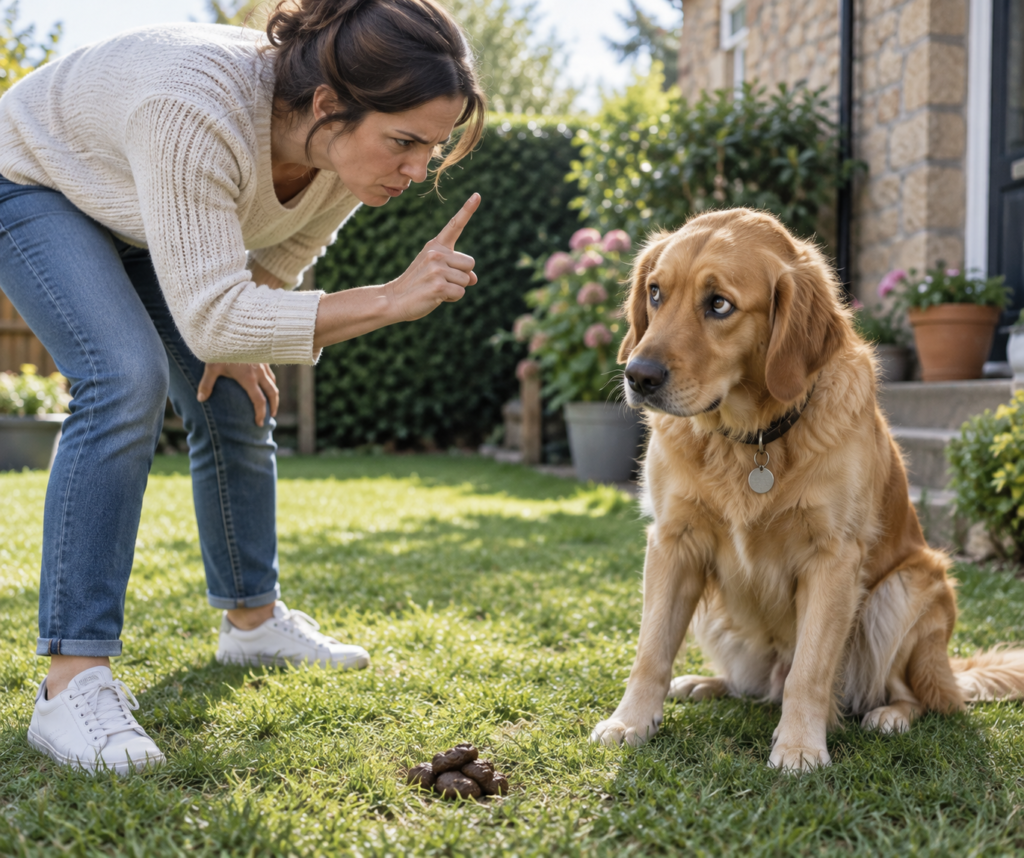
- Leaving dog excrement on another’s land
On the last, the neighbourhood law-tract Bretha Comaithchesa takes a severe line.
The owner must remove the faeces and the contaminated soil, then give the landowner matching quantities of butter, curds, and dough.
Cats were not spared either: another tract lists a kitten fouling the rush floor-strewings among the offences of domestic animals.
Bells, Chains, and the Ninth Stake
Dogs were the animals the law-texts most often blamed for attacks on people, so the tracts specify safeguards:
- An aggressive dog wears a bell or rattle.
- A guard-dog is tied to the ninth stake from the doorway, so it cannot bite anyone in the middle of the house or on the path.
- A guard-dog may be loosed only from the time the cows enter the milking-place until sunrise, and injuries in that window carry no liability.
- Anyone foolish enough to enter the range of a leashed guard-dog has no claim.
- Injuries in a dog-fight carry no liability, even, according to one text, if a king is hurt trying to break it up.
The Owner Who Knew
The law scaled blame to the owner’s knowledge.
Someone injured by a dog had to give public notice and place a plank across the dog’s feeding-trough forbidding anyone to feed it.
An owner who ignored the notice was liable for a ‘human offence’ (duinechin) rather than an ‘animal offence’ (ropchin).
A legendary case in Cormac’s Glossary shows the principle at work.
Cairpre Músc coveted a pet dog owned by relatives in Britain, so he smeared fat on his knife’s ornamental handle and left it in front of the dog overnight. When the dog gnawed the handle, he feigned outrage and demanded the dog itself as compensation, citing the principle that a guilty party is forfeit for its offence. The hosts agreed, and Cairpre brought the dog home to Ireland. Kelly notes that this principle seems to belong to Irish rather than British law.
The Priest, the Shovel, and Columba’s Service-Set
One case from the genealogies of the saints may reflect a real incident. A priest named Semplán visited Diarmait, who was clearing his path with a shovel.
Diarmait’s dog bit the priest, Semplán struck the dog, and Diarmait retaliated by hitting Semplán with the shovel, smashing the service-set of Columba that the priest carried on his back.
King Ruidén of Uí Dróna arbitrated, and Diarmait paid seven cumals to the Columban community.
Muzzles and Mutilation
Some dogs needed restraint of a different kind.
A herd-dog that snapped at poultry or lambs was to wear a leather muzzle.
Harming a dog was also a legal matter: shaving it, cropping its ears, or mutilating it cost half the fine for killing it.
In some circumstances, killing another’s dog was lawful. A stray that had become a danger could be killed, as could a bitch in heat that could not be confined.
Rabies, Recovery, and the Forbidden Meat
The most feared canine disease was rabies, conach or confad, both words built on cú, ‘dog’.
The owner of a rabid dog had to give public warning, kill the dog, burn the body, and throw the ashes into a stream. This suggests an awareness that the virus could survive in a dead body. The same words also came to mean any violent fury or madness.
The law also gives us early veterinary standards.
A sick dog counted as cured only when it could chew a bone as well as before its illness.
The legal commentary on animal healing sets a similar test for other animals: a cat had to catch mice again, and a pig had to root up the ground.
Dogs also carried taboo.
Cú Chulainn’s geis, or prohibition, forbade him to eat dog-flesh, and his enemies tricked him into doing so. In the best-known account, three sinister hags offer him a roasted dog, and his death soon follows.
Legal commentary says dog-flesh, like horse-flesh, had no value.
Yet Cormac’s Glossary lists dog-flesh among the raw meats chewed in the divination rite imbas forasna, which we discuss in the cat article.
Famine broke the taboo: the annals record the eating of dog-flesh alongside far worse horrors.
A Middle Irish tale of a hungry household in cold spring weather says its dogs are famished and its cats ravenous.
Loyal Companions, Legal Persons?
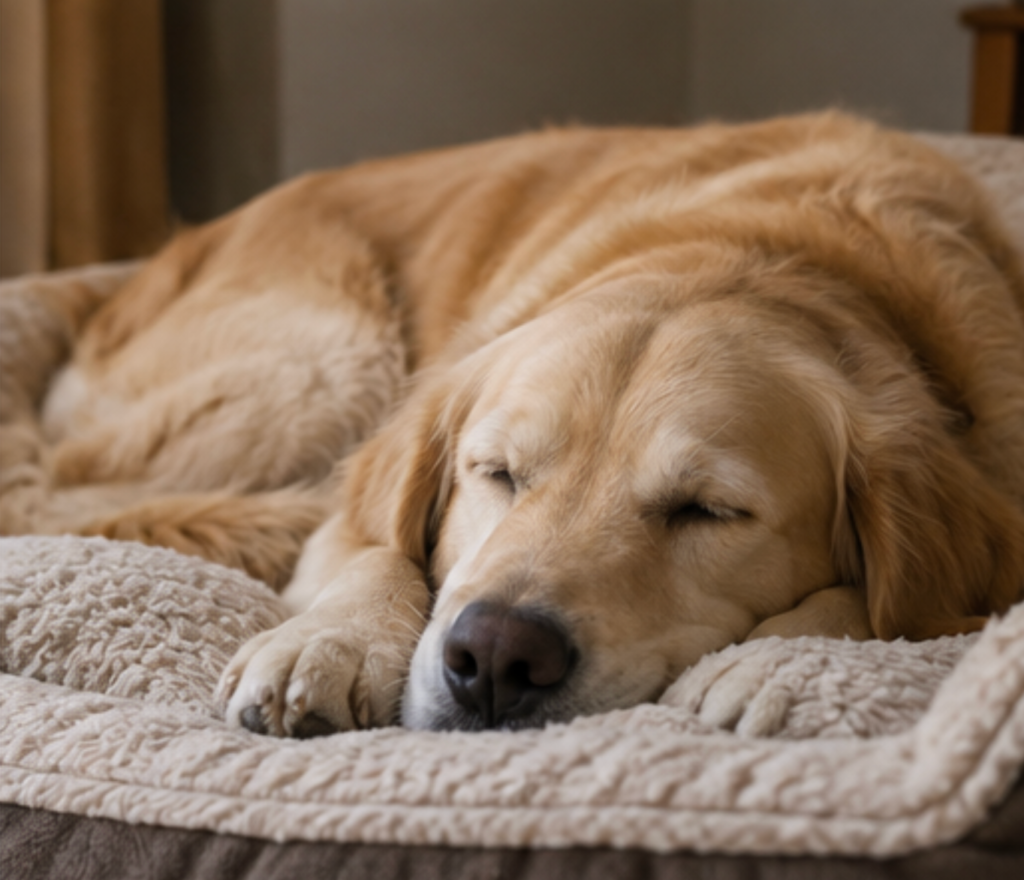
Dogs were not legal persons, but early Irish law treated them as far more than property.
It graded their worth, licensed their killing in narrow circumstances, restrained them with bells and stakes, and traced their bad behaviour back to the human who fed, tied, or incited them.
In legend they guarded a smith’s forge, hunted at a king’s side, and sparked a war between provinces.
And in the landscape they are still there, running in packs across the hills of Fermanagh and Cork.
Further Reading
Fergus Kelly
Kelly, Fergus, A Guide to Early Irish Law (Early Irish Law Series 3; Dublin: Dublin Institute for Advanced Studies), 1988 (reprinted; this article used the 2016 printing with updated bibliography). https://shop.dias.ie/product/a-guide-to-early-irish-law/
Kelly, Fergus, Early Irish Farming: A Study Based Mainly on the Law-Texts of the 7th and 8th Centuries AD (Early Irish Law Series 4; Dublin: Dublin Institute for Advanced Studies), 1997. https://codecs.vanhamel.nl/Kelly_1997a (for the bibliographic record) OR https://www.litriocht.com/siopa/early-irish-farming-2/ (to buy)
Jaski, Bart, “A Supplement to the Bibliography of Fergus Kelly, A Guide to Early Irish Law“, CODECS: Online Database and e-Resources for Celtic Studies, 2012 onwards https://codecs.vanhamel.nl/Supplement_to_GTEIL
Law-texts and literary sources
Binchy, D. A. (ed.), Corpus Iuris Hibernici (6 vols; Dublin: Dublin Institute for Advanced Studies), 1978. Conslechta fragments are cited by Kelly at CIH i 111.3–114.7; iv 1395.15–1396.6; v 1550.24–1551.12 https://en.wikipedia.org/wiki/Corpus_Iuris_Hibernici
Thurneysen, Rudolf (ed.), Scéla Mucce Meic Dathó (The Story of Mac Da Thó’s Pig; Mediaeval and Modern Irish Series 6; Dublin: Stationery Office), 1935. Online text with translations (UCC Irish Sagas Online): https://iso.ucc.ie/Scel-datho/Scel-datho-text.pdf
O’Rahilly, Cecile (ed. and trans.), Táin Bó Cúailnge, Recension I (Dublin: Dublin Institute for Advanced Studies), 1976 (the recension Kelly cites for Culann’s hound) https://celt.ucc.ie/published/T301012/header.html
Scholarship on hounds
Sayers, William, “Gunnarr, his Irish Wolfhound Sámr, and the Passing of the Old Heroic Order in Njáls saga“, Arkiv för nordisk filologi 112, 1997, pp. 43–66. https://journals.lub.lu.se/anf/article/download/11563/10249/26618
McCone, Kim, “Aided Cheltchair maic Uthechair: Hounds, Heroes and Hospitallers in Early Irish Myth and Story”, Ériu 35, 1984, pp. 1–30 (not consulted directly; cited by Sayers). https://www.jstor.org/stable/30007774
Evans Tang, Harriet J., “Reading Animal-Human Relations: Sámr and Gunnarr in Njáls saga“, Scandinavian Studies 95(1), 2023, pp. 35–55 (not consulted in full). https://doi.org/10.3368/sca.95.1.0035
McCormick, Finbar, “The Dog in Prehistoric and Early Christian Ireland”, Archaeology Ireland 5(4), 1991, pp. 7–9. https://www.jstor.org/stable/20558375
Place-names
Ó Crualaoich, Conchubhar, and Mac Giolla Chomhghaill, Aindí, “Running with the hounds! Coolnaconarty / Cúil na Conairte“, logainm.ie (Placenames Database of Ireland), 23 April 2025. https://www.logainm.ie/en/themes/98
Background sources
Joyce, P. W., A Social History of Ancient Ireland, 1903, ch. XXV, “Some Animals connected with Hunting and Sport in Ancient Ireland” (Symmachus and the Irish hounds; wolf-dogs). https://libraryireland.com/SocialHistoryAncientIreland/III-XXV-4.php
American Kennel Club, “Irish Wolfhound: History Behind the Breed”, undated (popular source; used only for the beheaded-Ailbe detail). https://www.akc.org/expert-advice/dog-breeds/irish-wolfhound-history-behind-the-breed
Wikipedia, “Irish Wolfhound” (background on Symmachus’s canes Scotici). https://en.wikipedia.org/wiki/Irish_Wolfhound
Companion article
Brehon Academy, Flanagan. K, “Purring Through Irish History: Learn About The History of Cats in Early Irish Society, Legend, and Law“, 2023.