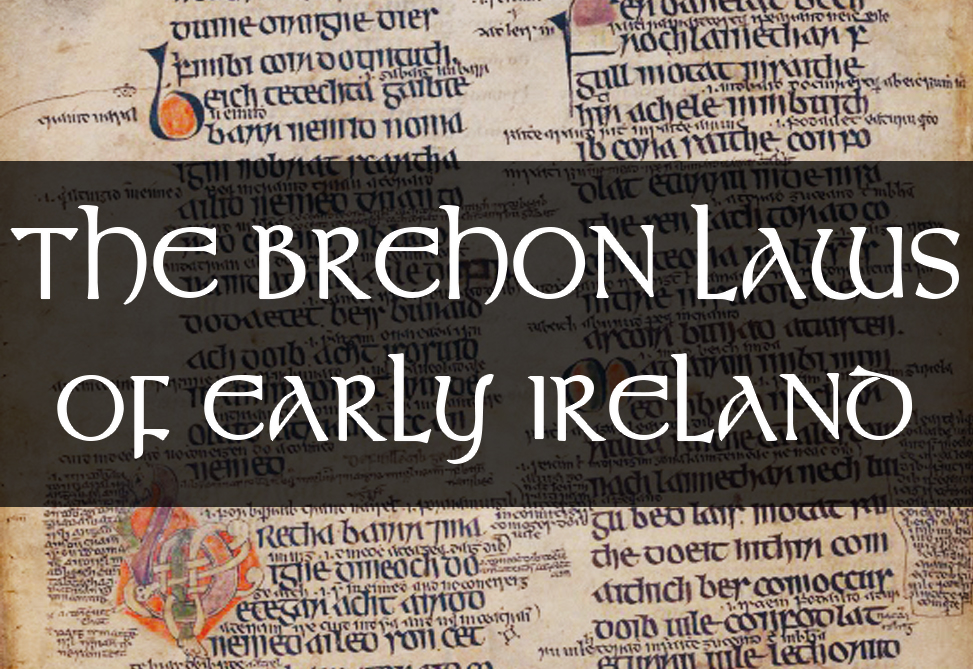
For over a thousand years, Ireland ran a legal system with no police force, no prisons, and no state courthouse, and it worked. Disputes were heard, judgements were handed down, and the losing party paid up, all without a single officer of the crown or the state standing over anyone. This was Brehon Law, named for the breitheamh or brithem, literally the ‘judge’, and its courts are one of the most remarkable and least understood parts of early Irish life.
PLACES OF LEGAL ASSEMBLIES
Cases were heard at gatherings called the airecht, a formal meeting of freemen convened for legal business, and often folded into the larger óenach, the regular assembly that combined politics, trade, games and law under the one roof. The law tracts themselves recognised that an airecht was not one single thing. A text titled Cís lir cenéla airechta dochuisin la Féiniu, ‘how many kinds of court are there among the Irish’, sets out five distinct categories, among them the airecht uirdnide, an ordained or regularly convened court, and the cúl-airecht, literally a ‘back court’, which some scholars have read as a form of appellate body sitting above the ordinary local hearing, though its precise function is still debated.
Many of these assemblies met in the open, often on hills with older ritual or ceremonial associations, since the óenach combined legal business with the kind of gathering that already had a claim on sacred ground. But the law tracts also describe more formal indoor or structured court settings, so the open-air picture, while real, wasn’t the whole system.
Archaeologists have traced several of these assembly sites on the ground, from Raheennamadra (‘little fort of the dogs’) in County Limerick to the royal landscape around Tara, taking in better-known fair sites such as Tailteann and Uisnech along the way, and every one of them was, in its own way, a courthouse.
GRADES OF BREHONS
The judge who presided sat at the top of a hierarchy built entirely on expertise. Every túath, one of the roughly 120 to 160 small kingdoms that made up early Ireland, kept its own brithem túaithe, a judge of the túath, trained for years in a body of law that had to be memorised rather than looked up. The most accomplished judges were called brithem trí mbérla, judges of three languages, fluent in traditional Irish law, in canon law and in the dense metre of poetry, since law, learning and verse were never fully separated in early Irish society.
A judge’s authority sat alongside, rather than above, that of the king. The law tract Gúbretha Caratniad, the ‘False Judgements of Caratnia’, stages this relationship as a kind of teaching dialogue between the legendary High King Conn Cétchathach (Conn of the ‘hundred battles’) and his judge, Caratnia. Fifty-one times Conn brings Caratnia a case, challenges the verdict as ba gó, ‘that was false’, and fifty-one times Caratnia defends it by pointing to the specific exception that made an apparently wrong judgement the correct one. Behind the fiction sits a real practice: that judgement was formulated by the brithem but confirmed, or in principle overturned, by the king or another dignitary before it was publicly declared.
CONSEQUENCES FOR FALSE JUDGEMENT
Before he ever heard a case, a judge was expected to stake something of his own on it, a pledge set down alongside his fee and, more than either, his reputation, all of it forfeit should the judgement he reached turn out to be a gúbreth, a false judgement.
The law tracts make clear that this exposure only sharpened the more often it happened. A pattern of false judgements, three of them, cost a judge half his honour price, and any more stripped him of the whole of it, the very currency that let him contract, stand surety, or swear an oath for anyone else in the túath. Nothing in the surviving texts states outright that the pledge itself scaled with the value of the case before him, but the logic of the wider system points that way.
A ráth surety was never permitted to guarantee more than his own honour price could cover, and it would be a strange inconsistency for the man sitting in judgement over that very system to risk less than the parties standing in front of him. A dispute over a handful of cows and a dispute over a kingdom’s worth of land were unlikely to have carried the same stake for the man deciding them.
A litigant who believed he had been wronged by a false judgement was not entirely without recourse, though the remedy came at a cost of its own. He could not simply take the same case to another brehon of equal standing, but he could appeal to a higher court, provided he put up security of his own before doing so. The system therefore mirrored its risk in both directions: a judge staked something on every case he heard, and a litigant staked something on every judgement he chose to challenge.
OTHER COURT ACTORS
A professional class of advocates, the áigne, pleaded cases on behalf of litigants, sparing them the need to argue their own case in court. The role evolved out of an older and less specialised one, the fethem, a noble guardian such as an aire tuíse, a lord of precedence, who once simply led his kin before the king and spoke for them.
As disputes over contracts and the distraint of property, athgabál (carrying-away), grew more intricate, that informal guardianship hardened into a dedicated legal profession, likely hereditary, running alongside the judges (brithem) and the poets (fili).
Where the profession itself first took root is genuinely unsettled. The poets are the most visible ancestors in the surviving law tracts, since verse and legal formulation were never far apart in early Irish learning, but druids are also recorded performing legal functions in early Christian-era sources, and no scholarly consensus picks one line of descent over the other.
PLEADING AND PROCEDURE
Even the length of a pleading was fixed by rank. The tract Bretha Nemed Toísech preserves the advice the legendary judge Morann is said to have given his pupil Neire, setting the time allowed to argue a lord’s suit at three breaths, the measure lengthening or shortening according to whose case was being heard and who was hearing it. A courtroom built on memorised law and spoken argument had every reason to police its own rhythm this closely, since there was no written transcript to fall back on afterwards, only what had actually been said aloud and witnessed.
The clearest window onto how a case actually moved through the courts comes from a short tract called Cóic Conara Fugill, the Five Paths to Judgement, composed around the eighth or ninth century. A later recension of the text lays the process out across eight stages, opening with a date fixed for the hearing, followed by the choice of the correct path, security given by both sides to bind them to the outcome, each side pleading its case, each side rebutting the other, judgement reached, judgement declared in public, and the matter formally closed.
The five paths themselves suited different kinds of dispute.
- Fír, truth, applied to perjury and to the division of property among kinsmen, and was secured by a pledge worth a single cow.
- Dliged, entitlement, was the route for enforcing a contract and was backed by an enforcing surety.
- Cert, justice, corrected inequities within a contract that was otherwise valid.
- Téchtae, propriety, and
- Coir n-athchomairc, proper enquiry, rounded out the system for cases that did not sit neatly on the other three paths.
Even this careful scheme had a shelf life. Scholars who have studied the text closely conclude that the system it describes had already fallen out of use by the tenth or eleventh century, a reminder that Brehon law was never one fixed procedure across its six or seven surviving centuries, but a working system that kept revising itself.
SURETIES, BONDS, PLEDGES & CONTRACTS
Sureties gave a judgement its teeth, and early Irish law built enforcement on three linked figures rather than on any police power.
- The naidm was an enforcing surety, expected to compel a defaulting debtor to pay, by force if it came to that, and owed his own honour price if he failed.
- The ráth was a paying surety, personally liable for the debt from his own property if the debtor failed to settle, though never for more than the value of his own honour price, and where a single ráth could not cover the whole sum, a main surety and a back surety split the guarantee, the former carrying two thirds of it and the latter one third.
- The aitire was a hostage surety, held for ten days during which the principal debtor could still redeem him by paying up, after which he became a captive in earnest and had to ransom himself for seven cumal, a substantial sum reckoned in the law tracts at roughly three milch cows apiece.
Most sureties, tellingly, were drawn from a person’s own kin or lord rather than from strangers, which kept the risk of a broken promise inside a web of relationships the debtor could not simply walk away from. One law tract puts it bluntly: a person who arranges a contract without an enforcing surety and a paying surety behind it has acted senselessly, and a contract lacking either was barely considered binding at all.
Where sureties failed, distraint gave the injured party the right to seize the debtor’s property directly, a last resort rather than a first one.
EVIDENCE, OATHS AND ORDEALS
Testimony still carried weight of its own, and here the honour price system reached into every corner of the court.
A person could stand as witness or surety only up to the value of his own honour price, and the practical effect was that a higher-ranking oath could outweigh, or ‘overswear’, a lower-ranking one on the very same point, regardless of which of the two was actually telling the truth.
Early Irish literature also preserves a rich tradition of ordeals bound up with the ideal of the truthful king, most famously the Twelve Ordeals credited to the reign of Cormac mac Airt in the tale Echtra Cormaic, alongside the Testament of Morann, greatest of all legendary brehons.
That material belongs more to the literature of kingship than to the daily grind of an ordinary court case, and it deserves its own telling. For those who are interested in learning more about this, please see:
A handful of tracts, Din Techtugad among them, also gesture at combat as a way of settling a disputed land claim, though how often, if ever, this was actually used rather than merely described by jurists remains genuinely unsettled among scholars, and it was never close to a routine feature of Irish court life.
WOMEN AND THE LAW
Honour price also exposes the sharpest limit on women’s standing under Brehon law, though it was a limit with a real exception built into it. An ordinary woman held no honour price in her own right; her legal standing instead followed her closest male relative, whether father, husband or grown son, and this curtailed her ability to enter contracts on her own and narrowed the circumstances under which her testimony was accepted.
Set against most of her European contemporaries, though, she still stood on remarkably firm ground. She could own property independently, keep her dowry after a divorce she herself was entitled to initiate on recognised grounds, and inherit land.
Women who practised a recognised craft stood apart from this rule. A physician, a wright, a satirist or a poet was compensated according to her own rank and skill, the same principle used to fix a man’s professional fee, which gave her an honour price the law treated as hers rather than her guardian’s.
The Senchas Már, the great compilation of early Irish law, preserves the memory of women who sat in judgement themselves. Its glosses remember Brig Ambue, daughter of the judge and poet Sencha mac Ailella, for a ruling that corrected her own father’s judgement and advanced women’s right to inherit. Her name carries real weight of its own; bríg was the Old Irish word for ‘power’ or ‘strength’, the same root that gives Brigid, Bríd, “the exalted one,” so the tradition names its lawgiver with the same word it uses for its goddess and saint.
In 697, at an assembly held at Birr in County Offaly that combined a royal gathering with a church synod, the abbot Adomnán of Iona promulgated Cáin Adomnáin, also known as the Lex Innocentium, the Law of Innocents (considered by some to be one of the earliest pieces of humanitarian law in human history). Tradition holds that Adomnán acted after a vision in which his own mother rebuked him for failing to protect the women of Ireland. Whatever its origin, the law’s central achievement was to exempt women, alongside clergy and children, from any obligation to take part in war, and to back that exemption with severe penalties for violence committed against them, an early and remarkably direct attempt to write a rule of non-combatant protection into law, whatever its reach in practice turned out to be.
THE END OF BREHON LAW
A system this intricate, resting on reputation and mutual obligation rather than on compulsion, held the island together for well over a thousand years.
It survived Viking raids, and the Norman arrival of 1169, and ran in an uneasy parallel with English common law across the Gaelic and Gaelicised lordships for centuries afterward, kept alive not by the state but by hereditary families of lawyers who ran their own schools.
The best documented of these stood at Cahermacnaghten in the Burren, County Clare, the seat of the Ó Duibhdábhoireann (‘descendants of the black/dark one of the two Burrens’), or O’Davoren, family, hereditary lawyers to the Ó Lochlainn (descendants of the lake lands – originally a name for Scandinavians, Vikings etc.) chiefs of the Burren from around 1500 into the seventeenth century.
Between 1563 and 1569, its most celebrated head, Domhnall Ó Duibhdábhoireann, and his students compiled the manuscript now known as Egerton 88, working alongside sister schools such as the Mac Aodhagáin, or MacEgan, school at Park in County Galway and the Ó Doráin school at Ballyorley in County Wexford. The Annals of Loch Cé record the death in 1529 of one such MacEgan judge, remembered as the most learned man of his day in both Irish customary law and poetry, proof that the old ideal of the judge trained in law and verse together had not faded even eight centuries after the earliest tracts were written down.
THE CASE OF TANISTRY, 1608
The formal end, when it came, arrived in a courtroom rather than on a battlefield.
The 1608 hearing is remembered as the case that abolished tanistry (the ancient Irish custom that held succession should fall to the most eligible male in the whole kin-group, not simply the first-born male), though the truth is stranger than that. It began as a dispute between two rival claimants to the same lands: plaintiff Murrough Mac Bryan (holding the tanist title), and defendant Donogh Mac Teige Callaghan (holding the common-law heir title).
It came before the Court of King’s Bench on referral from the Presidency Court of Munster. There, over the course of three or four years and several rounds of argument, the judges delivered the famous verdict that tanistry was ‘unreasonable and void’ from the outset, incompatible with the common law of England, and, by extension, so was the Brehon system that had produced it.
What the court never did, however, was hand down a final judgement. According to the case record itself, the parties grew tired of waiting and settled the matter privately, dividing the land between them before a verdict ever arrived.
The real legal death of tanistry had, in fact, already happened two years earlier, in 1606, when the Irish Privy Council resolved outside any courtroom that the custom was void. The 1608 case gave that resolution its fullest and most quoted legal argument, but the argument was, in the end, a shadow play performed after the real decision had already been made elsewhere.
FURTHER READING
- A Guide to Early Irish Law, Fergus Kelly, 1988, Dublin Institute for Advanced Studies. Accessed at: https://shop.dias.ie/product/a-guide-to-early-irish-law/
- ‘An Old-Irish Text on Court Procedure’, Fergus Kelly, 1986, Peritia 5, pp. 74–106. Accessed at: https://bill.celt.dias.ie/vol4/displayObject.php?TreeID=3231
- Corpus Iuris Hibernici, D.A. Binchy (ed.), 1978, Dublin Institute for Advanced Studies.
- The Road to Judgment: From Custom to Court in Medieval Ireland and Wales, Robin Chapman Stacey, 1994, University of Pennsylvania Press.
- Early Christian Ireland, T.M. Charles-Edwards, 2000, Cambridge University Press
- Cóic Conara Fugill: Die fünf Wege zum Urteil, Rudolf Thurneysen, 1926, Abhandlungen der Preussischen Akademie der Wissenschaften. Accessed at: https://archive.org/details/in.ernet.dli.2015.56242
- ‘The Five Paths to a Judge: An Interpretation of Cóic Conara Fugill’, Christophe Archan, 2016, Clio@Thémis 10. Accessed at: https://hal.science/hal-01522480/
- ‘The Irish Ordeals, Cormac’s Adventure in the Land of Promise, and the Decision as to Cormac’s Sword’, Whitley Stokes (ed. and trans.), 1891, in Irische Texte, Series III.1, Leipzig. Accessed at: https://celt.ucc.ie/document/T302000/
- ‘The Guarantor List of Cáin Adomnáin, 697’, Máirín Ní Dhonnchadha, 1982, Peritia 1, pp. 178–215
- ‘Cáin Adomnáin, 697: the Irish “Geneva Convention”‘, Marie O’Dwyer, 2015, History Ireland, Vol. 23, Issue 1. Accessed at: https://historyireland.com/cain-adomnain-697-irish-geneva-convention/
- ‘Lex Innocentium (697 AD): Adomnán of Iona – father of Western jus in bello’, J.W. Houlihan, 2019, International Review of the Red Cross, Vol. 101, No. 911. Accessed at: https://international-review.icrc.org/articles/lex-innocentium-697-ad-adomnan-iona-father-western-jus-bello
- ‘Gúbretha Caratniad. Agreement and disagreement in the classroom’, Alice R. Taylor-Griffiths, 2018, North American Journal of Celtic Studies 2:2.
- ‘The Brehons of Later Medieval Ireland’, Katharine Simms, 1991, in Brehons, Sergeants and Attorneys: Studies in the History of the Irish Legal Profession, Irish Academic Press
- The Brehon Laws: A Legal Handbook, Laurence Ginnell, 1894. Accessed at: https://www.libraryireland.com/Brehon-Laws/Contents.php
- Legal Advocates in Early Ireland, The Brehon Lawyer (blog, citing Bretha Nemed Toísech directly), 2021. Accessed at: https://thebrehonlawyer.com/2021/12/21/legal-advocates-in-early-ireland/
- Case of Tanistry, 1608, Davis 28, 80 ER 516. Accessed at: http://www.austlii.edu.au/au/journals/AILR/2001/37.html
- ‘Since Time Immemorial’: A Story of Common Law Jurisdiction, Native Title and the Case of Tanistry, Shaunnagh Dorsett, 2002, Melbourne University Law Review, Vol. 26. Accessed at: https://papers.ssrn.com/sol3/papers.cfm?abstract_id=3037780
- ‘Irish Legal Heritage: The Case of Tanistry’, Irish Legal News, 2018
Accessed at: https://www.irishlegal.com/articles/irish-legal-heritage-the-case-of-tanistry - Brehon law manuscripts reunited for Galway 2020 European Capital of Culture, Royal Irish Academy, exhibition notes on the O’Davoren law-school manuscripts. Accessed at: https://www.ria.ie/blog/brehon-law-manuscripts-reunited-for-galway-2020-european-capital-of-culture/
- The Gaelic Learned Tradition, Heritage Ireland, on Cahermacnaghten and the O’Davoren law school. Accessed at: https://heritageireland.ie/articles/the-gaelic-learned-tradition/
- eDIL: Electronic Dictionary of the Irish Language
Accessed at: https://dil.ie/ - CELT: The Corpus of Electronic Texts, University College Cork
Accessed at: https://celt.ucc.ie/