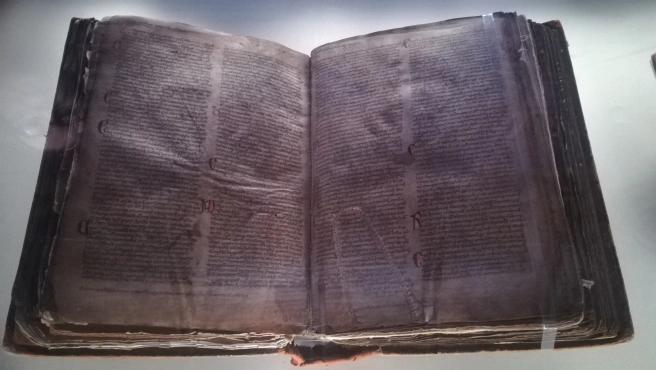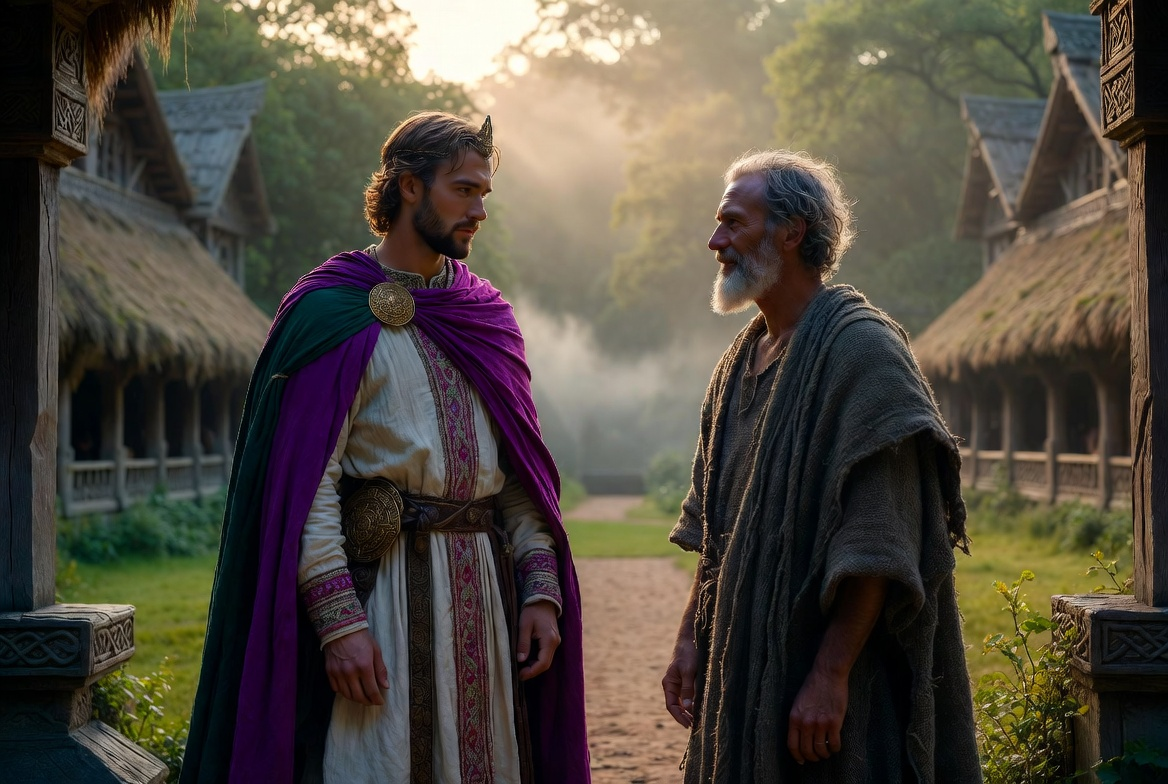
What follows is a 10th-century poem describing events set in the seventh century. It records an imagined conversation between King Guaire (Guare) of Connacht and his brother Marvan (Marban), a former warrior-prince who had renounced royal life to become a hermit in the woods.
King Guaire, a historical ruler of the Ui Fiachrach Aidhne in south Connacht (who died around 663 AD), was known for his generosity and his connections to saints and poets.
His half-brother Marvan chose a radically different path—leaving behind the comforts and responsibilities of the court for a simple shieling (hut) deep in the forest.
There, he lived close to nature, tending swine and seeking spiritual peace.
In this moving colloquy, the king urges his brother to return to the royal household.
Marvan responds by painting a lyrical picture of his woodland life: the songs of birds, the bounty of the forest, the companionship of wild creatures, and above all, the freedom from strife and the quiet presence of God.
The poem reaches its poignant climax when the king, deeply moved, declares that he would gladly trade his entire kingdom for the hermit’s humble existence.
Composed centuries after the events it depicts, this anonymous Old Irish work is a masterpiece of early Irish nature poetry. It beautifully contrasts the burdens of power with the rewards of simplicity and reflects a culture that deeply valued both kingship and the ascetic ideal.
The translation most often read today comes from the great Celticist scholar Kuno Meyer, who published it in the early 20th century.
KING AND HERMIT
Marvan, brother of King Guare of Connaught in the seventh century, had renounced the life of a warrior-prince for that of a hermit. The king endeavoured to persuade his brother to return to his court, when the following colloquy took place between them.
Guare
Why, hermit Marvan, sleepest thou not
Upon a feather quilt?
Why rather sleepest thou abroad
Upon a pitchpine floor?Marvan
I have a shieling in the wood,
None knows it save my God:
An ash-tree on the hither side, a hazel-bush beyond,
A huge old tree encompasses it.
Two heath-clad doorposts for support,
And a lintel of honeysuckle:
The forest around its narrowness sheds
Its mast upon fat swine.
The size of my shieling tiny, not too tiny,
Many are its familiar paths:
From its gable a sweet strain sings
A she-bird in her cloak of the ousel’s hue.
The stags of Oakridge leap
Into the river of clear banks:
Thence red Roiny can be seen,
Glorious Muckraw and Moinmoy.[1]
A hiding mane of green-barked yew
Supports the sky:
Beautiful spot! the large green of an oak
Fronting the storm.A tree of apples—great its bounty!
Like a hostel, vast!
A pretty bush, thick as a fist, of tiny hazel
nuts,
A green mass of branches.
A choice pure spring and princely water
To drink:
There spring watercresses, yew-berries,
Ivy-bushes thick as a man.
Around it tame swine lie down.
Goats, pigs,
Wild swine, grazing deer,
A badger’s brood.
A peaceful troop, a heavy host of denizens of the
soil,
A-trysting at my house:
To meet them foxes come,
How delightful!
Fairest princes come to my house,
A ready gathering:
Pure water, perennial bushes,
Salmon, trout.
A bush of rowan, black sloes,
Dusky blackthorns,
Plenty of food, acorns, pure berries,
Bare flags.
A clutch of eggs, honey, delicious mast,
God has sent it:
Sweet apples, red whortleberries,
And blaeberries.Ale with herbs, a dish of strawberries
Of good taste and colour,
Haws, berries of the juniper,
Sloes, nuts.
A cup with mead of hazel-nut, blue-bells,
Quick-growing rushes,
Dun oaklets, manes of briar,
Goodly sweet tangle.
When brilliant summer-time spreads its coloured
mantle,
Sweet-tasting fragrance!
Pignuts, wild marjoram, green leeks,
Verdant pureness!
The music of the bright red-breasted men,
A lovely movement!
The strain of the thrush, familiar cuckoos
Above my house.
Swarms of bees and chafers, the little musicians of
the world,
A gentle chorus:
Wild geese and ducks, shortly before summer’s
end,
The music of the dark torrent.
An active songster, a lively wren
From the hazel-bough,
Beautiful hooded birds, woodpeckers,
A vast multitude!
Fair white birds come, herons, seagulls,
The cuckoo sings between—
No mournful music! dun heathpoults
Out of the russet heather.The lowing of heifers in summer,
Brightest of seasons!
Not bitter, toilsome over the fertile plain,
Delightful, smooth!
The voice of the wind against the branchy wood
Upon the deep-blue sky:
Falls of the river, the note of the swan,
Delicious music!
The bravest band make cheer to me,
Who have not been hired:
In the eyes of Christ the ever-young I am no worse
off
Than thou art.
Though thou rejoicest in thy own pleasures,
Greater than any wealth;
I am grateful for what is given me
From my good Christ.
Without an hour of fighting, without the din of
strife
In my house,
Grateful to the Prince who giveth every good
To me in my shieling.Guare
I would give my glorious kingship
With the share of my father’s heritage—
To the hour of my death I would forfeit it
To be in thy company, my Marvan.
In the end, “King and Hermit” offers a quiet but powerful meditation on what truly constitutes a rich life. Through Marvan’s vivid catalogue of birdsong, forest fruits, wild companions, and unbroken peace, the poem suggests that freedom from strife, closeness to nature, and gratitude to the divine outweigh the burdens and splendours of kingship.
When Guaire declares he would trade his entire inheritance for a share of his brother’s simple existence, the poem reaches its clearest takeaway: true contentment lies not in power or worldy possessions, but in a life lived attentively, simply, and in harmony with the natural and spiritual world.
Further Reading and Accessible Online Sources:
Primary editions & translations
- Kuno Meyer, King and Hermit: A Colloquy between King Guaire of Aidne and his brother Marban (London: David Nutt, 1901). Internet Archive
- Kuno Meyer, “King and Hermit” in Selections from Ancient Irish Poetry (1911). Wikisource
- Gerard Murphy (ed. & trans.), Early Irish Lyrics, Eighth to Twelfth Century (Oxford: Clarendon Press, 1956; reprinted Four Courts Press). Poem on pp. 10–18.
- CELT electronic edition: “A Marbán, a díthrubaig”. CELT
Accessible online versions of the poem
Background on Guaire Aidne
- Dictionary of Irish Biography entry: Guaire Aidni