Kuno Meyer was born in Hamburg, taught German in Liverpool and died in Leipzig, yet few people did more to put early Irish literature back into Irish hands. Here is the story of the scholar behind the Triads of Ireland, the School of Irish Learning and the poems we still quote today, along with the war that nearly erased his name in Ireland.
A locked door on York Street
During Easter Week 1916, a small party of Irish Citizen Army volunteers crossed from their position at the Royal College of Surgeons on St Stephen’s Green and broke into a building on York Street through the roof, looking for anything heavy enough to build a barricade.
On the first floor they found a locked room stacked with large books, and they were about to break the door in when one of them, Liam Ó Briain, stopped them. He had attended lectures in that very building, and he knew what lay behind the door.
These were the facsimiles of the great manuscripts of Ireland, the Book of Leinster, the Book of the Dun Cow, the Yellow Book of Lecan and the Book of Ballymote, and Ó Briain told his comrades that it was on behalf of these old books that they were fighting.
The door stayed shut and the books survived.
The rooms behind that door belonged to the School of Irish Learning, and the School was the creation of a man who, that same week, was thousands of miles away in America, a German professor who had by then been struck off the rolls of the freemen of Dublin and Cork.
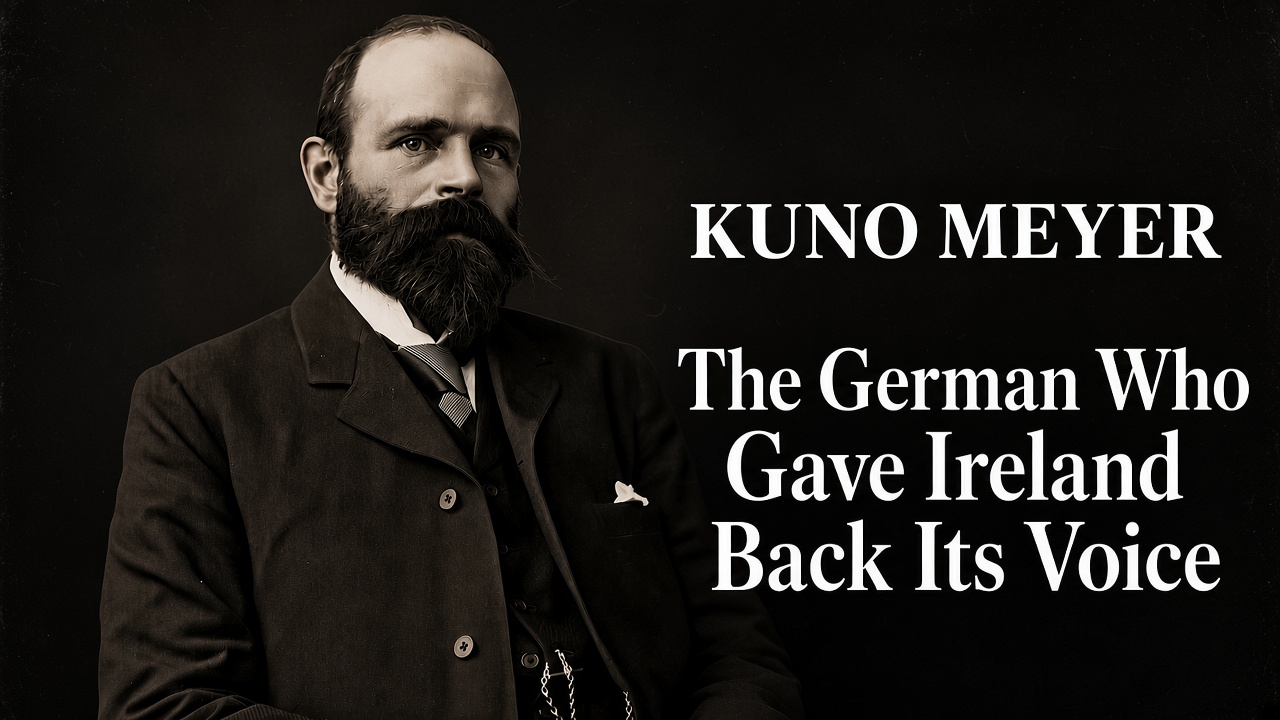
His name was Kuno Meyer. Few people in the generation before independence did more to show the world that early Ireland had produced a literature worth reading, and few have been so thoroughly forgotten by the general public since.
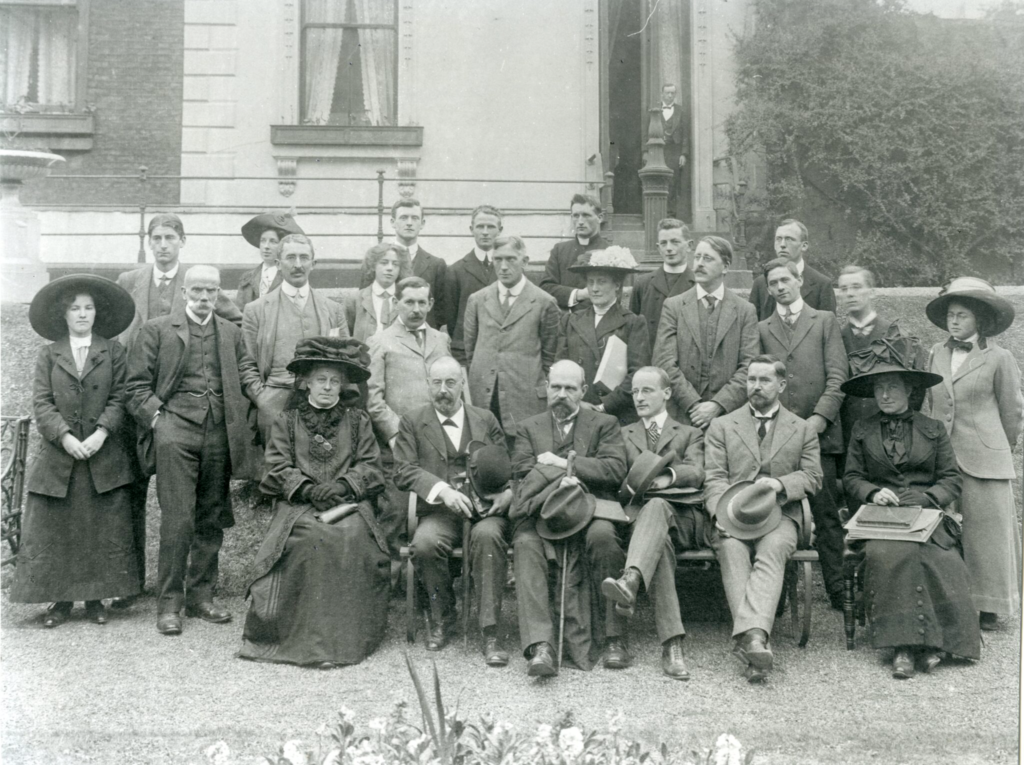
Kuno Meyer is seated in the front row (3rd seat, right of Rudolf Thurneysen)
I want to tell his story properly, because it is one of the most surprising in the history of Irish scholarship. It runs from a Hamburg schoolroom to a Liverpool lecture hall, from the Aran Islands to the Rotunda, and from the honour of the freedom of Dublin to a death in a Leipzig nursing home a year after the end of the First World War.
A Hamburg boy in Edinburgh
Kuno Meyer was born in Hamburg on 20 December 1858 into a family that would give Germany two eminent scholars. His older brother Eduard Meyer became one of the most celebrated historians of the ancient world in Germany, and Kuno himself was educated at the Johanneum, the old Latin school of Hamburg.
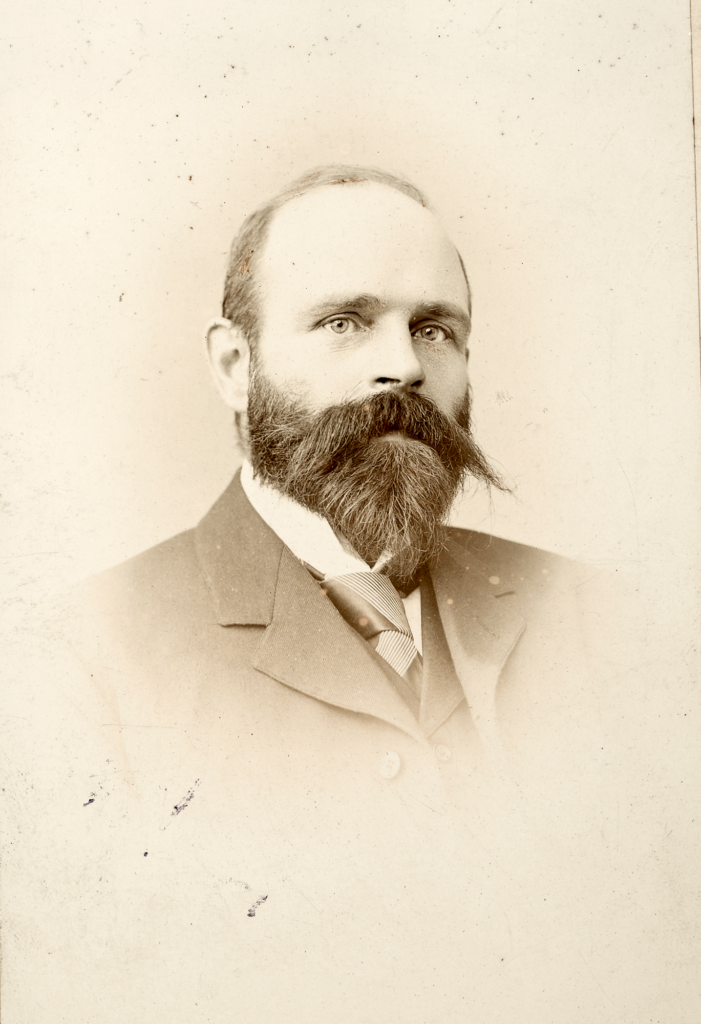
His life changed course when he was fifteen. Between 1874 and 1876 he lived in Edinburgh, where he assisted a blind German scholar, learned to speak English fluently, and had his first contact with Celtic culture.
That Scottish interlude matters, because it explains a great deal about the man Meyer became. He came back to Hamburg to finish school in 1879 already at ease in English and already drawn towards the Celtic world, and when he went up to the University of Leipzig he found the one teacher in Germany who could turn that curiosity into a vocation.
Ernst Windisch was a Sanskritist and Indo-Europeanist who had become one of the founders of modern Celtic philology, and he introduced Meyer to Old and Middle Irish.
Meyer’s doctoral thesis, completed in 1883 and published in 1884 as Eine irische Version der Alexandersage, was an edition of a medieval Irish retelling of the Alexander the Great legend. It is worth pausing on that choice of subject.
From the very start Meyer was interested in how Irish writers took material from the wider medieval world and made it their own, and that interest would run through his whole career.
Falling for Ireland from Liverpool
In 1884 Meyer took up a post as lecturer in Teutonic languages at the young University College Liverpool, and he stayed there for twenty-seven years. Liverpool was the right city for him. It looked across the Irish Sea, it had one of the largest Irish communities in Britain, and it had a branch of the Gaelic League where Meyer would later speak.
He taught German by day, rising to a professorship in 1895, and he gave the rest of his energy to Irish. The university eventually recognised where his heart lay, making him Reader in Celtic in 1903 and Professor of Celtic in 1908.
Celtic studies at Liverpool had a generous patron in the industrialist Edmund Knowles Muspratt, and Meyer later dedicated his most popular book to him.
What drew him in was the literature itself. Meyer read the early Irish nature poems and hermit poems in the manuscripts and saw something he believed had no equal in medieval Europe. He put it plainly in 1911, writing that to seek out and love nature “in its tiniest phenomena as in its grandest” was given to no people so early and so fully as to the Celt.
The Irish poets, he said, never gave an elaborate description of a scene. They gave a succession of quick images instead, like an impressionist painter, and he reached for a comparison from the other side of the world. “Like the Japanese, the Celts were always quick to take an artistic hint,” he wrote, “the half-said thing to them is dearest.”
He wanted to hear the language spoken as well as read it, and in 1889 he visited the Aran Islands. Three years later rheumatoid arthritis set in, and it stayed with him for the rest of his life.
In the portrait Augustus John painted of him in 1911, now in the National Gallery of Ireland, he sits with a walking stick in his hand.
The illness never slowed his pen. Douglas Hyde, who knew him well, later called him “one of the most lovable men who ever existed, and himself undoubtedly in love with Ireland.”
The books that made his name
Meyer published at a pace that still astonishes Celtic scholars. He edited and translated dozens of texts, many for the first time, and the list below gives the ones I think every student of early Ireland should know.
The Triads of Ireland (1906)
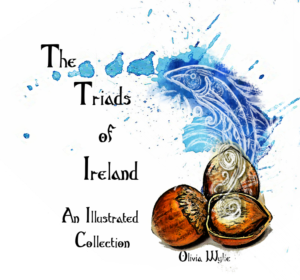
Trecheng Breth Féne, the Triads of Ireland, was Meyer’s Todd Lecture for the Royal Irish Academy in 1906, and for anyone interested in Brehon Law it is one of the most rewarding books he ever produced. The Triads are a collection of about 256 short sayings, most of them grouped in threes, which Meyer edited from nine manuscripts including the Yellow Book of Lecan, the Book of Ballymote and the Book of Uí Maine. He dated the collection to the second half of the ninth century from its late Old Irish verb forms.
The Triads are compressed wisdom in the Irish manner, and each one names a theme in a few words and then lands three examples on it with no explanation at all.
“Three candles that illumine every darkness: truth, nature, knowledge.”
“Three things that ruin wisdom: ignorance, inaccurate knowledge, forgetfulness.”
“Three things that are best for a chief: justice, peace, an army.”
A whole run of them deals with judges and legal procedure, and one of my favourites shows the practical mind of the early Irish lawyer.
“Three dead things that give evidence on live things: a pair of scales, a bushel, a measuring-rod.”
Meyer loved their wit. He noticed that the sharpest triads save a sting for the third item, and he quoted “Three things that constitute a buffoon: blowing out his cheek, blowing out his satchel, blowing out his belly.”
He also observed that among the Welsh and the Irish “the manufacture of triads seems at times almost to have become a sport.”
He translated them literally, keeping their bare, enumerating shape, and that is why his edition is still the one people quote more than a century later.
Selections from Ancient Irish Poetry (1911)
This slim book is the reason the general reader knows Meyer’s name at all. It gathered his translations of the early Irish lyrics, among them the poem of the monk and his white cat Pangur, the blackbird calling over Belfast Lough, the Lament of the Old Woman of Beare, the Viking Terror quatrain, the hermit Marbán’s song in King and Hermit, Deirdre’s farewell to Scotland and verses from the Triads and the Instructions of King Cormac.
Meyer made a deliberate choice in this book, and it is one of his lasting contributions. Victorian and Revival translators such as James Clarence Mangan, Samuel Ferguson and George Sigerson had generally turned Irish poems into rhymed, metrical English verse, which made them read like Victorian poems and often carried them far from their originals.
Meyer refused to do it. “I have made no attempt at either rhythm or rhyme,” he wrote in the preface, and he gave the poems in plain, faithful prose, laid out stanza by stanza so that readers could see the shape of the Irish.
His aim was to let the original poets speak for themselves, and those spare prose versions are still the ones many readers meet first.
The Voyage of Bran (1895–97)
Imram Brain, the voyage of Bran son of Febal to the Land of the Living, is one of the great Otherworld tales of early Ireland. Meyer edited and translated it in two volumes with the folklorist Alfred Nutt, who added long studies of the Irish ideas of the happy Otherworld and of rebirth.
For anyone interested in the Silver Branch, the islands of the blessed and the sea-god Manannán mac Lir, this is still the place to begin.
Cáin Adamnáin (1905)
Meyer edited and translated Cáin Adamnáin, the Law of Adomnán, promulgated at the Synod of Birr in 697. This is the law known as the Law of the Innocents, which sought to protect women, children and clerics from violence in war, and it sits right at the meeting point of the Church and Brehon Law.
It is often described as one of the earliest laws in Europe to protect non-combatants, a precursor to humanitarian law.
Sanas Cormaic (1912)
Sanas Cormaic, Cormac’s Glossary, is attributed to Cormac mac Cuilennáin, the king-bishop of Cashel who died in 908. It explains well over a thousand difficult Irish words, often with a story attached, and it is a treasure house of lore about early Irish society, law and belief.
Meyer edited it from the copy in the Yellow Book of Lecan in the fourth volume of Anecdota from Irish Manuscripts.
And many more
The obituaries of 1919 listed the titles that had brought him fame, and the range is extraordinary.
Cath Finntrágha (1885), the Battle of Ventry from the Fenian cycle.
Merugud Uilix maicc Leirtis (1886), the Irish Odyssey, a medieval Irish retelling of the wanderings of Ulysses.
Aislinge Meic Conglinne (1892), the Vision of Mac Conglinne, a riotous satire in which a scholar cures a king of a demon of gluttony.
Hibernica Minora (1894), King and Hermit (1901), Liadain and Curithir (1902), the tragic love story of two poets, and Four Old-Irish Songs of Summer and Winter (1903).
His Todd Lectures added The Death-Tales of the Ulster Heroes (1906), The Instructions of King Cormac mac Airt (1909) and Fianaigecht (1910).
His Contributions to Irish Lexicography (1906) and A Primer of Irish Metrics (1909) were tools for other scholars, and in 1909 he published a facsimile of the Bodleian Library manuscript Rawlinson B 502, one of the great Irish manuscript collections held outside Ireland.
It is sometimes said that Meyer translated the Book of the Dun Cow, and that is worth correcting. Lebor na hUidre is a manuscript compilation from around 1100, a whole library of tales bound into one volume. Meyer edited a number of individual texts preserved in it and in its fellow manuscripts, such as the Yellow Book of Lecan and the Book of Leinster, and it was Richard Irvine Best and Osborn Bergin, two scholars from the circle of his School of Irish Learning, who published the full diplomatic edition of Lebor na hUidre in 1929.
The builder of Celtic scholarship
Meyer’s editions would have been enough for most careers, but he also built the institutions that Irish scholarship still relies on. In 1896 he founded the Zeitschrift für celtische Philologie with Ludwig Christian Stern, and it is still published today.
In 1898 he began the Archiv für celtische Lexikographie with Whitley Stokes, the great Irish Celticist who became one of his closest friends. These were German and international journals, and Meyer wanted something more.
He wanted Ireland to train its own scholars.
He made his case at the Rotunda in Dublin in May 1903, in an address to the Oireachtas of the Gaelic League introduced by Douglas Hyde. Meyer praised the Gaelic revival as “one of the most remarkable and unexpected national movements of our time,” and then he told his audience what was missing.
Since the deaths of John O’Donovan in 1861 and Eugene O’Curry in 1862, Irish scholarship had no school behind it. Manuscripts of immense value lay unread in the libraries of Ireland and Europe. The Book of Uí Maine had been in the Royal Irish Academy since 1883 and, twenty years on, still lacked anyone qualified to study it properly.
If English manuscripts of that importance had turned up relating to King Alfred, Meyer argued, the whole world would have heard about it. He called the training of Irish scholars “a question of national importance.”
The School of Irish Learning opened that same year, founded by Meyer with John Strachan of Manchester and supported by Whitley Stokes, E.J. Gwynn and the historian Alice Stopford Green.
It was modelled on the École des Chartes in Paris and ran Easter and summer courses in palaeography, Old Irish and the editing of texts, taught by Meyer, Strachan, Rudolf Thurneysen, John Rhys and others.
Around sixty students from Ireland, Britain and the United States came through its doors in the first three years, on a budget of about £250 a year.
In 1904 it launched its own journal, Ériu, which Meyer edited and which is still one of the leading journals of Irish-language scholarship. The same year he was made Todd Professor in the Celtic Languages at the Royal Irish Academy.
The students it trained became the next generation of Irish scholarship. Osborn Bergin, Richard Irvine Best, Tomás Ó Máille and Máire Ní Chinnéide all passed through its circle, and the Norwegian Carl Marstrander, a former Olympic athlete who learned his Irish on the Great Blasket, was part of the same company.
A photograph of the School from 1911, which still hangs in the library of the Royal Irish Academy, shows Meyer seated in the front row among them.
Dublin and Cork both made him a freeman in 1912, alongside An tAthair Peadar Ó Laoghaire. Douglas Hyde later paired the two men neatly, writing that Meyer brought Ireland back into the long-past centuries while the Canon grasped Ireland as it was in the present.
The lesser-known Kuno Meyer
The Meyer of the textbooks is a careful philologist, but the man himself had some unexpected enthusiasms and some bold theories, and these are the parts of his story I enjoy telling most.
The secret language of the Travellers
Liverpool had a lively circle of Gypsy Lore scholars in Meyer’s time, and the Gypsy Lore Society’s archive is still held by the University of Liverpool. Meyer moved in that world alongside John Sampson, the university’s librarian and a leading scholar of the Romani language. Their shared interest was Shelta, the cant of the Irish Travellers, which outsiders had only recently begun to record.
Meyer studied Shelta’s Irish roots and set out his case in “On the Irish Origin and the Age of Shelta,” published in the Journal of the Gypsy Lore Society in 1891. He and Sampson both argued that the language went back as far as the thirteenth century, far older than the eighteenth-century word lists suggested.
Meyer went further and traced Shelta in early Irish records, and Charles Leland, the American writer who first brought Shelta to public notice, summed up where their work led.
Shelta, he wrote, appears to have been an artificial, secret or ogham tongue used by the bards, passed on by them in all probability to the bronze-workers and jewellers, and from them down to the tinkers. If that theory is right, the cant spoken on Irish roads in the nineteenth century preserved a trace of the secret speech of the old learned classes.
Modern linguists debate how old Shelta really is, but Meyer was one of the first scholars to take the language seriously as part of Ireland’s heritage.
Leland himself told a wonderful story about it. His first teacher of Shelta was a half-Gypsy tinker named Owen Macdonald, known to everyone as Pat, and after Leland published The Gypsies in 1882 one of the reviews sneered that Owen had simply passed off old Irish on him as Shelta.
Leland spotted Owen in the street one day and called out to him.
“Pat, ye divil. Do ye know what the Satherday Review says av yees?”
“An’ what ‘ull it be afther sayin’?” Owen replied, as gravely as if being discussed in the leading reviews happened to him every day.
“It says that ye passed off ould Irish on me for Shelta.”
Without moving a muscle, Owen answered, “An’ what would I be afther makin’ two languages av them for, if there was only wan av thim?”
In April 1891 Leland wrote that Professor Meyer had now shown Owen was right, and that there were indeed two languages. Meyer had shown it so well, Leland said, that he hoped Meyer would go on to write a whole book on “this Lost Language of the Bards,” a book he believed every person of Celtic descent should want to own.
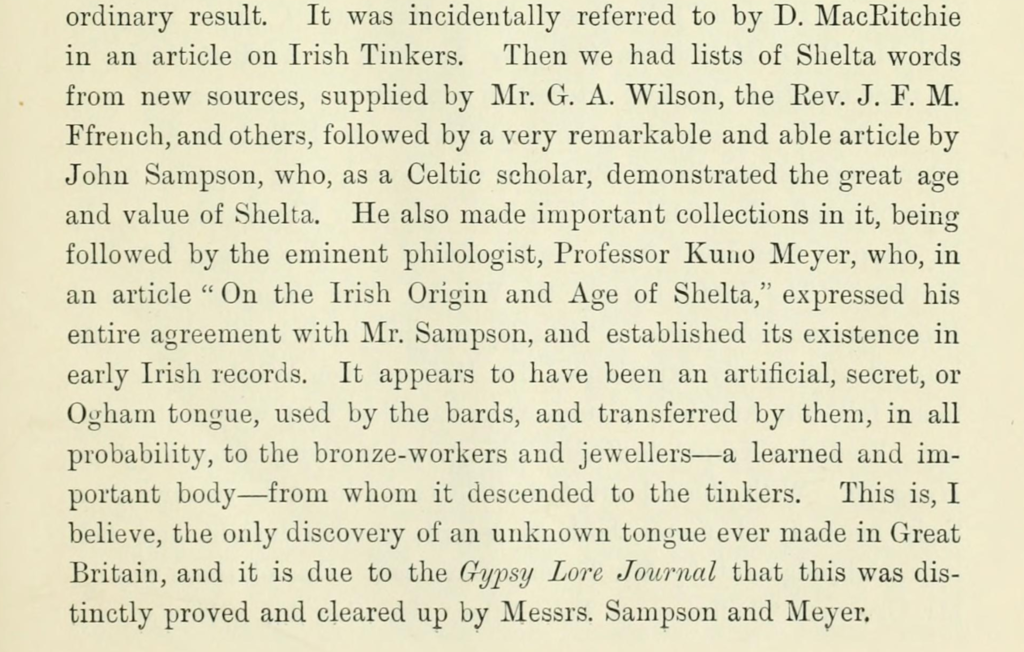
By Charles Godfrey Leland.
Meyer never wrote it, and the article in the Journal of the Gypsy Lore Society remains his main word on the subject.
Refugee scholars from Gaul
In September 1912 Meyer gave a lecture to the School of Irish Learning that made a startling claim about how Ireland became a land of saints and scholars.
Learning in Ireland in the Fifth Century and the Transmission of Letters, published in 1913, rested on a short note in a manuscript at Leiden. The note says that when the Huns, Vandals, Goths and Alans laid waste to the Continent, “all the learned men on this side of the sea” fled, and that those who went across the sea to a place written as “Hiheria” brought great advancement in learning to its people.
Meyer read “Hiheria” as Ireland and concluded that Gaulish scholars had fled to Ireland in the first decades of the fifth century, bringing their books and the classical tradition of late Roman schools with them.
On this reading, the brilliance of the Irish monastic schools owed less to Patrick and the missionaries than to these refugee teachers. He was confident enough to declare that the origin and early development of Irish learning was “now accounted for.”
Later historians have been far more cautious, and the theory is not generally accepted today, but it remains a fascinating idea and it shows how highly Meyer rated early Irish learning.
The oldest Irish poetry did not rhyme
In Über die älteste irische Dichtung (1913–14), Meyer argued that the very oldest Irish verse was unrhymed. He identified a layer of rhythmical, alliterative stanzas without rhyme, older than the rhymed syllabic poetry of the monasteries, and he saw in it the native poetry of Ireland from before rhymed verse took hold.
For anyone interested in the poets and druids of early Ireland, it is one of his most intriguing contributions, and scholars still argue about these early poems today.
A Gaelic Academy on the Hungarian model
Meyer saw Irish as a living language with a future. In October 1904 he spoke to the Liverpool branch of the Gaelic League and appealed for a Gaelic Academy, pointing to the Hungarian Academy as the model.
Hungary had revived its language in the nineteenth century under the shadow of a larger neighbour, and Meyer believed Ireland could do the same.
War, disgrace and a death in Leipzig
In October 1911 Meyer left Liverpool to succeed Heinrich Zimmer in the chair of Celtic philology at Berlin, the only such chair in Germany, and the same year he was elected to the Prussian Academy of Sciences.
The freedoms of Dublin and Cork followed in 1912. He was at the height of his reputation, admired in Ireland, Britain and Germany alike, and within three years almost all of that goodwill was gone.
When war broke out in 1914 Meyer was a patriotic German, and he made no secret of it. He signed a contribution to the Zeitschrift für celtische Philologie “on the day of the capture of Antwerp,” and then he crossed to the United States, where he lectured at Columbia, the University of Illinois and elsewhere while arguing Germany’s case to American and Irish-American audiences. Harvard, which had invited him to lecture, withdrew the invitation that autumn.
In December 1914 he spoke to a Clan na Gael gathering on Long Island, and his pro-German remarks caused uproar in Britain and among many in Ireland.
The consequences were swift.
Meyer gave up his honorary chair at Liverpool, his directorship of the School of Irish Learning and the editorship of Ériu.
On 15 March 1915 Dublin Corporation, then controlled by the Irish Parliamentary Party, struck his name from the roll of freemen, and Cork did the same. W.T. Cosgrave opposed the move in Dublin, and in a letter that year he described Meyer as “the greatest Celtic authority since the death of Whitley Stokes” and a man who had “done more for Irish scholarship and Irish national glory than any other living man.”
A month later, in April 1915, Meyer protested when Harvard gave its first prize to an anti-German poem titled “Gott mit Uns,” and he withdrew his name from consideration for a Harvard exchange professorship.
His personal life took a strange turn in the same year.
Meyer was badly injured in a railway collision in California, and while recovering in hospital he met Florence Lewis, a 27-year-old woman from Nebraska. They married soon afterwards.
He remained in America until 1917, and he kept up his links with the Irish republican movement there. On 8 October 1916 he wrote from Chicago to Joseph McGarrity of Clan na Gael about the death of Roger Casement, who had been hanged in London that August, and the letter is now in the National Library of Ireland.
Florence went ahead of him to Germany in 1916, he followed in 1917, and by 1919 the marriage had broken down and she had moved to Switzerland with her daughter.
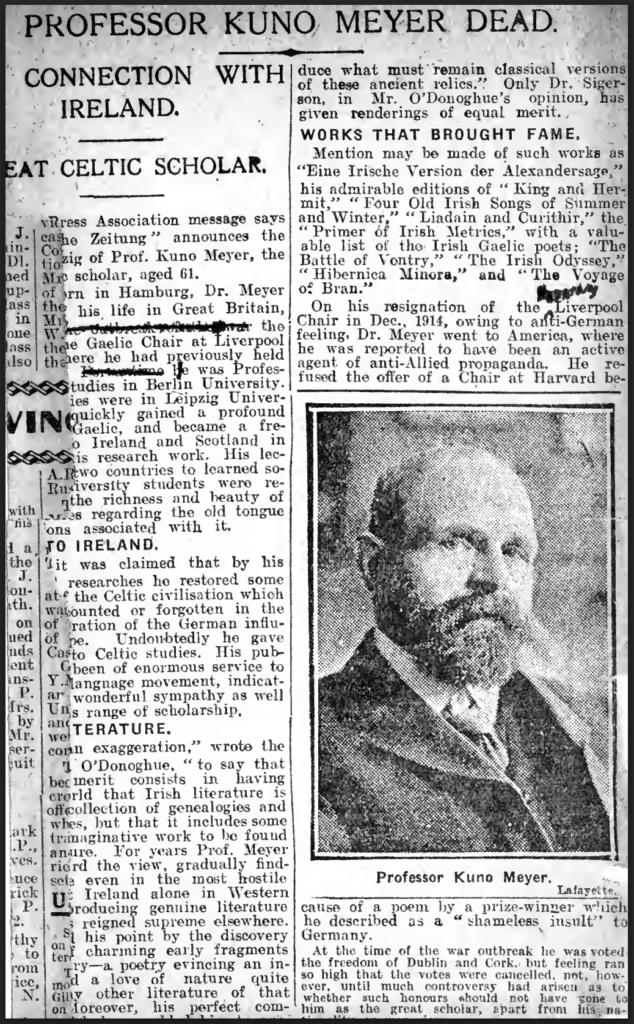
Kuno Meyer died in a nursing home in Leipzig on 11 October 1919, aged sixty. Angus Mitchell suggests in History Ireland that his end was hastened by grief at Germany’s humiliation under the Treaty of Versailles.
Obituaries came from Osborn Bergin, Richard Irvine Best, Julius Pokorny and Rudolf Thurneysen, and the Irish press reported his death with a mixture of admiration and suspicion. One Irish newspaper obituary praised his translations as classical versions that only George Sigerson had matched, while repeating the wartime claim that in America he had been “an active agent of anti-Allied propaganda.”
That phrase hints at the suspicion that hung over his name, and talk of German agents was everywhere in those years, but what the surviving record shows is a scholar lecturing and writing openly for the German cause.
How Ireland remembered him
Meyer did not live to see his name cleared. In 1920, after Sinn Féin had won control of Dublin Corporation, Cosgrave moved that the decision of 1915 be reversed, and on 19 April 1920 Meyer was restored to the roll of freemen of Dublin. Cork followed on 14 May 1920. It was a gesture made by the men and women who were building an independent Ireland, and they chose to honour a German scholar who had given them back their oldest literature.
The story has a curious postscript. In 1965 the Gaelic League and the Irish Press launched a campaign to have Meyer’s freedom restored, apparently unaware that it had been restored forty-five years earlier.
The School of Irish Learning outlived its founder by only a few years. Hit by the war and short of money, it was absorbed into the Royal Irish Academy, and its final meeting took place there in May 1926.
The vision survived. In 1940 Éamon de Valera established the School of Celtic Studies within the Dublin Institute for Advanced Studies, which carries on exactly the kind of work Meyer called for at the Rotunda in 1903.
Ériu and the Zeitschrift für celtische Philologie are both still published, and many of the manuscripts whose facsimiles Ó Briain’s comrades nearly turned into barricades in 1916 can now be viewed free of charge through Irish Script on Screen.
I think Meyer’s greatest gift was the way he taught the world to read early Irish writing on its own terms.
He refused to dress the old poems in borrowed rhymes; he printed the Triads in their bare and witty form, and he insisted that Ireland deserved scholars of its own to study its manuscripts.
When you read Pangur Bán or the blackbird over Belfast Lough in translation, there is a good chance you are reading words shaped by Meyer.
If you would like to meet him through his own work, start with Selections from Ancient Irish Poetry and The Triads of Ireland, both of which are short, readable and free online, the Triads through CELT at University College Cork and the Selections through Project Gutenberg.
For the Brehon Law side of his work, Cáin Adamnáin and The Instructions of King Cormac mac Airt are the next steps.
Read a few of the Triads aloud and see which one stays with you.
I would love to hear which it is.
Sources
- Angus Mitchell, “The School of Irish Learning (1903–26),” History Ireland 34, no. 3 (May–June 2026), pp. 32–34.
- “Professor Kuno Meyer Dead,” Irish newspaper obituary, mid-October 1919, found bound in before the title page of a copy of Meyer’s Selections from Ancient Irish Poetry (1911).
- Kuno Meyer, The Triads of Ireland, Todd Lecture Series XIII (1906), CELT edition
- Kuno Meyer, Selections from Ancient Irish Poetry (London, 1911), Project Gutenberg
- Kuno Meyer, Learning in Ireland in the Fifth Century and the Transmission of Letters (Dublin, 1913), Warburg Institute scan
- Kuno Meyer, “On the Irish Origin and the Age of Shelta”, Journal of the Gypsy Lore Society, old series, vol. 2, no. 5 (January 1891), pp. 257–66, Internet Archive scan
- Charles Godfrey Leland, “What We Have Done: A Few Parting Words from Our President,” Journal of the Gypsy Lore Society, old series, vol. 3, no. 4 (April 1892), pp. 193–98 (the Shelta passage is on p. 195), and also “Shelta”
- Kuno Meyer chronology and bibliography, CELT, University College Cork
- Meyer, Kuno, Neue Deutsche Biographie
- Kuno Meyer, Wikipedia (for the Harvard episode, the freedom dates and the 1965 petition)
- Olive Morrin, “Kuno Meyer (1858–1919) and Peadar Ó Laoghaire (1839–1920)”, Maynooth University Special Collections
- Kuno Meyer exhibition, University of Liverpool Special Collections and Archives
- Letter from Kuno Meyer to Joseph McGarrity regarding the death of Sir Roger Casement, 8 October 1916, National Library of Ireland, MS 17,629/10
- Shelta, Wikipedia
- Seán Ó Lúing, Kuno Meyer 1858–1919 (Dublin, 1991), and the Papers of the School of Irish Learning, Royal Irish Academy Special List A033.