The Auraicept na n-Éces, commonly known in English as The Scholars’ Primer, is one of the most important and fascinating surviving texts from medieval Ireland.
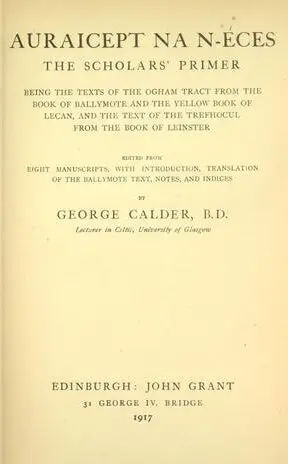
Scholars’ Primer—Auraicept na n-Éces
Composed likely between the 7th and 9th centuries (with later additions and expansions), it stands as the earliest known native Irish treatise on grammar, poetics, and the philosophy of language.
Written in a mixture of Old Irish and Latin, the Auraicept is not a dry linguistic manual. It is a richly layered work that blends technical instruction in grammar and metrics with vivid mythological narrative.
At its heart lies a legendary account of the origin of the Irish language (Gaelic), which the text presents as the most perfect and comprehensive of all tongues.
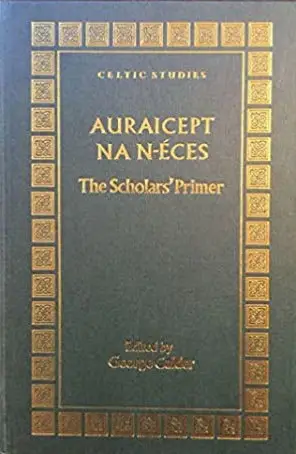
This story connects the Irish scholarly tradition to the biblical Tower of Babel, featuring key figures such as the Scythian prince Fenius Farsaid and the sage Gaedel (Goídel Glas), who together select and refine the language from the seventy-two tongues of the world.
The work is traditionally attributed to the collective wisdom of ancient Irish poets and scholars (éces), and it served as a textbook for fili (professional poets and learned men) in the medieval Irish bardic schools.
Beyond language origins, it contains detailed discussions of the Ogham alphabet (including its invention and use), the rules of poetry, and the structure of the Irish language itself.
Why The Auraicept na n-Éces Matters
The Auraicept na n-Éces is significant for several reasons:
- It offers a rare window into how medieval Irish intellectuals viewed their own language and culture.
- It demonstrates the sophisticated level of linguistic analysis present in Ireland centuries before similar works appeared in most of Europe.
- It preserves a unique fusion of Christian biblical learning, classical knowledge, and native Irish mythological tradition.
Though complex and sometimes repetitive (as it survives in several manuscript versions), the Auraicept remains a foundational text for understanding early Irish literature, language, and intellectual life.
Gaelic’s Origin Story from the Scholars’ Primer
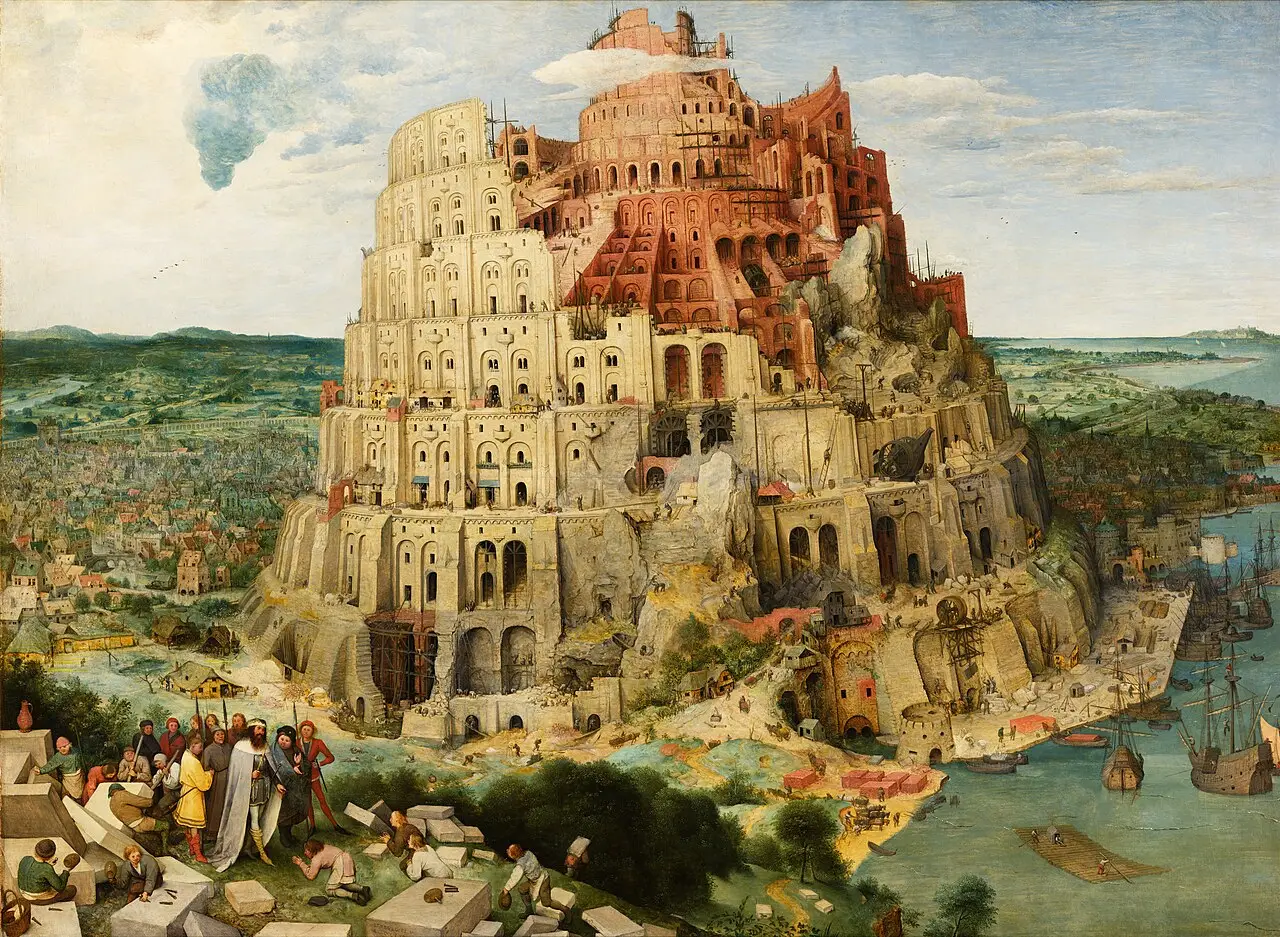
After the Great Flood, humanity grew numerous and ambitious. A powerful leader named Nimrod, a mighty hunter, united 72 counsellors to build an enormous tower on the plain of Shinar.
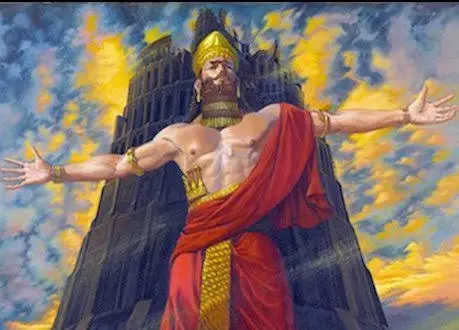
Their goals were practical and proud: to survive any future flood, to physically ascend into heaven, and to make their names immortal.
God, seeing their arrogance, came down and confused their single language into 72 different tongues.
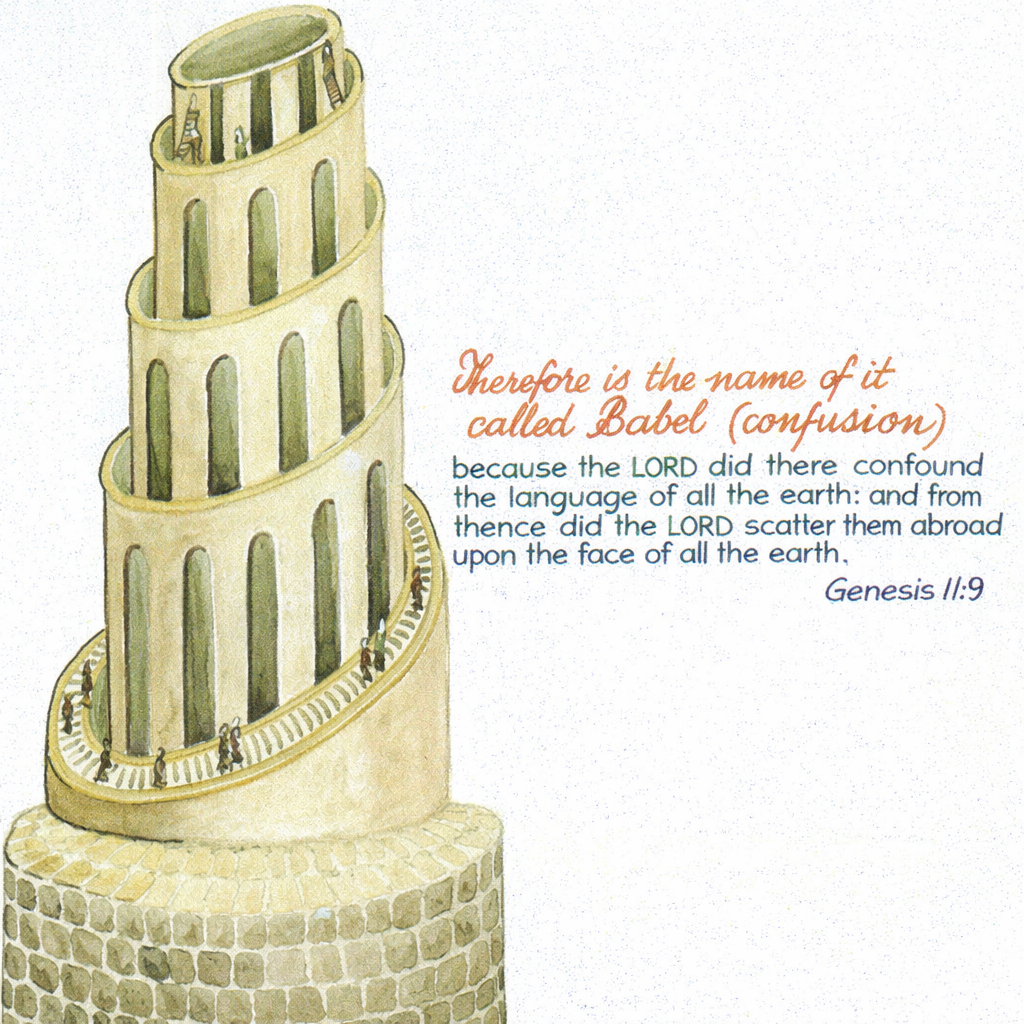
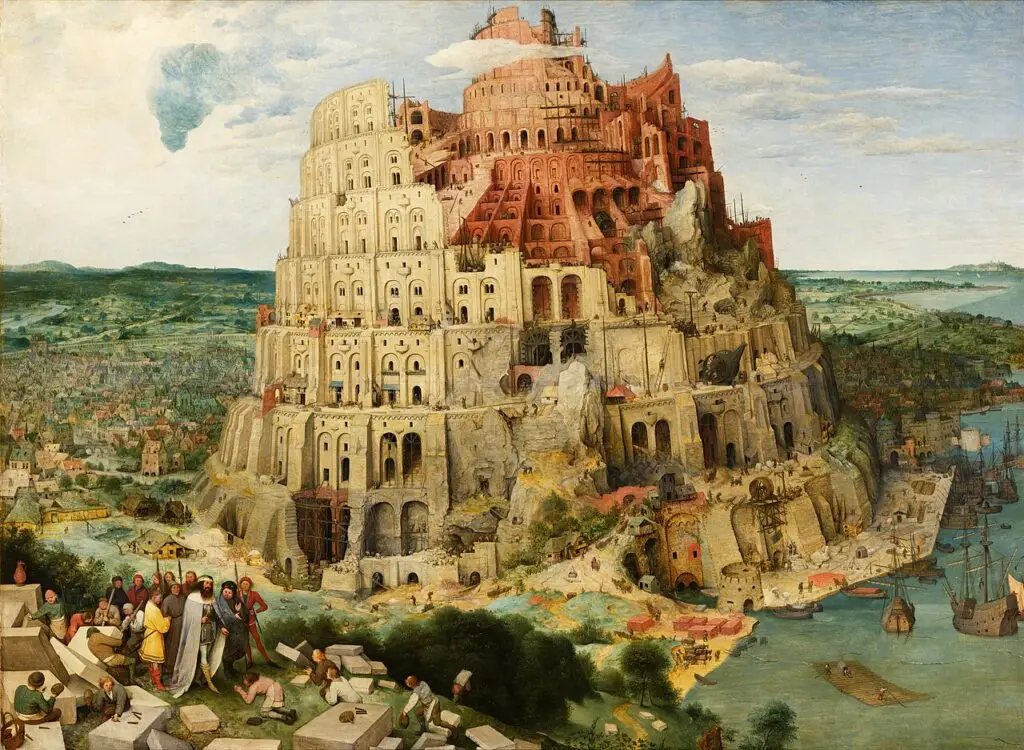
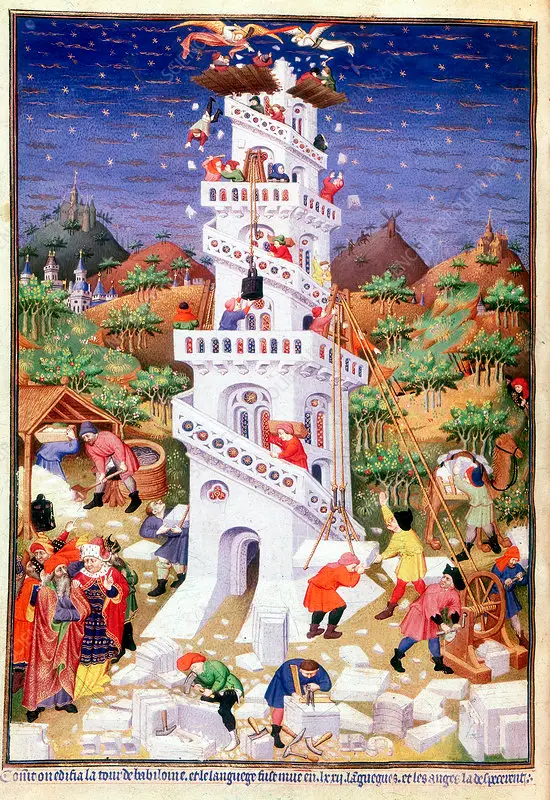
Suddenly, workers could no longer understand each other — someone asking for a stone might be handed a stick instead. Construction halted, and the people scattered. This was the Confusion of Tongues.
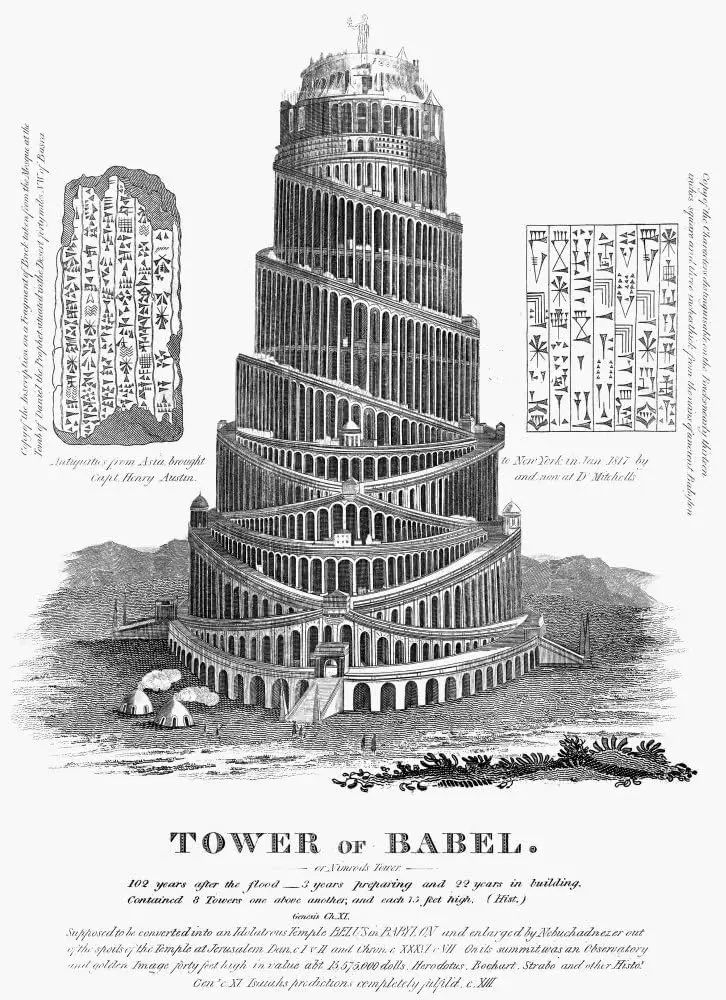
Some time later, a group of 75 poets and scholars from Scythia, led by Fenius Farsaid, travelled to the site of the ruined tower.
“Now poets came from Scythia a little time after these doings to seek to learn the many languages at the Tower… The poets numbered seventy-five… Fenius Farsaidh was the name of their chief, and he was a sage in the principal languages even before he came from the North out of Scythia.”
— Auraicept na n-Éces, pp.8-10 George Calder, trans. 1917
They believed it was the perfect place to study all the newly created languages. Fenius, already a master linguist who knew Hebrew, Greek, and Latin, sent his students out into the world to master every tongue. He housed and fed them for seven years while they studied.
“Since Fenius did not get a perfection of the languages at the Tower, he dispersed his school and his disciples abroad… seven years… and Fenius stayed at the Tower… till his school came unto him from every direction.”
— Auraicept na n-Éces, p. 10 of George Calder, trans. 1917
When the students returned, they asked Fenius to create something special: a new language that would belong only to them — one superior to all others. Fenius and his chief sages selected the finest, most noble, and most comprehensive elements from all 72 languages. They refined and organised these sounds and words into a single, harmonious tongue.
“Then they asked the sage, to wit, Fenius to select for them out of the many languages, a language that no one else should have but which might belong to them alone. Wherefore on that account for them was invented the Select Language… the Language of the Irish…”
— Auraicept na n-Éces, pp. 10-12 of George Calder, trans. 1917
This new language was Gaelic (Irish). It was called the “Select Language” because it was deliberately chosen and assembled. It was said to be more comprehensive than any other speech, containing a place for every obscure sound that existed.
Gaedel (Goídel) Glas, who was one of the key sages, played a central role in shaping and recording it. He is credited with writing the language down on tablets and stones, particularly in Egypt, where he had been born.
“There Gaedel wrote Gaelic… in the particular place which is named Calcanensis. Gaedel, son of Ether, son of Toe, son of Baracham, a Greek, was one of the two sages in Fenius company, so that from him was named Gaelic, to wit, ealg means noble, to wit, Gaedel ennobled it… Now Fenius Farsaidh… and Iar son of Nema, and Gaedel son of Ether are the three sages who selected these languages…”
— Auraicept na n-Éces, pp. 6, 12 of George Calder, trans. 1917
Thus, Gaelic was born at the Tower of Babel — the first language Fenius published — and it became the noble tongue of the poets and the Irish people.
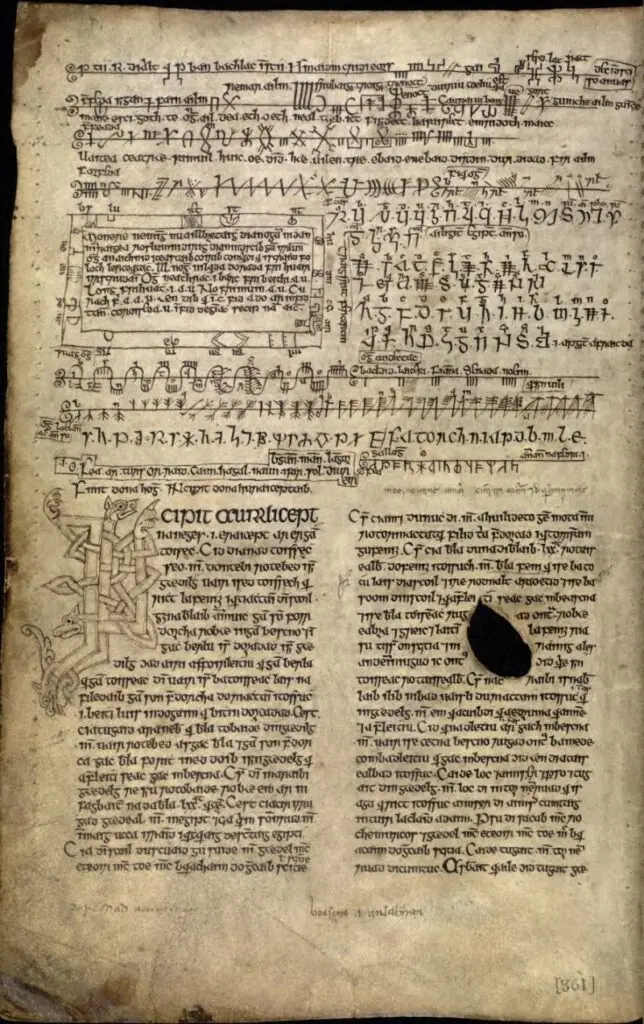
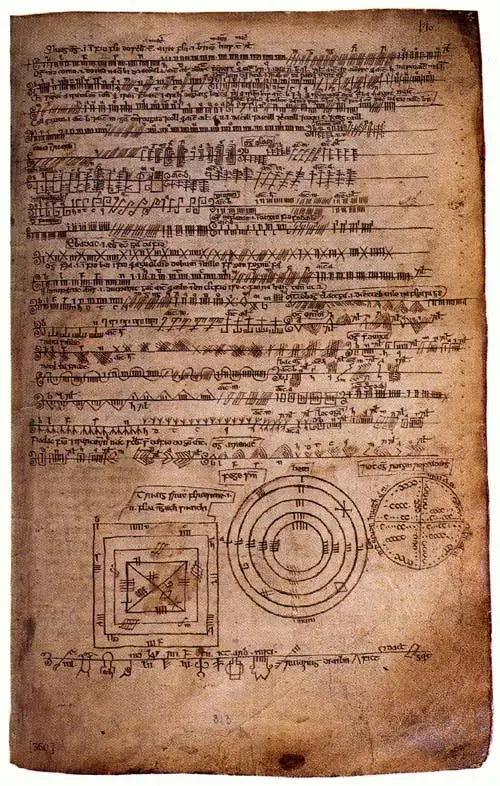
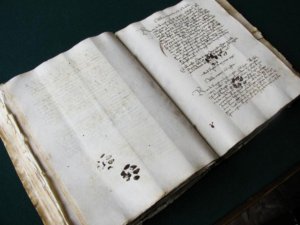
Folios from the Book of Ballymote containing: Auraicept na n-Éces — The Scholars’ Primer
Origins of Oghams
The Auraicept na n-Éces treats Ogham (the early Irish writing system of notches and lines) as part of the special “superadditions” to the Gaelic language.
Ogham is presented as an Irish invention tied to the same scholarly tradition. It is one of the secret or specialised forms of communication created by the poets. The text links its invention to the broader project of language refinement after the Tower.
The basic Ogham alphabet is called Beithe-Luis-Nin (named after the first three letters: B-L-N, which correspond to Birch, Rowan, and Ash trees). Other variations include Beithe-Luis-Fearn (B-L-F, corresponding to the Birch, Rowan, and Alder trees).
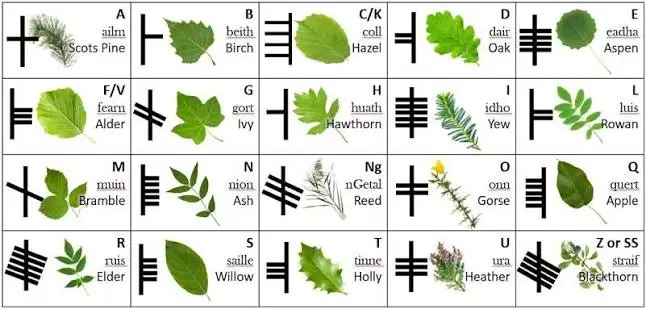
How Ogham Works (Summary of the Rules)
- It is a tree-based alphabet: each letter is named after a tree or plant.
- The core alphabet has 20 letters (later expanded).
- Letters are grouped into four aicmi (or acme, families or groups of five).
- Written along a central stem-line:
- Strokes to the right of the line = one group
- Strokes to the left = another
- Strokes across the line = third
- Diagonal strokes = fourth
- Used for inscriptions (especially on standing stones), secret communication among poets, and scholarly purposes.
- The text includes wide varieties and cryptographic forms of Ogham.
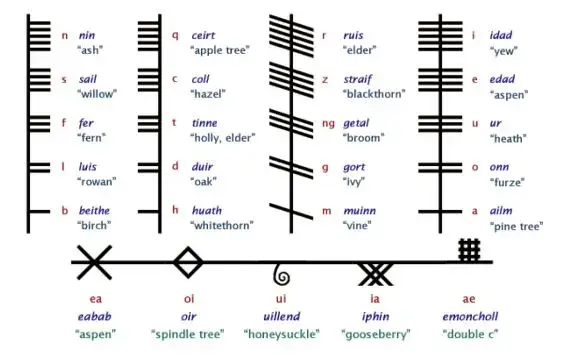
The Auraicept devotes significant space to listing the letters, their tree names, kennings (poetic descriptions), and examples of usage. It treats Ogham as a sophisticated, native Irish scholarly achievement.
Who Was Gaedel Glas?
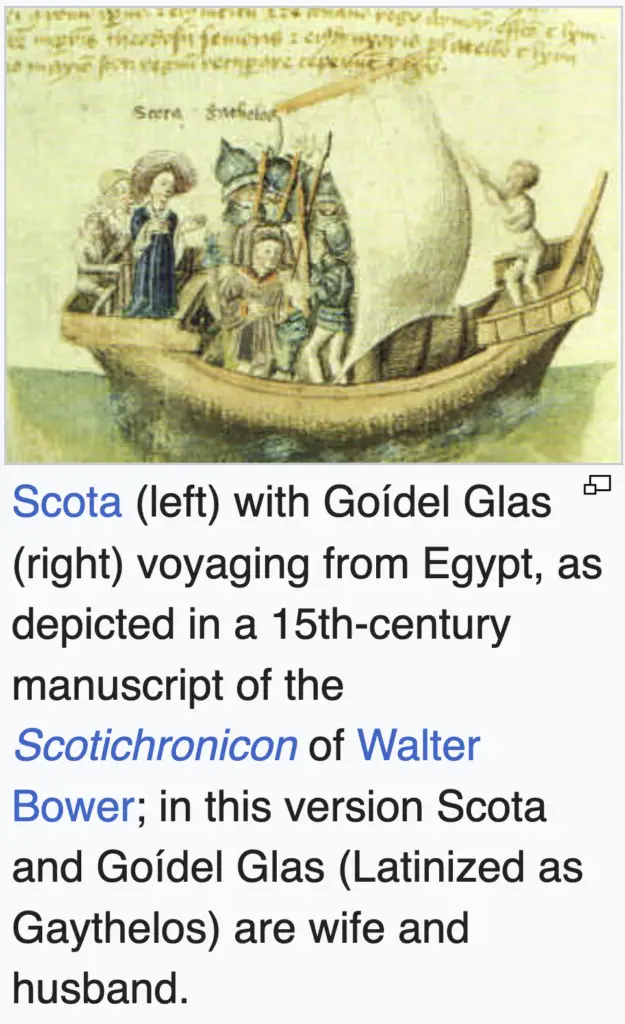
Gaedel, also known as Goídel Glas, was the son of Ether, son of Toe, son of Baracham, and is described as a Scythian Greek.
Born in Egypt in the plain of Ucca, he became one of the two or three chief sages working alongside Fenius. Gaedel played a central role in the creation of the new language.
He helped select and refine its sounds and structures from the seventy-two tongues, and he is credited with physically writing it down on tablets and stones.
The language itself was named after him — Gaelic (Gaedealg) — because, as the text explains, “Gaedel ennobled it” (from ealg, meaning noble).
In the broader Irish legendary tradition (such as the Lebor Gabála Érenn), this same figure appears as the eponymous ancestor of the Gaels, linking the linguistic myth directly to the origin story of the Irish people.
In some accounts, he is depicted as the husband of Scota, as shown in this Wikipedia image.
Who Was Fenius Farsaid?
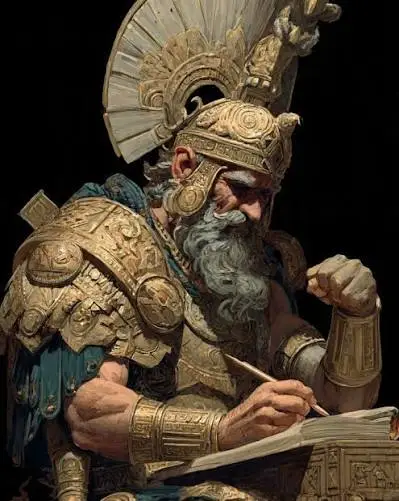
Fenius Farsaid was a Scythian prince and renowned master linguist, said to be descended from Noah through his son Japheth (though the texts offer slightly varying genealogies).
Even before he reached the Tower of Babel, he was already fluent in the three principal languages of the ancient world: Hebrew, Greek, and Latin.
When the poets and scholars journeyed to the site of the Tower of Babel after the confusion of tongues, Fenius emerged as their natural leader.
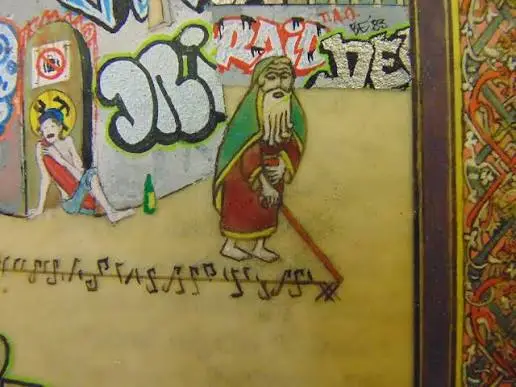
He established a great school, dispersed his students across the known world to master every language, and generously supported them with food and clothing for seven years while he himself remained at the Tower. Once his students returned, Fenius oversaw the creation of a new, superior language.
He is portrayed as a wise and patient teacher who selected and refined the finest elements from all existing tongues to produce Gaelic — the “Select Language” — which he then published first among all the languages.
Further Reading and Sources:
Primary
- The Scholars’ Primer (Full English Translation) https://www.maryjones.us/ctexts/scholar_primer.html
— Clean, readable HTML version. Excellent starting point. - CELT Edition (Corpus of Electronic Texts) https://celt.ucc.ie/published/T502003.html
— Full scholarly text with background information. - Auraicept na n-Éces, The Scholars’ Primer (George Calder’s 1917 Edition) https://archive.org/download/auraicept00calduoft/auraicept00calduoft.pdf
— The standard scholarly edition with Irish text and facing English translation.
Secondary
- Lebor Gabála Érenn (The Book of Invasions) https://celt.ucc.ie/published/T100054.html
– The broader legendary history that expands on the Fenius/Gaedel story. - Wikipedia Overviews:
- Auraicept na n-Éces — https://en.wikipedia.org/wiki/Auraicept_na_n-%C3%89ces
- Goídel Glas — https://en.wikipedia.org/wiki/Go%C3%ADdel_Glas
- Genesis 11 1-9 | The Biblical Tower of Babel Story — https://www.biblegateway.com/passage/?search=Genesis%2011&version=NIV
Books
- Anders Ahlqvist, The Early Irish Linguist (1983)
— excellent modern analysis of the text’s linguistic content. - Kim McCone, Pagan Past and Christian Present in Early Irish Literature (1990)
— places the Auraicept in its cultural and religious context. - John Carey, The Irish National Origin-Legend: Synthetic Pseudohistory (1994)
— discusses the Fenius/Gaedel story within broader Irish pseudohistory.