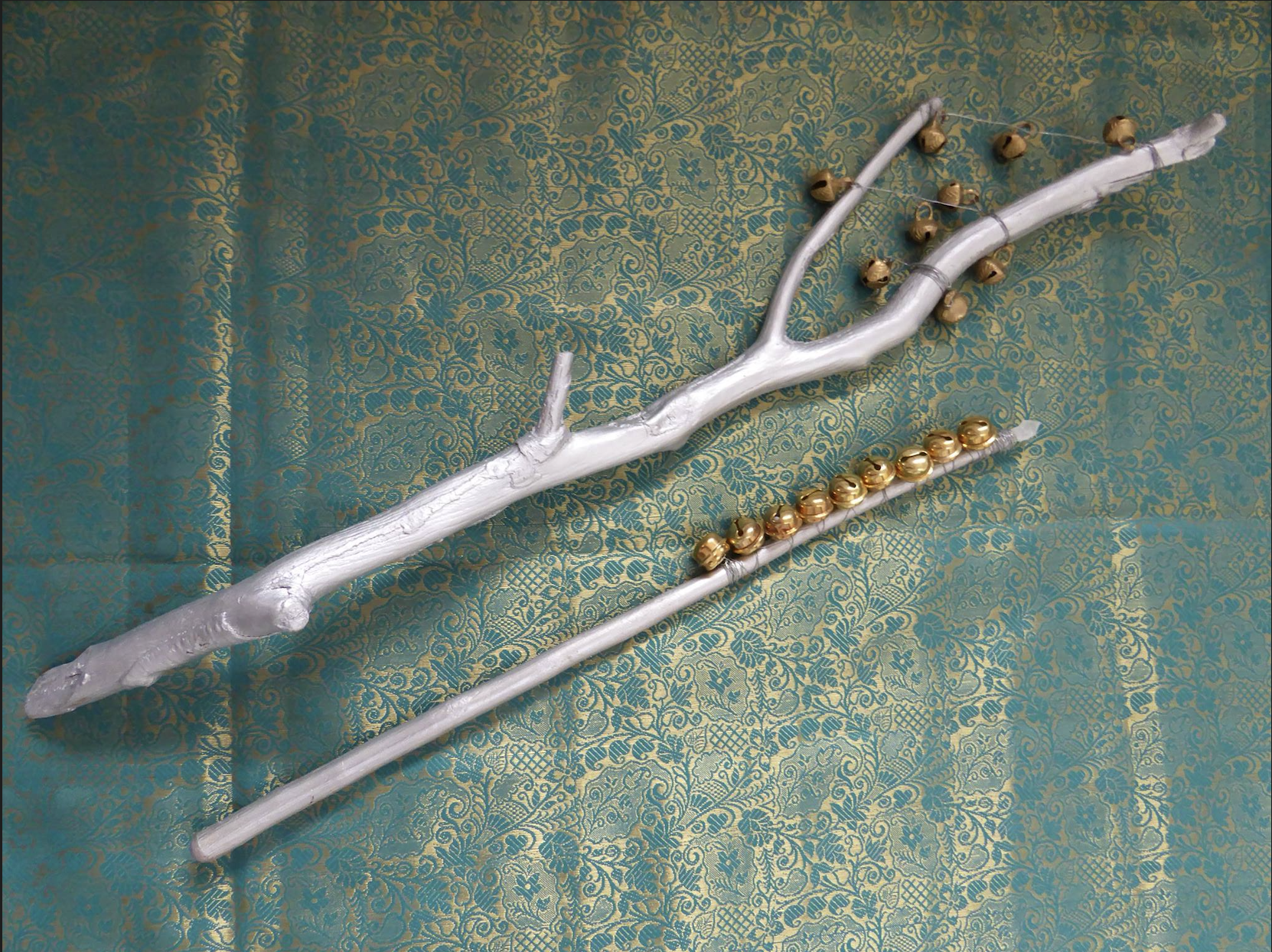
There’s a passage that turns up in a lot of anthologies of Irish myth, usually just a page or two, that starts with a strange young man walking up to the King of Tara carrying a branch of silver with three golden apples on it.
It’s a lovely, self-contained little scene, and it’s often printed as though that’s the whole story.
It isn’t.
It’s the opening move of a much longer and stranger tale, and it’s worth knowing where it actually comes from, because the manuscript history is nearly as interesting as the story itself.
Where the story comes from
The tale is called Echtra Cormaic i Tír Tairngiri — “Cormac’s Adventure in the Land of Promise” — and it belongs to a category of early Irish literature called echtrai, “adventures,” in which a mortal is drawn into the Otherworld, usually by a supernatural visitor with an agenda of their own.
It sits within the so-called Cycle of the Kings, the body of tales built around historical or semi-historical high kings, as opposed to the better-known Ulster Cycle (Cú Chulainn) or Fenian Cycle (Fionn mac Cumhaill).
Of the Four Cycles of Irish Mythology, the Cycle of Kings is the one that has one foot in myth and the other firmly in historicity.
Cormac mac Airt himself is said by the annals to have reigned in the third century, and Irish tradition remembers him as the ideal lawgiver-king, the ruler under whom justice and fír flaithemon — the ruler’s truth, the idea that a king’s honesty and integrity kept the land itself fertile and orderly — were said to be perfectly upheld.
That reputation is exactly what this story is built to test.
The tale survives in several manuscript recensions, which is worth explaining because it changes how we should think about “the” text:
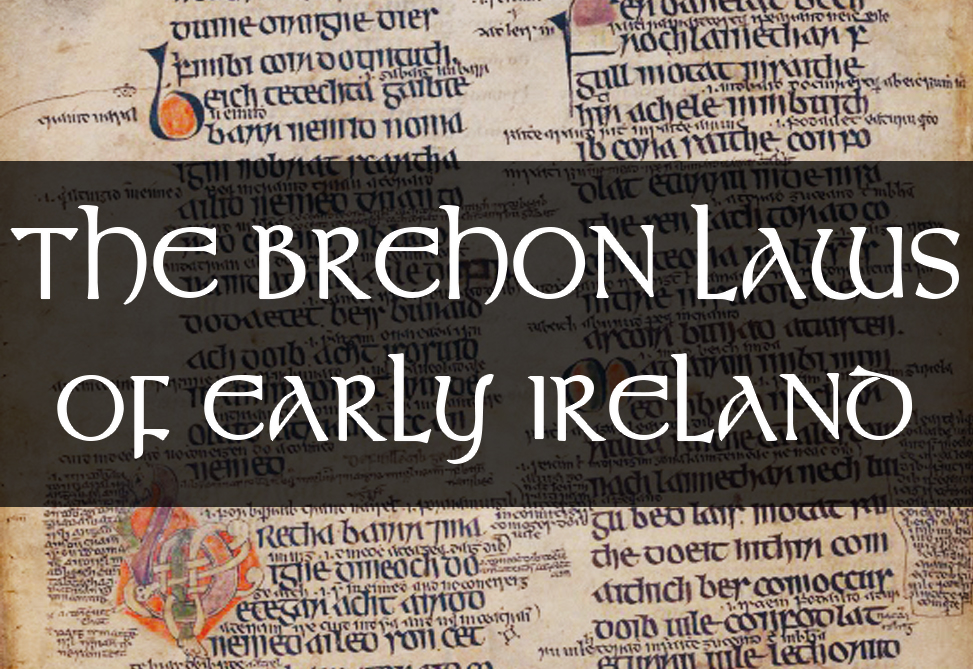
- The earliest full version, titled in the manuscripts Scél na Fír Flatha, Echtra Cormaic i Tír Tairngiri ocus Cert Claidib Cormaic (“The Tale of the Ordeals, Cormac’s Adventure in the Land of Promise, and the Judgment of Cormac’s Sword”), is preserved in the Book of Ballymote and the Yellow Book of Lecan, both compiled in the late fourteenth century.
The two copies are close enough to each other that scholars think they descend from a shared exemplar, and the language of the text itself looks a good two centuries older than the manuscripts — pointing to a composition somewhere around 1150–1200. Whitley Stokes edited and translated this version in 1891. - A second, independent recension turns up in the Book of Fermoy (fourteenth–fifteenth century), edited and translated by the American scholar Vernam Hull in 1949.
- A third, later version in early Modern Irish, called Fághail Craoibhe Cormaic (“How Cormac Got His Branch”), was edited by Standish Hayes O’Grady from a manuscript of uncertain origin, one of at least nine surviving paper copies, none older than 1699.
This is the version Joseph Jacobs condensed for his popular Victorian fairy-tale anthology, and it’s also the backbone of Lady Gregory’s retelling in Gods and Fighting Men, which is probably the version most people have actually read.
So when you meet this story in a general mythology book, you are very likely reading Lady Gregory’s early twentieth-century English retelling of a late medieval Irish version, which is itself the youngest of at least three separate manuscript traditions stretching back to a lost twelfth-century original.
It’s a story that has already survived several centuries of retelling before it ever got as far as Jacobs or Gregory.
The story itself
It opens exactly the way the fragment you may have seen suggests: a mysterious young man appears at Cormac’s ramparts at Tara, carrying a silver branch bearing three golden apples.
When shaken, the branch produces music so sweet that it sends the sick, the wounded, and women in labour into peaceful sleep.
Cormac asks where he’s come from. The stranger describes a land where there is nothing but truth, and where old age, death, decay, gloom, sorrow, envy, and pride are all unknown — a fairly precise photographic negative of the ordinary world, and a description that (unnamed at this point) marks him out as a visitor from Tír Tairngire, the Land of Promise.
Cormac wants the branch. The stranger will give it to him, but only in exchange for three wishes, to be claimed at a time of the stranger’s own choosing. Cormac agrees.
A year passes.
The stranger returns and claims his first wish: Cormac’s daughter.
Then his son.
Then, finally, his wife Eithne.
Each time, Cormac — bound by his word as a king must be — lets them go, and each time the loss cuts deeper.
On the third occasion, his patience snaps and he pursues the stranger across the country, chasing him into a thick, unnatural fog.
When the fog lifts, Cormac finds he is no longer in Ireland at all, but standing before a strange, richly built dwelling.
Inside, a second host — seemingly unconnected to the first — puts Cormac through a further trial.
He’s served a pig that will not finish roasting until a true story has been told for each of its four quarters.
Cormac supplies the stories, drawing on the very losses that have just been inflicted on him — his daughter, his son, his wife — and the pig cooks.
When it’s served, Cormac (ever the stickler for form) objects that he never dines without fifty companions.
His host answers with a lullaby of such power that Cormac falls straight asleep.
He wakes to find his missing family restored to him, and fifty warriors besides.
His host reveals himself as Manannán mac Lir, the sea god and lord of the Otherworld — the same figure who had appeared as the young stranger with the branch in the first place.
The ordeals, it turns out, were never punishment; they were the means of drawing Cormac properly into the Land of Promise.
Manannán sends him home to Ireland with his family intact, the silver branch, and a second treasure:
a golden cup that shatters if a lie is spoken over it and mends itself when the truth is spoken instead — the perfect instrument for a king whose whole authority rests on fír flaithemon.
Manannán’s parting warning is that these gifts belong to Cormac for his lifetime only.
Sure enough, tradition holds that both branch and cup vanished from Ireland the moment Cormac died.
Why it’s worth reading past the opening scene
Taken on its own, the scene with the branch reads as a charming curiosity — an early appearance of the “otherworldly music that heals” motif that turns up again and again in Irish tradition.
But the full tale is really an extended meditation on kingship: it takes Cormac, the model just ruler, and tests whether his integrity holds up when the cost is his own family rather than an abstract principle.
The pig that won’t cook without true stories, and the cup that can’t tolerate a lie, are both versions of the same idea running through the whole echtra — that truth is not just a moral nicety but something with real, almost mechanical force in this world, one that either sustains a reign or refuses to.
It’s also a reminder of how much editorial history sits behind almost anything we now call “Irish mythology.”
The story you may know wasn’t taken down from an oral storyteller by a folklorist with a notebook — it passed through at least three medieval scribal hands before reaching the printed page, and then through Victorian and Edwardian retellers before reaching most modern readers at all.
Integrating The Silver Branch Into One’s Own Life?
How can we integrate this knowledge into our own lives?
Many people have meditated on and considered this very point, and the one person who stands out, perhaps more than any other, is John Moriarty.
Moriarty’s concept of Silver Branch perception invites us to move beyond the surface of everyday awareness and rediscover a living, sacred connection with the natural world.
Drawing from mythology, cosmology, and deep ecology, Moriarty urged a fundamental shift in how we see reality—one that restores wonder and belonging in an age of disconnection.
At its heart, “Silver Branch perception” calls us to ground our lives and cultural stories in the elemental forces of the cosmos: supernovas, ancient landscapes, galaxies, and the wild intelligence of nature itself.
Rather than viewing the world through a narrow, ego-centred lens, this way of seeing restores our original relationship with the Earth.
It transforms mere observation into participation, reminding us that we are not separate from the universe but intimately woven into its unfolding story.
By embracing this perception, we open ourselves to new ways of being—more harmonious, reverent, and alive. It challenges the modern habit of domination and invites a return to the sacred interconnectedness of all things.
What would it look like for you to cultivate a “Silver Branch” gaze in your own life?
Step outside, quiet the noise, and let the living world speak.
Read Moriarty’s work as you walk among trees, or simply watch the stars with fresh, open eyes.
The branch is waiting—will you reach for it?
Further Reading
- Whitley Stokes (ed. and trans.), The Irish Ordeals, Cormac’s Adventure in the Land of Promise, and the Decision as to Cormac’s Sword, in Irische Texte, Ser. III.1 (Leipzig, 1891), pp. 193–221 — the Book of Ballymote/Yellow Book of Lecan recension, with the Old Irish text, translation, and notes.
Digital edition at Archive.org https://archive.org/details/irischetextemite00stok;
English translation also hosted at MaryJones.us http://www.maryjones.us/ctexts/cormac4.html
And Tech Screpta http://sejh.pagesperso-orange.fr/keltia/version-en/echtraCormacB.html. - Vernam Hull, “Echtra Cormaic Maic Airt, ‘The Adventure of Cormac Mac Airt'”, PMLA 64.4 (1949), pp. 871–883 — the Book of Fermoy recension. On JSTOR https://www.jstor.org/stable/459637.
- Standish Hayes O’Grady (ed. and trans.), in Transactions of the Ossianic Society, vol. 3 (Dublin, 1857), pp. 212–228 — the third recension, with facing English translation. Digital edition at Archive.org https://archive.org/details/transactionsofos03ossiuoft.
- Lady Augusta Gregory, “His Three Calls to Cormac”, in Gods and Fighting Men (1904) — the popular English retelling most readers actually encounter. Full text at Sacred-Texts.com http://www.sacred-texts.com/neu/celt/gafm/gafm21.htm.
- Joseph Jacobs (ed.), “How Cormac Mac Art Went to Faery”, in More Celtic Fairy Tales (1894), a condensed retelling drawn from O’Grady’s translation. Full text at Sacred-Texts.com https://sacred-texts.com/neu/celt/mcft/mcft18.htm.
- For an overview of the manuscript sources and links to digitised page images of the Book of Ballymote and Yellow Book of Lecan themselves, see the Irish Script on Screen project via UCC’s Irish Sagas source page https://iso.ucc.ie/Echtra-cormaic/Echtra-cormaic-sources.html.