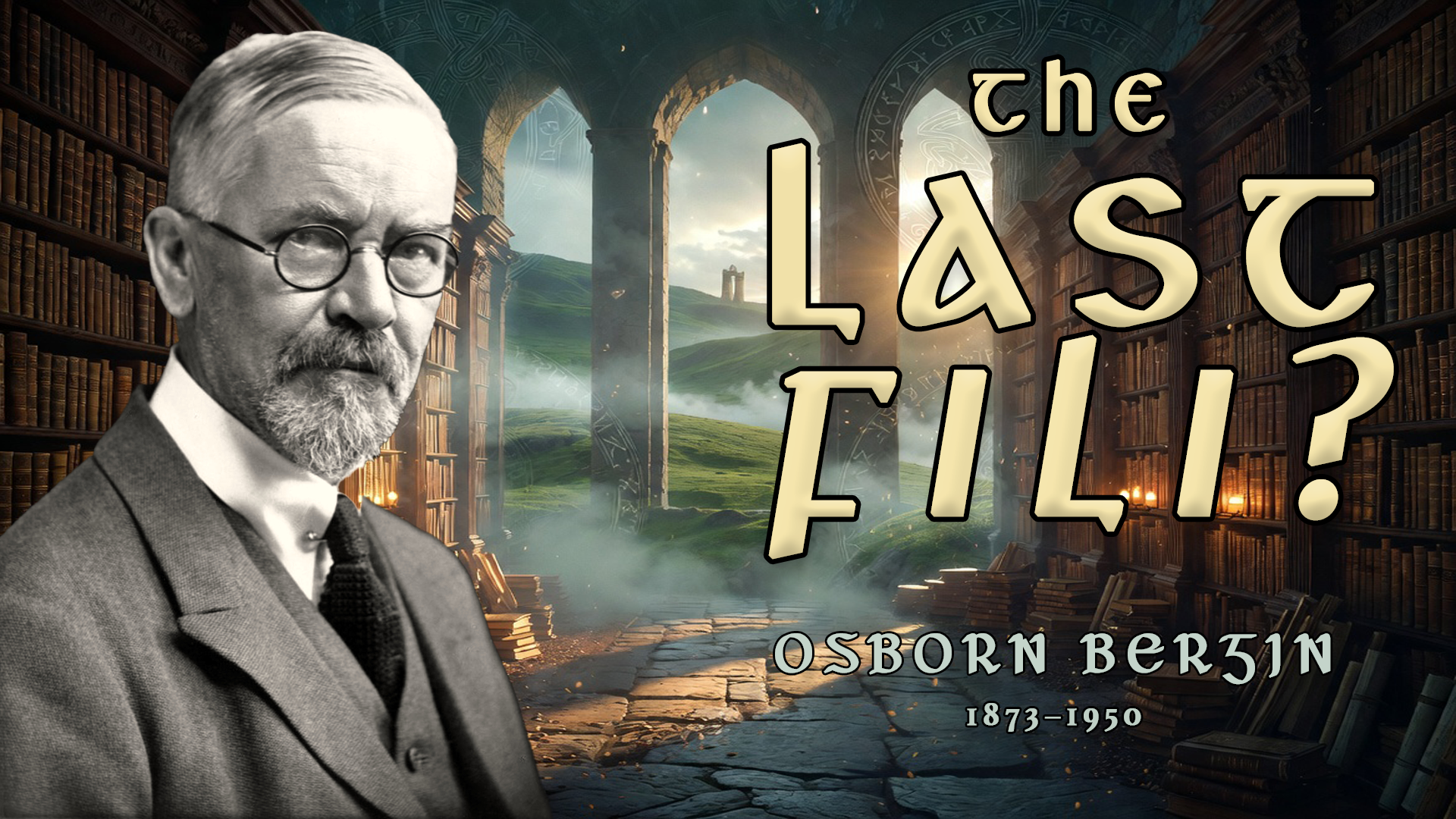
Osborn Joseph Bergin (1873–1950) was a towering figure in Celtic studies. Read on to learn more about this veritable master of the Irish language, in all its historical forms, a brilliant philologist, an exacting editor of manuscripts, and a dedicated teacher who helped shape the next generation of scholars, including Myles Dillon.
Early Life and Education
Born on 26 November 1873 in Cork city—the sixth child and eldest son of Osborn Roberts Bergin and Sarah Reddin—he grew up in a Protestant family (with Quaker connections and exposure to various denominations) that moved from Tobin Street to Westcourt on College Road.
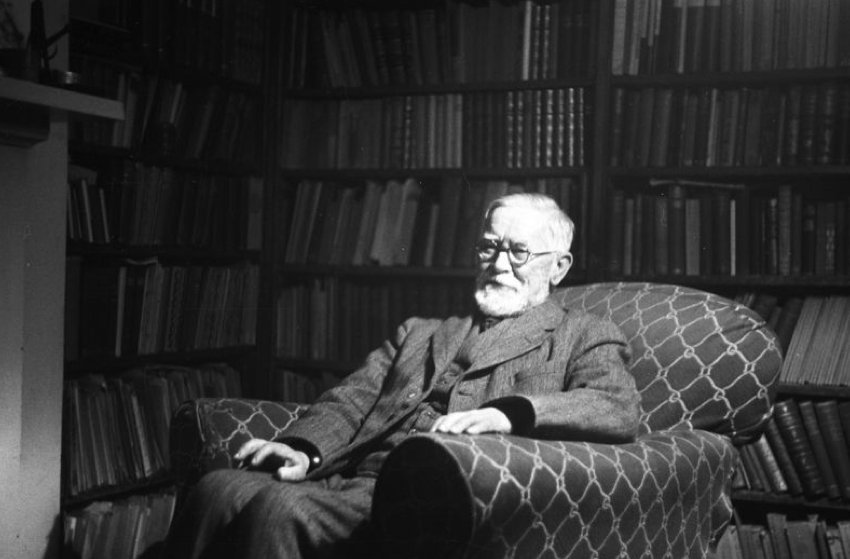
Bergin was educated at Cork Grammar School and Queen’s College Cork (now University College Cork), where he studied classics.
He quickly developed a deep interest in Irish, learning the spoken language of West Munster and becoming active in the Gaelic League (Conradh na Gaeilge).
By 1897, his proficiency was such that he was appointed lecturer in Celtic at Queen’s College Cork, a position created partly through Gaelic League advocacy.
Bergin pursued advanced studies in Germany, funded by a scholarship from the School of Irish Learning. He worked with Heinrich Zimmer in Berlin and Rudolf Thurneysen in Freiburg, earning his doctorate in 1906 with a dissertation on palatalisation in Irish.
This rigorous Germanic philological training complemented his native insight into Irish, making him one of the most precise scholars of his era.
He later held the Chair of Old and Middle Irish at University College Dublin (1909–1940) and briefly served as Director of the School of Celtic Studies at the Dublin Institute for Advanced Studies in 1940 before resigning (the reasons were never publicly explained).
Bergin published extensively in Ériu and other journals, producing editions, translations, and studies on metrics, poetry, glosses, and more. His work helped move Celtic studies from 19th-century romanticism toward a more scientific, text-critical discipline.
Bergin’s Law (aka Bergin’s Rule or Bergin’s Construction)
He is best remembered today for Bergin’s Law, a key principle of Old Irish syntax. In normal Old Irish word order (verb–subject–object), the verb typically heads the clause as part of a verbal complex.
Bergin identified this phenomenon in his seminal 1938 paper “On the syntax of the verb in Old Irish,” published in Ériu.
The law describes a non-standard word order where the finite verb appears late in the clause—often at or near the end—rather than in its usual initial position, and it takes its conjunct (dependent) form instead of the independent (absolute) form.
Under certain conditions, the verb could thus appear in its conjunct form at the end of the sentence. This construction is more common in poetic, legal, or archaic/gnomic texts and is thought to preserve older syntactic patterns (possibly reflecting archaic SOV or SVO residues before the full establishment of VSO order). His friend Frank O’Connor later quipped humorously that while Bergin discovered the law, “he never really believed in it.”
“Bergin” Derived from: Ó hAimhirgín — A Name from Myth
Bergin’s chosen Irish name was Osborn Ó hAimhirgín, translating to “Osborn, descendant of Aimhirgín.”
This directly links him to Amergin (Amhairghin Glúingel), the legendary bard and druid of the Milesians in the Lebor Gabála Érenn (Book of Invasions).
Upon landing in Ireland, Amergin sings the mystical “Song of Amergin,” one of the most powerful and enigmatic poems in early Irish literature, invoking the land, elements, and a deep sense of oneness with nature.
The name is often interpreted as meaning something like “born of song,” “wondrous birth,” or “marvellous progeny” (from elements suggesting amhra “wonderful” + gin “birth”).
The surname Ó hAimhirgín (anglicised as Bergin, with variants like Ó Beirgin or Ó Meirgin) originated with a Gaelic family from Offaly (King’s County), who were historically chiefs of the barony of Geashill.
Like many Irish surnames, it asserts a connection—literal, symbolic, or aspirational—to the ancient mythical figure.
The family spread into Laois (Leix) and surrounding Leinster areas over time.
A Beautiful Full Circle
There is something profoundly fitting about one of modern Ireland’s greatest scholars of the Irish language and literature bearing the name of Ireland’s archetypal mythical poet.
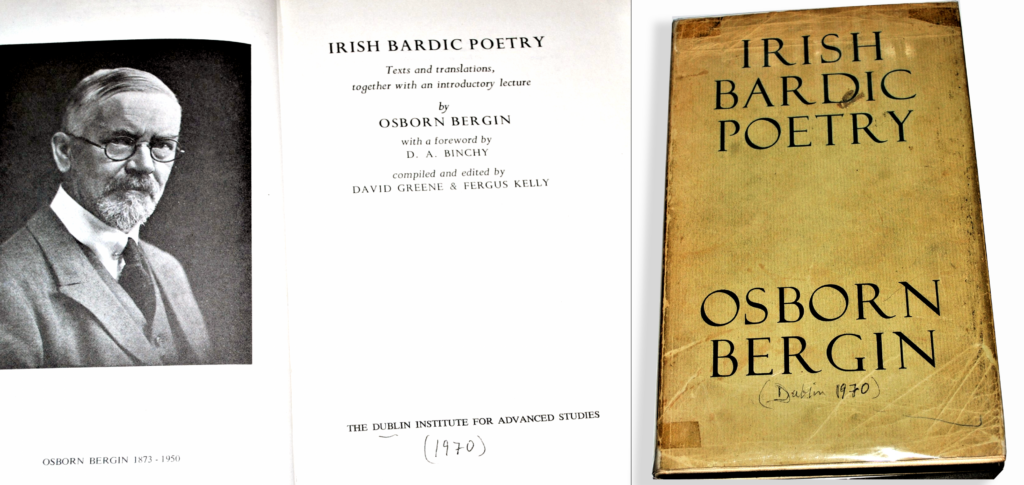
Osborn Ó hAimhirgín spent his life studying, editing, preserving, and teaching the very literary and linguistic tradition that Amergin is said to have inaugurated as the first fili (poet-seer) in the island.
Bergin embodied the role of a modern fili—a guardian and interpreter of the Irish tongue and its ancient wisdom.
He was known for his exacting standards, inspiring teaching, and deep knowledge spanning Old Irish to contemporary spoken dialects.
He wrote poetry in Irish himself and produced admired translations of Old Irish love poetry.
A lifelong nationalist without strong party ties, he had a sceptical or detached attitude toward institutional religion and rarely attended services.
Lesser-known details that add colour to his legacy:
- He feuded publicly with figures like George Moore and W.B. Yeats but maintained a warm, lifelong friendship with George William Russell (Æ). Frank O’Connor affectionately described Bergin’s eccentricities in his memoir My Father’s Son.
- Brian O’Nolan (Flann O’Brien/Myles na gCopaleen) celebrated him in the poem “Binchy and Bergin and Best,” poking gentle fun at the great trinity of Irish scholars.
- Upon his death on 6 October 1950 in a Dublin nursing home (he never married), Bergin left his substantial library—over 1,200 volumes, many annotated—to the Royal Irish Academy, along with personal papers. He is buried in St. Finbarr’s Cemetery, Cork.
- His lectures on Irish metrics produced valuable notes critiquing and expanding on Kuno Meyer’s Primer of Irish Metrics.
- He edited or contributed to major works like editions from the Book of Fermoy, studies on ogham inscriptions (e.g., Kilbonane), and textual emendations that refined understanding of tales like the Táin Bó Cúailnge.
Final Thoughts
Bergin’s insistence on precision helped professionalise the field at a time when romantic nationalism sometimes blurred lines with scholarship.
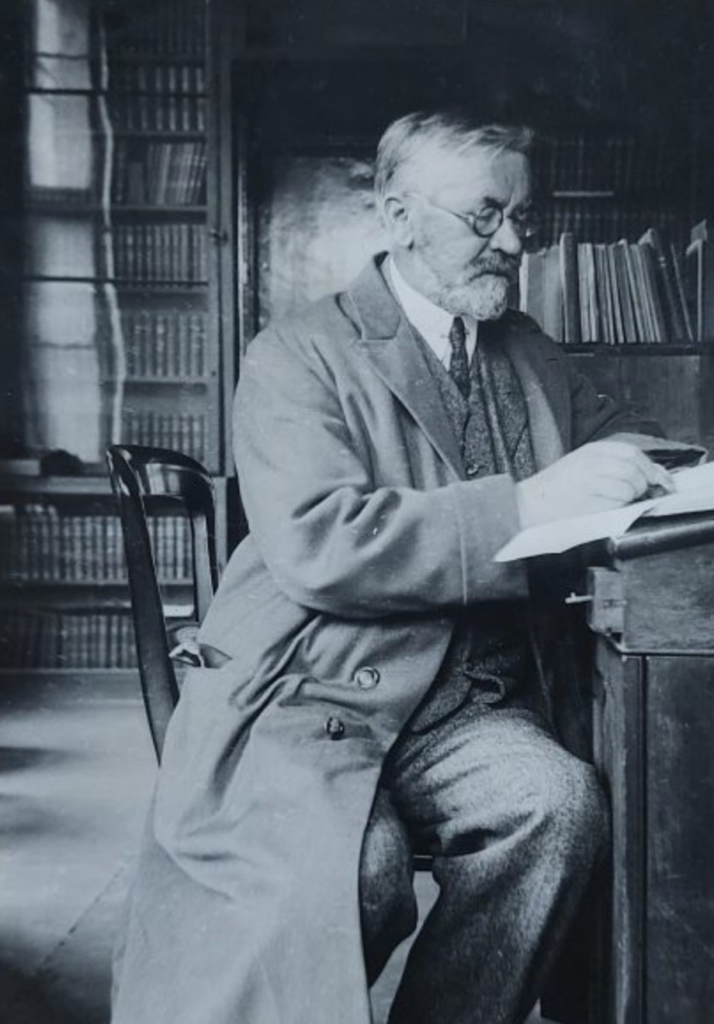
His German training and native fluency created a formidable combination that influenced scholars like Myles Dillon, who studied under him and was introduced to Sanskrit by Bergin, broadening comparative Indo-European perspectives.
In carrying both the scholarly torch and the mythic name, Osborn Bergin closed a poetic loop across more than two millennia of Irish cultural history—from druidic song on the shores of ancient Ireland to meticulous philology in the lecture halls of 20th-century Dublin.
Sources / Further Reading
- Wikipedia: Osborn Bergin (overview and references).
https://en.wikipedia.org/wiki/Osborn_Bergin - Dictionary of Irish Biography: Entry on Osborn Joseph Bergin.
https://www.dib.ie/biography/bergin-osborn-joseph-a0608 - Royal Irish Academy: The Library of Osborn Bergin, MRIA.
https://www.ria.ie/collections/printed-works/the-library-of-osborn-bergin/ - CELT (UCC): Select Bibliography of Osborn J. Bergin (comprehensive list of his publications).
https://celt.ucc.ie/berginbib.html - Frank O’Connor, My Father’s Son (memoir with personal anecdotes).
- D.A. Binchy, Osborn Bergin (UCD lecture, 1970).
- Gerard Murphy’s obituary in Studies (1950).
- Eleanor Knott’s obituary in Ériu (1952).
For primary engagement, explore his articles in Ériu, editions in Anecdota from Irish Manuscripts, and translations of early Irish verse. The RIA holds his library and papers for deeper research.