A guide to the principles of Ireland’s ancient legal tradition,
told through myth and legend.
The Demise of the Brehon Laws?
Sir John Davies wrote the following in a treatise in 1612 titled: A Discoverie of the True Causes Why Ireland Was Never Entirely Subdued [and] Brought Under Obedience of the Crowne of England:
“For there is no Nation of people under the sunne, that doth love equall and indifferent justice, better then the Irish; or will rest better satisfied with the execution thereof, although it be against themselves; so as they may have the protection and benefit of the Law, when upon iust cause they doe desire it.”
Fast-forward to the 1950s to RW Bentham, a barrister writing on the history of the Bench and Bar in Ireland. He outlines several anecdotes that highlight the drastic shift in attitudes of Irish people towards the laws.
In one such anecdote, Bentham recalls:
“[t]he Irish witness’ reply to Lord Justice Darling when the judge turned sternly to him and said: ‘Tell me, in your country, what happens to a witness who does not tell the truth?’ ‘Begor, me Lord,’ replied the Irishman, with a candour that disarmed all criticism, I think his side usually wins!’”
He then goes on to state:
“This Irish irreverence for law, however, does not stem from sympathy with crime, or wrongdoing in general, but rather from the fact that the Irish, who have a longish memory, are aware even now that the law in Ireland is not Irish law. However just it may be—and it was once most unjust—it does not command reverence as a native institution, but simply respect nowadays as an essential part of the machinery of government.”
What changed?
How did we evolve from a people Davies described as unique in our love for justice, even if the judgment was against ourselves, to a people who were irreverent towards the law?
Before there were established courts, prisons, or police forces, Ireland was governed by one of the most sophisticated legal systems the ancient world produced.
The Brehon Laws derive their name from the Gaelic word breitheamh, meaning “judge,” and are believed to have originated long before the Christianisation of Ireland, reaching their peak between the 7th and 8th centuries (at least that’s where the strongest manuscript evidence is to be found).
The laws were transmitted orally by the Brehons — professional jurists who held significant respect within the community.
These were not laws handed down from a monarch or a church.
The Brehon Laws covered nearly every aspect of life, from personal relationships to environmental stewardship, from sportsmanship to beekeeping.
At their heart was a radical idea: that justice should restore rather than punish.
Restitution rather than punishment was prescribed for wrongdoing, and capital punishment was not among the range of penalties available to the Brehons.
The basis of that society was the clan. The family being the unit meant that kinsmen were very much interested in what their kin were up to.
Honour was very, very important — and it was carefully measured and weighed up in all scenarios.
What makes the Brehon Laws so vivid is that their principles were taught through story.
And these stories were used as precedents.

Central to the Brehon tradition was the distinction between fír flathemain — the true judgment of a ruler — and gú flathemain — the false judgment.
A true judgment was one aligned with nature, equity, and the inherent order of things; a false one violated that order, however plausible it might appear on the surface.
This was not merely a philosophical distinction.
A king or Brehon who gave false judgment suffered real consequences: loss of honour, loss of status, and — in the deepest sense of Irish cosmological thinking — the withering of the land itself under his rule.
In addition to true judgement, the Brehon tradition rested on three interlocking foundations:
1. Poetic judgment — a true judgment had to be uttered in the form of verse. This was not ornament; poetry was understood as the language closest to truth, its discipline forcing precision of thought, and its rhythm allowing the law to be memorised, tested, and transmitted across generations.
2. Custom — the accumulated expectations and practices of the people themselves. The Brehon did not impose law from above but drew it up from below, recognising what the community already knew to be right.
3. Natural law — the observable principles of the living world.
The stories that follow are, at their heart, explorations of this ancient question:
What does a true judgment look like, and how do we know it when we hear it?
Each one is a legal case that highlights a different principle under the Brehon law — judgments handed down before history began and remembered ever since.
This video was delivered at the Clans of Ireland Cultural Summit 2026.
The Collar of Morann — The Living Lie Detector
Among the most celebrated Brehons in Irish tradition was Morann Mac Máin, Chief Ollam to the High King Feradach Finnfechtnach.
Morann would wear a Brehon sín — a collar or fetter — which was said to contract around his neck when he gave a false judgment, and would then only loosen once he made a just one.
This is more than a colourful legend.

The story of Morann’s collar articulates something the Brehon tradition held absolutely sacred: that the giving of a true judgment was a physical, moral, and almost sacred act.
A judge who spoke falsely was diminished — choked — by his own dishonesty. Only truth set him free.
The image of the tightening collar became a symbol of judicial integrity across the Irish legal tradition.
Brehons were liable for damages if their rulings were incorrect, illegal or unjust.
In a system with no police force and no prison, the reputation of the Brehon was everything.
A Brehon who gave false judgments lost standing — and with it, income, protection, and place in society.
How Setanta Became Cú Chulainn — The Law of Compensation and the Honour Price
The Principle: When harm is done, justice requires fair and proportionate restitution — not vengeance, but restoration.
Long before he became the great warrior of Ulster, the boy Setanta was known for two things above all others: his fearlessness and his skill with a hurling ball.
One day, the smith Culann invited the High King’s court to a feast at his forge.
The young Setanta, nephew of King Conchobar mac Nessa, was delayed by a game of hurling and arrived late — after the gates had been shut and Culann had released his enormous guard dog to prowl the grounds.
This was no ordinary hound.
Known as “The Dog of Four Doors,” it protected the dwelling house, the cow byre, the sheep fold, and the ox shed — a creature of immense value: guardian, property, and livelihood all in one (FYI, animals also had an honour-price under Brehon Law).
When the great dog came at Setanta from the darkness, snarling and lunging, the boy did not run. He drove his hurling ball with such force down the creature’s throat that it killed it stone dead.
The feast fell silent.
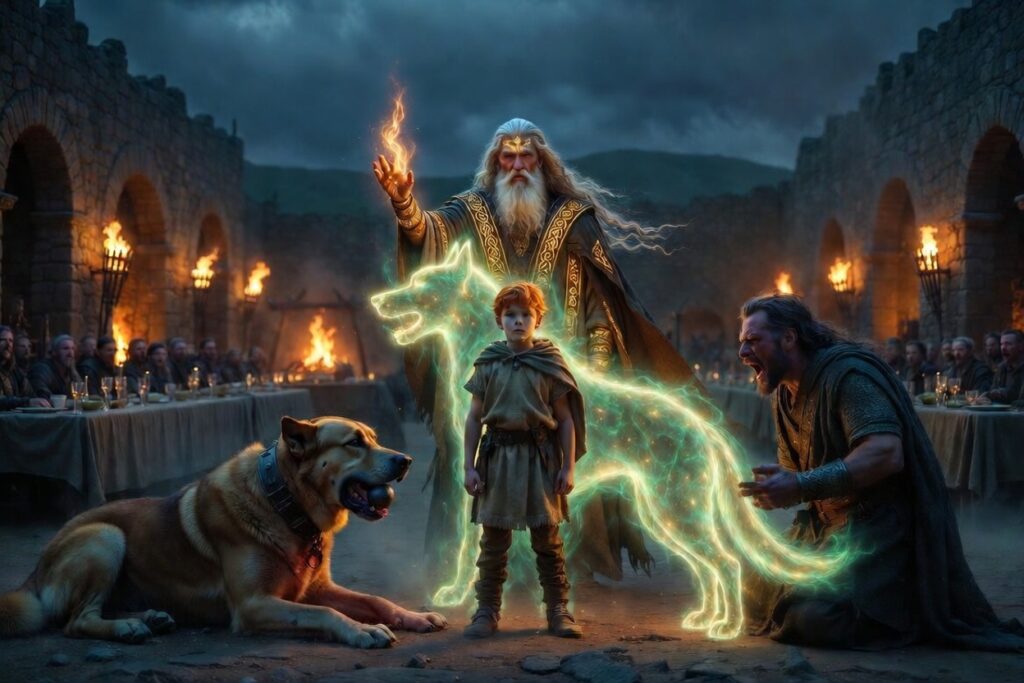
Culann emerged to find his precious guard dog dead, and grief and fury rose in him in equal measure.
He lamented:
“It is not good luck that you should come here this night, for now my hound is killed — my living will be torn asunder, my crops laid waste and my cattle stolen.”
In a different age — or a different country — this might have ended in blood.
But Setanta knew the law.
He offered full restitution in words that have never been forgotten:
“Do not be vexed on account of that, and I myself will make up to you for what I have done. If there is a whelp of the same breed to be had in Ireland, I will rear him and train him until he is as good a hound as the one killed; and until that time, Culann, I myself will be your watchdog, to guard your goods and your cattle and your house.”
The druid Cathbad, hearing this, declared:
“I could have given no better judgement myself. And from this out, your name will be Cuchulain — the Hound of Culann.”
Setanta accepted the name and carried it for the rest of his life.
This is not merely a charming origin story.
It is a precise illustration of the Brehon legal principle of éiric — the honour price or compensation paid for harm done.
Cú Chulainn did not merely apologise.
He offered his own body, his own time, his own labour as restitution — proportionate, restorative, and agreed upon by all parties.
Ancient Irish law viewed wrongdoing as a disruption of natural harmony; the offender’s duty was to restore the injured party as closely as possible to their prior state.
This principle is set out in detail in tracts such as the Senchas Már.
A boy who might have been branded an animal killer became a hero because he understood that true justice is not about punishment, but about making the injured party whole.
That principle was woven into every corner of Irish life.
The Curse of Macha — When the Powerful Fail the Vulnerable
The Curse of Macha is the hidden engine of the entire Ulster Cycle. When the goddess Macha, heavily pregnant, was forced by the king of Ulster to race against his horses simply to settle a boast, she won — and in winning, gave birth on the finish line, dying in the effort.
With her last breath, she laid a curse on the men of Ulster: that in their hour of greatest need, they would feel the pains of a woman in labour and be unable to fight.
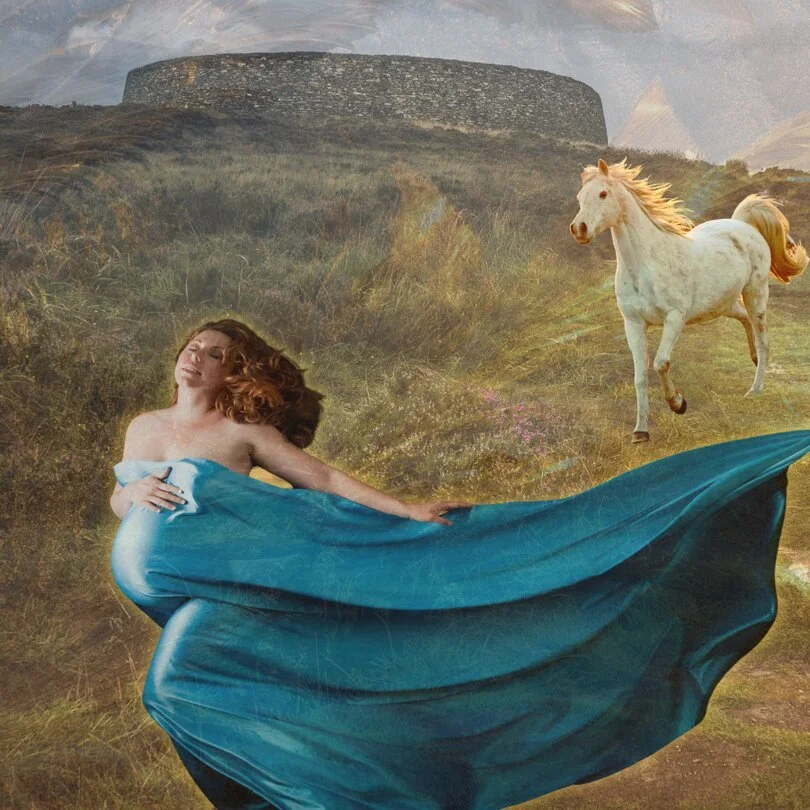
The curse held for generations (explaining why Cú Chulainn had to face the Maeve’s armies single-handedly, as he had not yet reached the age of maturity and was not considered a “man”).
From a Brehon perspective, the story encodes a principle of serious gravity:
There are categories of people — the sick, the pregnant, the very young, the very old — whom the law places under special protection.
Those without property couldn’t be expected to pay a debt.
Defendants could make pledges to delay judgment while they gathered evidence.
To exploit, humiliate, or endanger someone in a condition of vulnerability was not merely cruel — it was an offence that invited redress of the most severe kind.
The king of Ulster violated Macha’s dignity and her body.
The law could not reach back in time to remedy it.
But the myth ensured that everyone knew: there is always a reckoning.
The True Judgment of Cormac Mac Airt — Fír Flathemon (The Truth of the Ruler)
The Principle: A true king gives true judgment. A false judgment corrupts not just the court, but the land itself.
Cormac Mac Art was the greatest High King that Ireland had ever known, later credited with codifying the Brehon Law and with the Book of Aicill — a foundational text on compensation and justice.
But before he ever sat on the throne at Tara, he was a young man raised in secret, walking into the city for the first time, his only inheritance his father’s sword and his own sharp mind.
The reigning king was Lugaid Mac Con—a usurper who held power but not wisdom.
On the very day Cormac arrived at Tara, Lugaid was sitting in judgment on an important case.
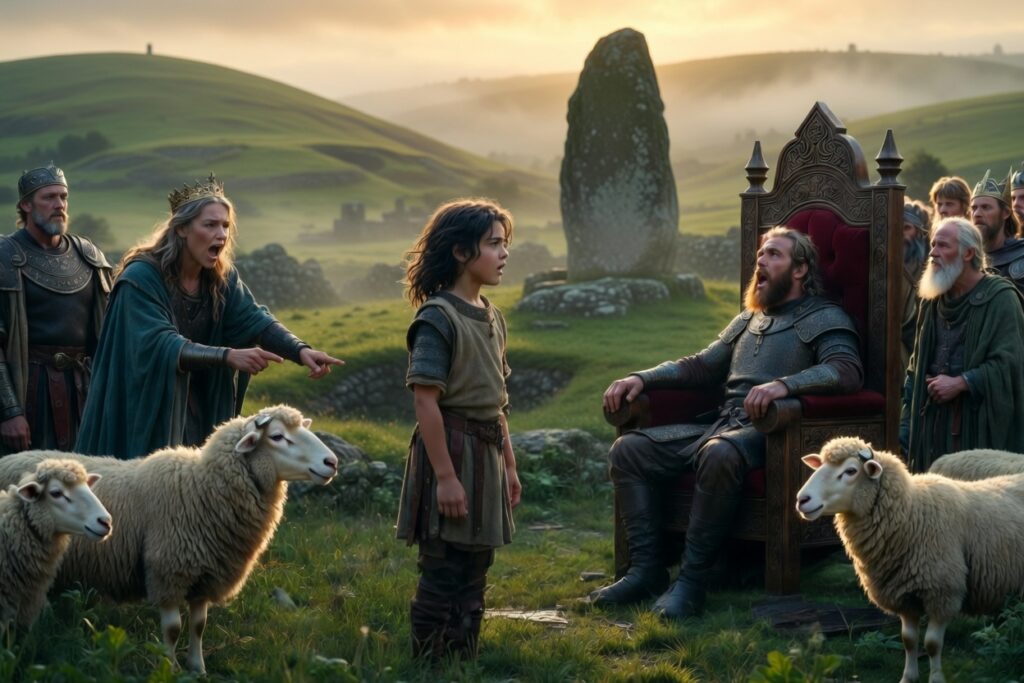
A woman named Benna, a shepherd, had allowed her sheep to stray into the queen’s woad garden, where they grazed the crop bare.
Woad — a plant used to make precious blue dye — was valuable, and the queen was furious.
Lugaid heard the evidence and ruled that the sheep themselves should be forfeited entirely to the queen as compensation.
A murmur went through the crowd.
Something felt wrong — but no one could say why.
Then a young stranger stepped forward.
“Nay, but let the wool of the sheep, when they are next shorn, be given to the Queen, for the woad will grow again and so shall the wool.”
The crowd erupted:
“A true judgment, a true judgment! A very king’s son is he that hath pronounced it.”
The logic was exquisite in its simplicity. The sheep had eaten the fleece — the growing, renewable surface — of the land.
Therefore, they owed their own growing, renewable surface in return.
A shearing for a shearing.
Like for like. No more, no less.
The judgment was proportionate, restorative, and sustainable — looking to future productivity rather than immediate seizure.
Lugaid, hearing the crowd’s verdict, conceded that Cormac’s judgment was superior to his own and abdicated the throne.
Cormac’s reign that followed brought legendary prosperity: the land itself, recognising its rightful lord,
“yielded harvests such as never were known, while the forest trees dripped with the abundance of honey and the lakes and rivers were alive with fish.”
This is fír flathemon in action— the truth of the ruler. It was justice that was alive, electric, and you could feel the fairness. This, I suspect, is what Davies was referring to in the opening quote above.
Proper judgment was held to be the most important duty on the shoulders of a king; to give a false judgment was as unacceptable as fleeing from battle, and would reduce a king to the status of a commoner.
Under a false king, the land withers.
Under a true one, it blooms.
Justice was not merely a legal formality — it was a cosmological force, one that could be felt as surely as the seasons.
The concept of “true” versus “false” judgment — breth fir — was central to the entire Brehon framework.
A true judgment was one aligned with the inherent principles of nature and fairness.
It is as though justice could be perceived as a real force in the world: one would know it when they saw it, and the land itself would confirm it.
The Battle of the Book — “To Every Cow Its Calf” c. 560 AD
The Principle: The creator retains ownership of what springs from their creation. Property rights are grounded in natural law.
But it also illustrates some of the shortcomings in the Brehon law, that it was not a panacea for all wrongs.
The year was around 560 AD.
Colmcille — later Saint Columba, one of Ireland’s great patron saints — was a young monk of fierce intelligence and burning ambition.
During a visit to St. Finnian of Movilla, he secretly copied Finnian’s precious Psalter of Jerome, known as the Cathach, by candlelight — letter by letter, night after night — until he had made a complete duplicate for himself.
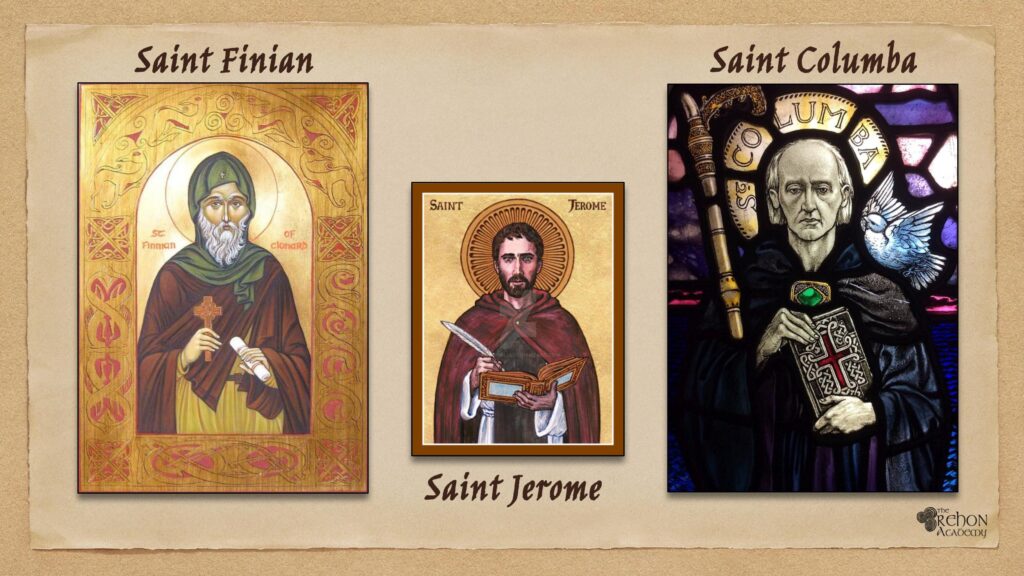
When Finnian discovered what had been done without his permission, he demanded the copy back.
Colmcille refused.
The matter was brought before the High King Diarmait Mac Cerbaill at Tara for judgment.
The king listened carefully to both sides.
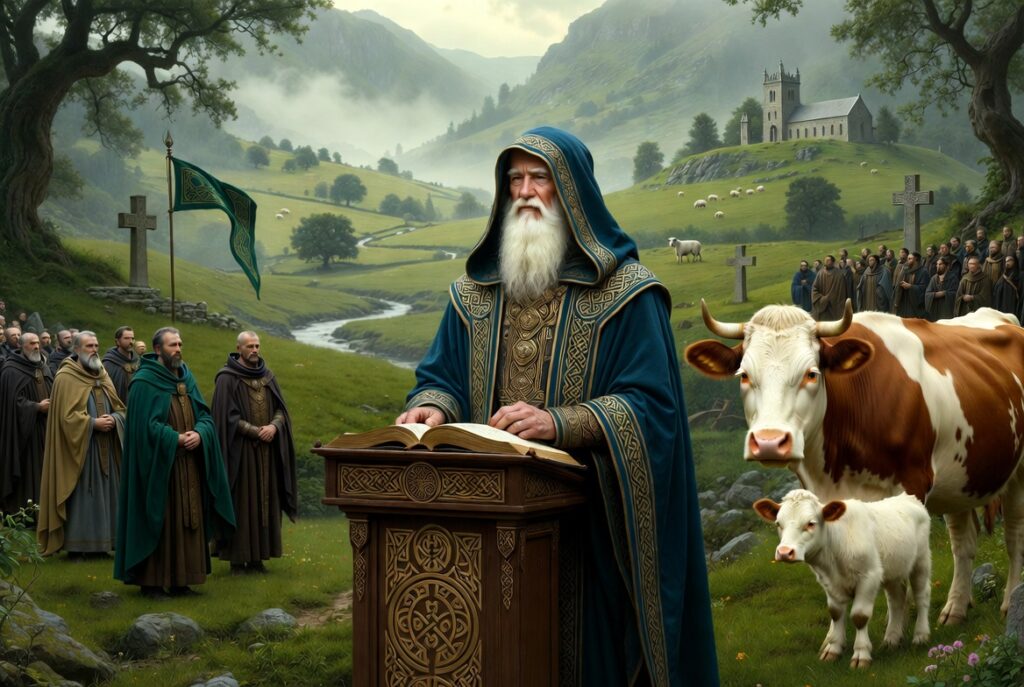
Then he delivered his verdict in words that have echoed across fifteen centuries:
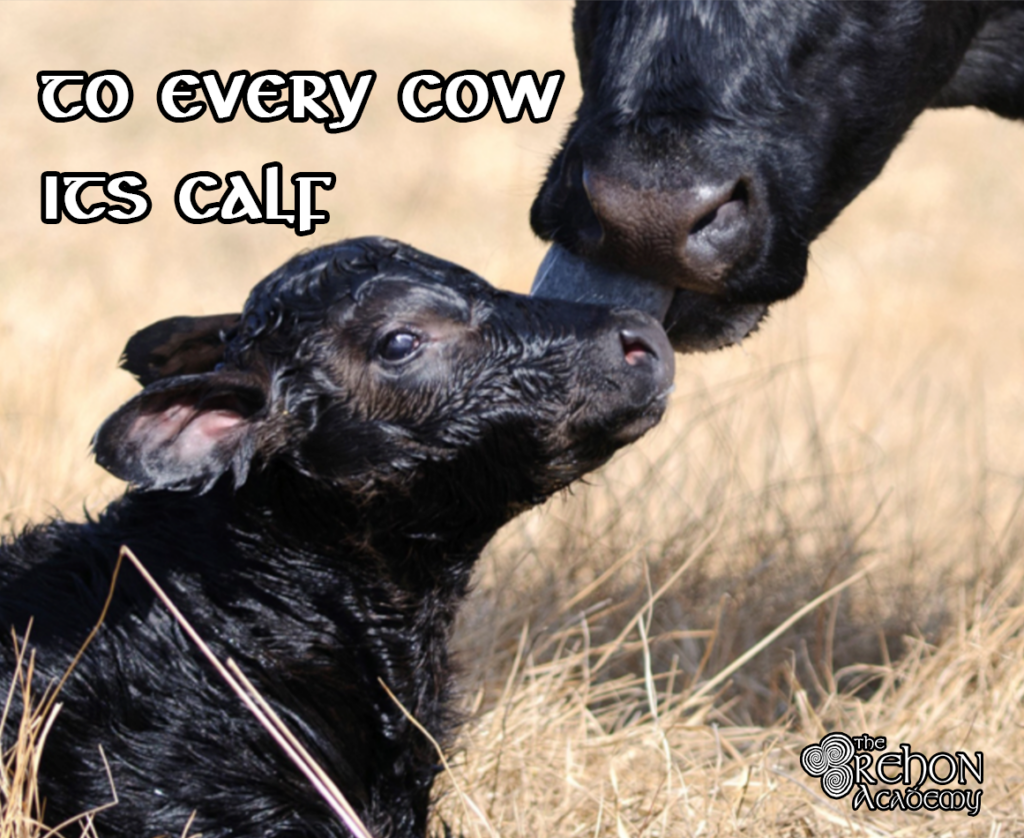
“To every cow belongs her calf — therefore to every book belongs its copy.”
As a cow gives birth, the calf belongs to the owner of the cow — not to whoever happened to be present at the birth.
As a book gives birth to a copy, the copy belongs to the owner of the book.
The offspring, whether material or intellectual, follows its source.
Ownership of the original extends naturally to its derivative — just as it always had with cattle, so now with manuscripts.
Colmcille was furious.
He refused to accept the judgment and rallied his clan, the Uí Néill, behind him.
The conflict escalated into the Battle of Cúl Dreimhne in 561 AD, in which thousands died.
Colmcille, overwhelmed by guilt at the carnage his pride had caused, accepted exile from Ireland as his penance — and sailed to Iona, where he founded one of the greatest monastic communities of the medieval world.
What makes this case so remarkable is not merely its outcome, but its method.
The Brehon legal tradition characteristically resolved new and unfamiliar disputes by reaching for analogies rooted in nature and in the rhythms of everyday life.
Cattle law was ancient, understood, and trusted. By applying it to a manuscript, King Diarmait did not invent a new principle — he recognised that an old one already covered the situation.
The psalter was the cow.
The copy was the calf.
The law had always known what to do.
This occurred around 560 AD, and is widely regarded as the earliest recorded judgment on intellectual property in the world, predating the development of English common law by over a millennium (it would be over 1100 years until it was codified in 1710 in the Statute of Anne). That statute created the first statutory copyright. It did not codify or “introduce” an existing common-law right; it created a new, time-limited public-law right.
Partholón and Delgnat — The First Judgment in Ireland
The Principle: No one may take justice into their own hands. Proportionality is the soul of the law — and women have standing before it.
This is the oldest legal story in Ireland, recorded in the Lebor Gabhála Érenn — the Book of the Taking of Ireland — and it begins with a betrayal.
Partholón, leader of Ireland’s second wave of settlers, left his wife Delgnat alone on their island off the coast of Donegal while he went to survey the land.
While away, Delgnat took up with the servant Topa, a lower-grade kinsman of Partholón’s household.
Adding insult to injury, the two drank from Partholón’s personal ale using his golden tube — an act of deliberate intimacy with his most prized possession.
When Partholón returned, parched from his journey, he placed the golden tube to his lips and instantly knew what had happened.
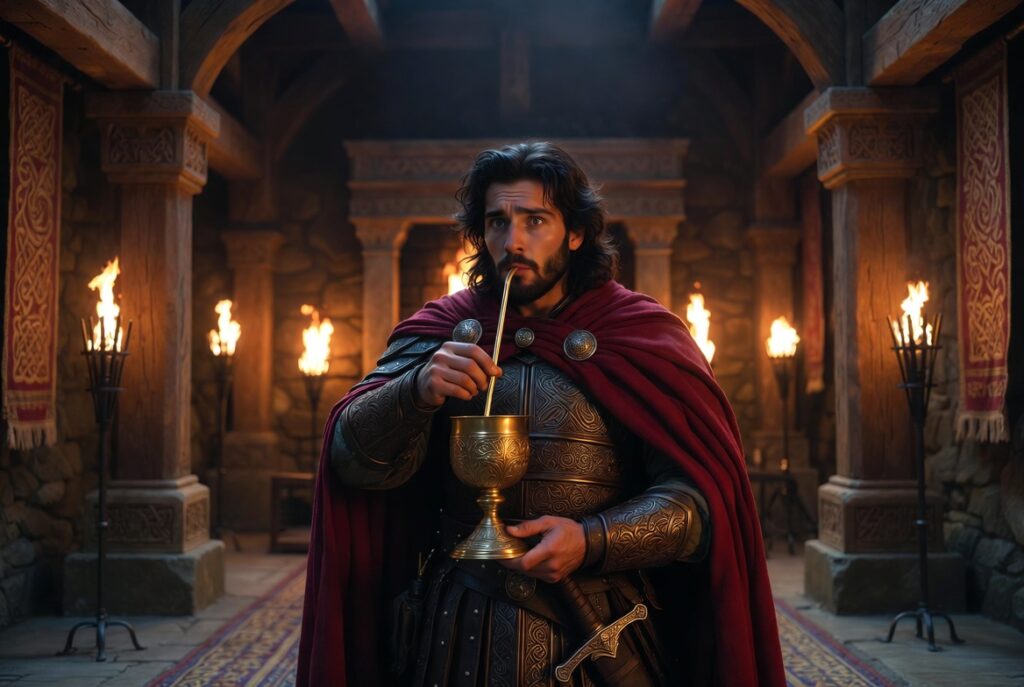
He did not summon a Brehon. He did not call witnesses. He drew his blade, cut the head from Topa, and then — in the full fury of his rage — killed Delgnat’s beloved hound, Saimer.
When the community learned what had happened, something remarkable occurred. They did not simply condemn the adultery. They examined the whole picture: the wrong Delgnat had done, and the far greater wrong Partholón had done in response.
Delgnat appeared before the Brehon and offered a defence that has never been forgotten.
She did not deny the affair.
Instead, she used her feminine guile to turn the case on its head, arguing that Partholón himself bore a share of responsibility.
Leaving a woman alone with a man, she said, was like:
Honey with a woman, milk with a cat,
food with one generous, meat with a child,
a wright within and an edge[d tool]
one before one, ’tis a great risk.’The woman will taste the thick honey,
the cat will drink the milk,
the generous will bestow the pure food,
the child will eat the meat.The wright will lay hold of a tool,
the one with the one will go together:
wherefore it is right to guard them
well from the beginning.— Lebor Gabhála Érenn §38
Difficult to argue that Partholón was not at least partly to blame…
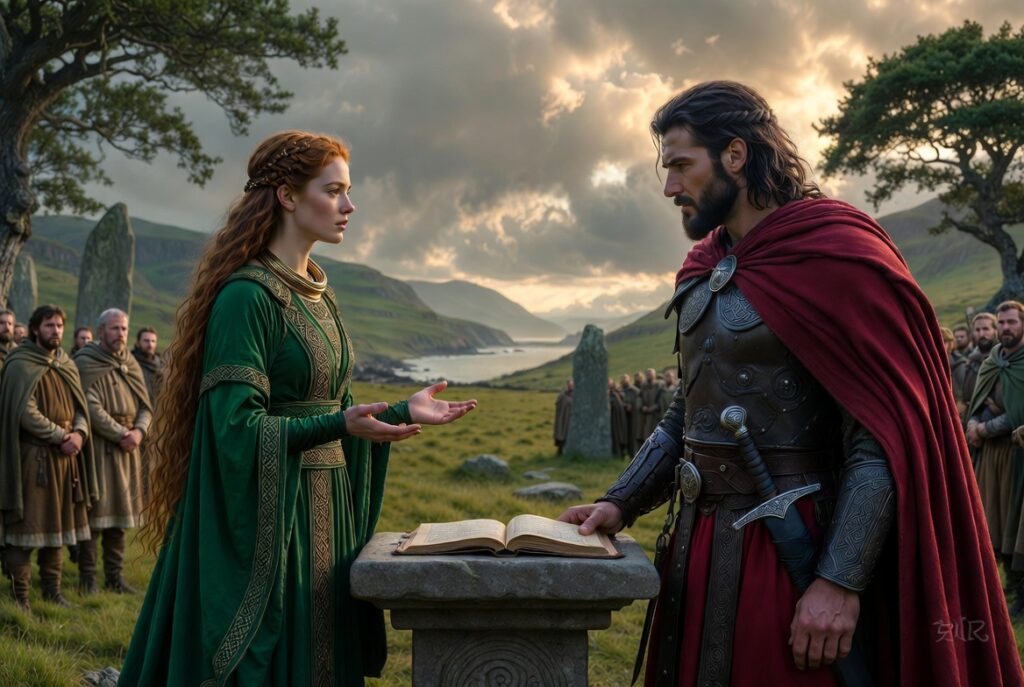
This was not mere audacity. It was a legally structured argument about culpability and the duty of care — the same logic a Brehon would apply to any case where one party had created the conditions for harm.
Delgnat was arguing that Partholón’s negligence diminished his moral standing to condemn her, and that his violent response had in any case vastly exceeded what justice permitted.
Killing Topa, in the heat of discovery, might be understood, if not a little heavy-handed.
Killing her dog Saimer was something else entirely — a gratuitous cruelty visited upon an innocent party, an act of pure vengeance that the law could not condone.
The Brehon agreed.
Partholón had taken justice into his own hands and committed an offence against his wife greater than the injury he had suffered.
The ancient text records the moment with quiet solemnity:
“And that, without deceit, is the first judgement in Ireland: so that thence, with very noble judgement, it is the right of his wife against Partholón.”
— Lebor Gabhála Érenn §38
Damages were awarded against the husband in favour of the wife — establishing, in the process, a legal precedent that would echo through Irish law for centuries.
As restitution, Delgnat was awarded the island on which the affair had taken place — formerly Partholón’s own fastness.
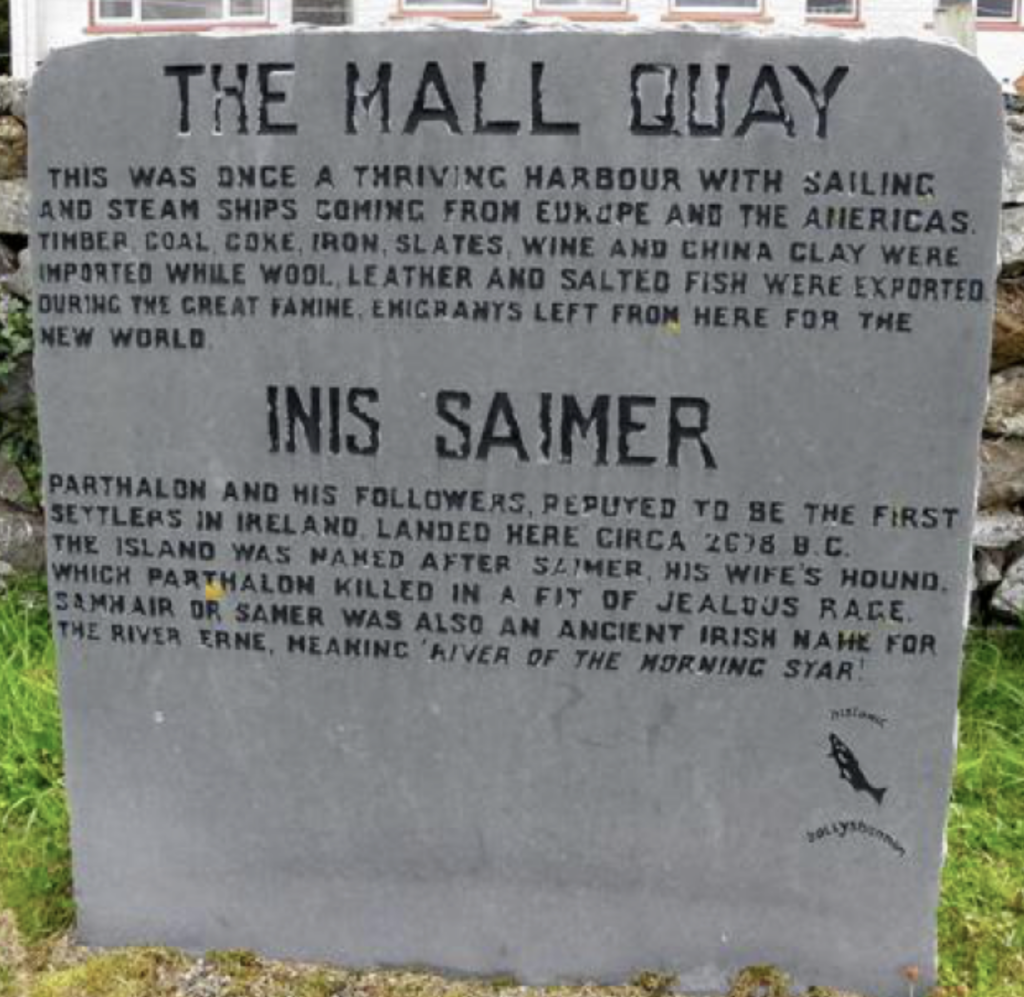
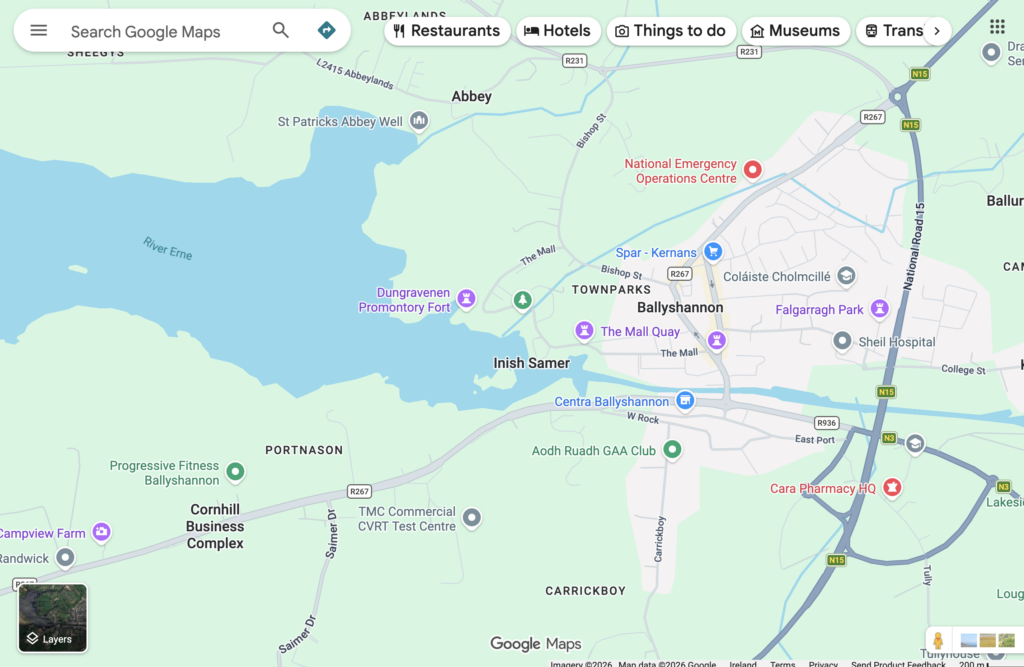
She renamed it Inis Saimer, in memory of her dog.
It bears that name to this day and can be visited off the coast of Ballyshannon, Co. Donegal.
This earliest recorded Irish judgment tells us several things at once:
- It tells us that a woman was a legal person — not property, not a chattel, but a party with full standing before the law, capable of bringing a claim and receiving restitution.
- It tells us that self-help vengeance was not permitted: a husband could not take unilateral violent revenge without becoming liable himself.
- It tells us that equity and proportionate remedies are applied regardless of who the wronged party is.
- And it tells us that the law was interested not merely in the act, but in the whole story — context, conditions, and the chain of responsibility that led to harm.
Although Irish society under the Brehon Laws was male-dominated, women had greater freedom, legal standing, and rights to property than in any other European society of the time.
The story of Delgnat is, perhaps, the clearest single window into why.
Queen Medb and the Opening of the Táin — The Law of Equal Marriage
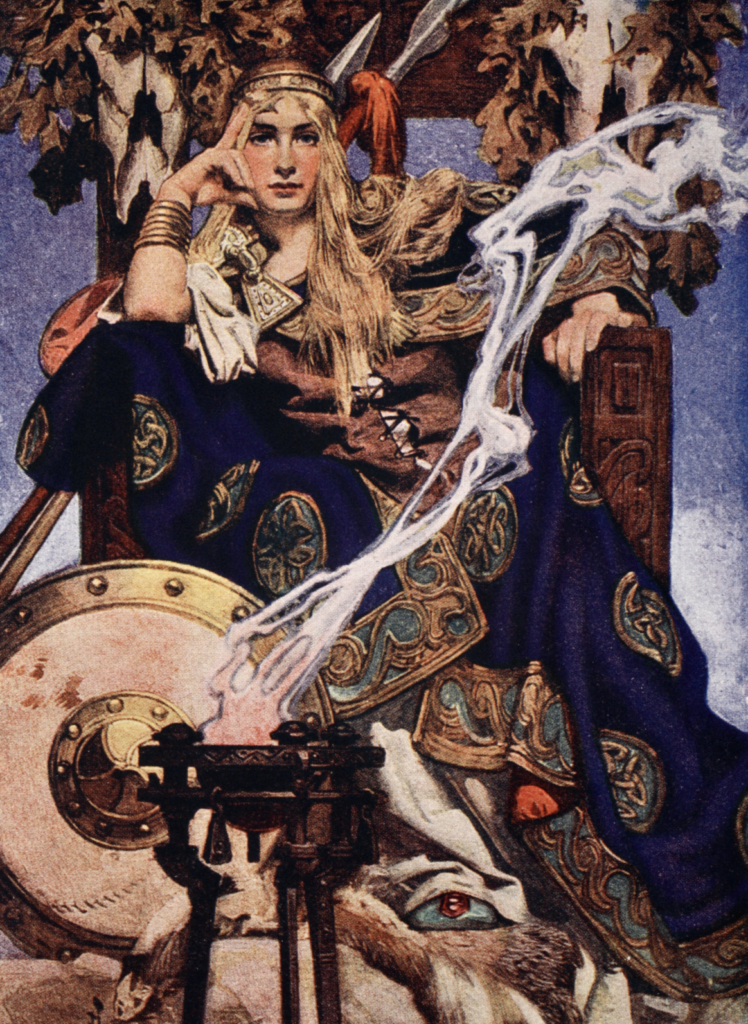
The great epic Táin Bó Cúailnge—the Cattle Raid of Cooley—opens not with battle, but with a property dispute between husband and wife.
In the opening scene, Queen Medb (Maeve or Maev) sought to equal her husband Ailill’s wealth. After they had measured each of their possessions, Medb was found to be lacking as she had no possession that could match Ailill’s white-horned bull, Finnbennach.
This scene exists because it was legally meaningful.
Medb’s condition of marriage — the basis on which she had agreed to wed — was that her husband could not outrank her in wealth.
Medb says to Ailill:
“I gave you a contract and a bride-price as befits a woman… whoever brings shame and annoyance and confusion on you, you have no claim for compensation or for honour-price for it except what claim I have — for you are a man dependent on a woman’s marriage-portion.”
The whole war — the armies mustered, the single combat of Cú Chulainn, the death of thousands — is framed as the consequence of a broken marital contract.
Medb cannot allow the imbalance to stand because the law does not allow it to stand.
The marriage laws were very complex.
There were scores of ways of combining households and properties, and divorce was provided for on a number of grounds, after which property was divided according to what contribution each spouse had made to the household. (Many grounds for divorce, and, yes, wives could divorce their husbands – imagine the thought?!)
Medb is not presented as a sympathetic heroine.
The monks who transcribed the tale made sure of that.
But the legal structure beneath her actions is sound: she is a contracting party enforcing the terms of an agreement.
That is Brehon law in action, dressed in the clothing of myth.
Conclusion: The Living Law
These stories illustrate how the Brehon tradition was grounded in what nature itself demonstrates:
A calf belongs to the cow that bore it; a fleece grows back as a crop grows back; women should not be treated differently.
Justice was not an abstraction imposed on the world — it was the world’s own logic, carefully read and faithfully applied.
What was lost when the Brehon Laws ended was not merely a legal code. It was an entire philosophy of justice — one built on community, restoration, and the idea that every person, regardless of rank or gender, had a recognised place within the law.
What makes these stories so enduring is not just their legal content, but their moral imagination. They do not present law as a cage or a weapon.
They present it as a mirror — a way of seeing human situations clearly, of asking what is fair, what is proportionate, what truth looks like when you hold it up to the light of nature.
The boy who kills a dog and offers his life as a replacement. The king whose false judgment causes the earth itself to rebel. The saint whose pride over a book sends thousands to their deaths. The wife who stands before a court and argues that the trap was laid before she fell into it.
These are not just Irish stories. They are timeless tales about what it means to live together, the human condition — and, most importantly, what we owe each other when things go wrong.
The ancient Irish had an unusually progressive, forward-thinking legal system, far ahead of its time, and one we can learn from even today — the Brehon Laws balanced the honour/shame culture of the time with legal restitution and restoration, to create a society that managed to survive free from any of our modern law enforcement or penal institutions.
Once I first learned about these Brehon laws, I was hooked. Because far from being an insignificant part of our past, these laws are, were and irrebuttable witness to our character, and make the very core of our identity.
And, when I realised that few people understand much, if anything, about these ancient laws, I resolved to do something about it, and I established the Brehon Academy in 2013 after graduating from Law School.
Now, while I don’t like to admit it, I can see how Sir John Davies was right when he said:
There is no Nation of people under the sun, that doth love equal and indifferent justice, better then the Irish…
My work with the Brehon Academy seeks to restore and revive an awareness of this often overlooked aspect of our ancient heritage.
Source texts referenced:
1. Lebor Gabhála Érenn (Book of the Taking of Ireland)
- Internet Archive — Macalister’s 5-volume edition (Irish Texts Society, 1932–1942): Vol. 1 | Vol. 2
- Ancient Texts — English translation (first redaction, Book of Leinster): ancienttexts.org
- UT Austin — Lesson text with commentary: lrc.la.utexas.edu
- CODECS — Full scholarly bibliography: codecs.vanhamel.nl
2. Táin Bó Cúailnge (The Cattle Raid of Cooley)
- York University — Faraday’s English translation (PDF), based on the Windisch 1905 edition: yorku.ca
- Project Gutenberg — Full text of the O’Rahilly translation: gutenberg.org
- CELT / UCC — Medieval Irish text with Modern Irish and English translation: iso.ucc.ie
- Internet Archive — Ciarán Carson’s 2007 Penguin translation: archive.org
- CODECS — Comprehensive scholarly overview and bibliography: codecs.vanhamel.nl
3. The Senchas Már
The Senchas Már is not freely available online as a standalone text (Binchy’s Corpus Iuris Hibernici is its authoritative edition — see item 7 below).
- Internet Archive — Ancient Laws of Ireland (6 vols., 1865–1901): Vol. 1–3 cover the Senchas Már, with Irish text and English translation on facing pages. archive.org
- Wikipedia — Overview and manuscript tradition: en.wikipedia.org
- CODECS — Scholarly index of Senchas Már tracts: codecs.vanhamel.nl
4. The Book of Aicill
- Internet Archive — Ancient Laws of Ireland, Vol. 3: the Book of Aicill appears here alongside the Corus Bescha. archive.org (select Vol. 3 from the series)
- Library Ireland — Readable excerpt with commentary (Ginnell, The Brehon Laws, 1894): libraryireland.com
- Brehon Academy — Background article: brehonacademy.org
5. Teagasc an Riogh (The Instructions of Cormac)
- CELT / UCC — Irish text (Kuno Meyer’s edition, 1909): celt.ucc.ie
- Internet Archive — Meyer’s full edition & English translation (Todd Lecture Series 15, 1909): search archive.org
- Ancient Texts — Selection from Meyer’s translation: ancienttexts.org
- CODECS — Scholarly entry: codecs.vanhamel.nl
6. Ulster Cycle Mythological Tales
- CELT / UCC — The primary repository for Ulster Cycle texts in Irish and English translation: celt.ucc.ie (search for individual tales)
- Ancient Texts — Index of Ulster Cycle tales with links: ancienttexts.org
- Ulster Cycle blog — Translations and links to many individual tales: ulstercycle.wordpress.com
- Wikipedia — Full list of Ulster Cycle texts: en.wikipedia.org
7. D.A. Binchy — Corpus Iuris Hibernici
The Corpus Iuris Hibernici (CIH) is a six-volume collection of early Irish law texts edited by Binchy, presenting transcriptions of Old Irish and Latin manuscripts, published by the Dublin Institute for Advanced Studies in 1978. It is not freely available online in full, but:
- DIAS Shop — Official publisher page (for purchase): shop.dias.ie
- CODECS — Scholarly entry with volume-by-volume detail: codecs.vanhamel.nl
- Open Library — Catalogue record: openlibrary.org
- Brehon Academy — Accessible overview of the work: brehonacademy.org