Long before modern contract law, before the Anglo-Norman invasions rewrote Ireland’s social fabric, and centuries before the Church imposed its singular vision of marriage across the land, the early Irish had developed one of the most nuanced legal frameworks for human relationships in the ancient world.
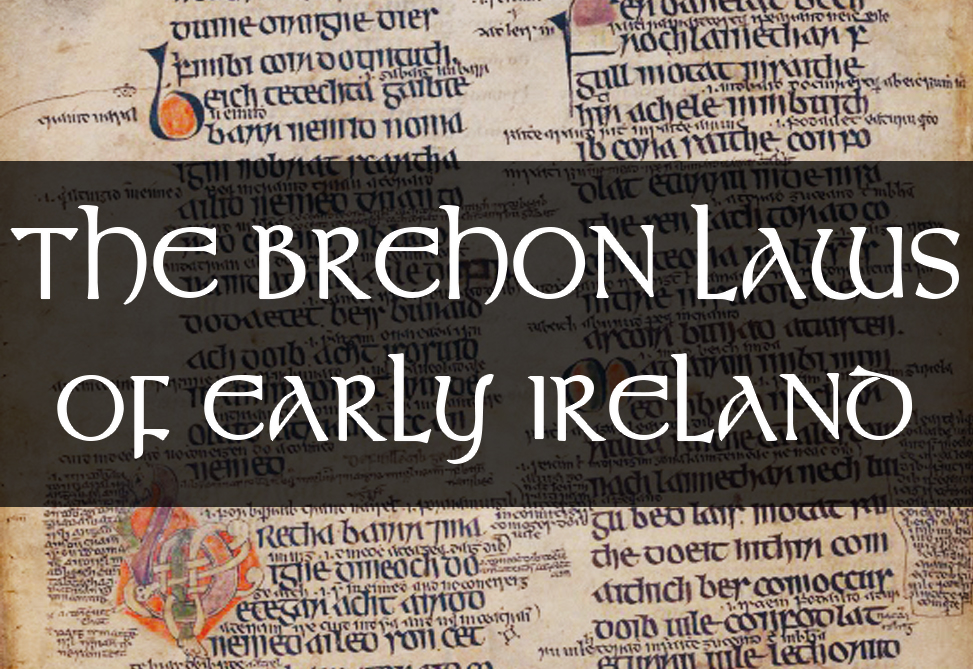
The Brehon Laws, that remarkable body of Gaelic jurisprudence maintained by a professional class of jurists called the Brehons, recognised no fewer than nine distinct categories of marriage union. Each carried its own rights, obligations, and protections.
The status of women within these unions was, by the standards of contemporary European societies, startlingly progressive:
- A woman could own property.
- She could initiate divorce.
- She was entitled to compensation if her husband was unfaithful.
In a world where most legal systems treated women as chattels, early Irish law saw them as persons with standing.
What’s striking about this, reading it now, isn’t just the sophistication of the legal architecture. It’s the underlying premise. The Brehon Laws built their framework for relationships around something much more durable than romantic feelings or social conventions.
They built it around obligation, community, and shared identity. A union under Brehon Law wasn’t primarily a private arrangement between two individuals. It was a social contract embedded in the wider fabric of the túath, the local kingdom and kin-group that formed the basic unit of early Irish society.
The community had a stake in it. The family had a stake in it. And the values that shaped the union were held in common by everyone involved.
The Wisdom in That Approach
There’s a reason this framework lasted for over a thousand years. It wasn’t because it was rigid; if anything, the Brehon Laws were remarkably flexible and practical in their recognition of different kinds of human arrangement. It lasted because it understood something that modern approaches to relationships have largely lost: that the most durable bonds are those rooted in shared identity and mutual obligation, not just mutual attraction.
Contemporary research bears this out, even if it arrives at the conclusion by a different route. Couples who share deep values, a common worldview, a fundamental alignment in how they understand their obligations to each other and to the world around them, consistently report higher long-term relationship satisfaction than those who don’t. The surface-level compatibility that dominates how most people approach finding a partner, shared interests, physical attraction, proximity, turns out to be a poor predictor of what actually holds two people together through the difficulty of a shared life.
The early Irish Brehons understood this intuitively. The modern world is only slowly rediscovering it.
Finding Your People in the Digital Age
One of the interesting developments in contemporary relationship culture is the growth of platforms that have taken this same principle seriously.
SALT is a Christian dating app built and run by a small Christian team, and it’s one of the more thoughtful examples of what it looks like when a platform is designed around shared identity rather than shared proximity. Available in 50 countries and translated into 20 languages, it serves millions of users worldwide, with a core demographic in the 25 to 35 age range.
Rather than leading with the photo-and-location defaults that dominate mainstream apps, it uses values-based filtering and profile badges so that what someone believes and how they live is visible from the start.
Users send an intro message before any match is confirmed, and in-app video calling and voice notes allow genuine familiarity to develop before meeting.
Human moderation, selfie verification, and fraud detection make it a trustworthy environment.
It’s been covered by the BBC, Vogue, and GQ, and its success stories include couples who found each other across different continents through shared faith.
For Christians who take their beliefs seriously, it functions rather like the túath did in a different context: a defined community with shared values, within which authentic connection becomes not just possible but natural.
What the Ancestors Knew
The hedge schools that kept Irish language, culture, and learning alive through the Penal Laws did so not because they had superior resources, but because they understood what was worth preserving.
They knew that a people’s identity, their laws, their stories, their way of understanding the world, was the thing that held communities together through every kind of adversity.
The same is true of relationships.
Strip away the shared identity, the common framework, the sense of belonging to something larger than the two of you, and what remains is thinner than it looks. The Brehon Laws knew this.
The Irish diaspora communities who’ve kept their heritage alive across generations know it. And the couples who build their relationships on something deeper than circumstance tend to discover it too, usually in the moments when everything else is being tested.
The ancient Irish didn’t have a word for swiping right. But they understood, with remarkable clarity, what made a union worth entering and worth keeping.
Some things don’t change much.