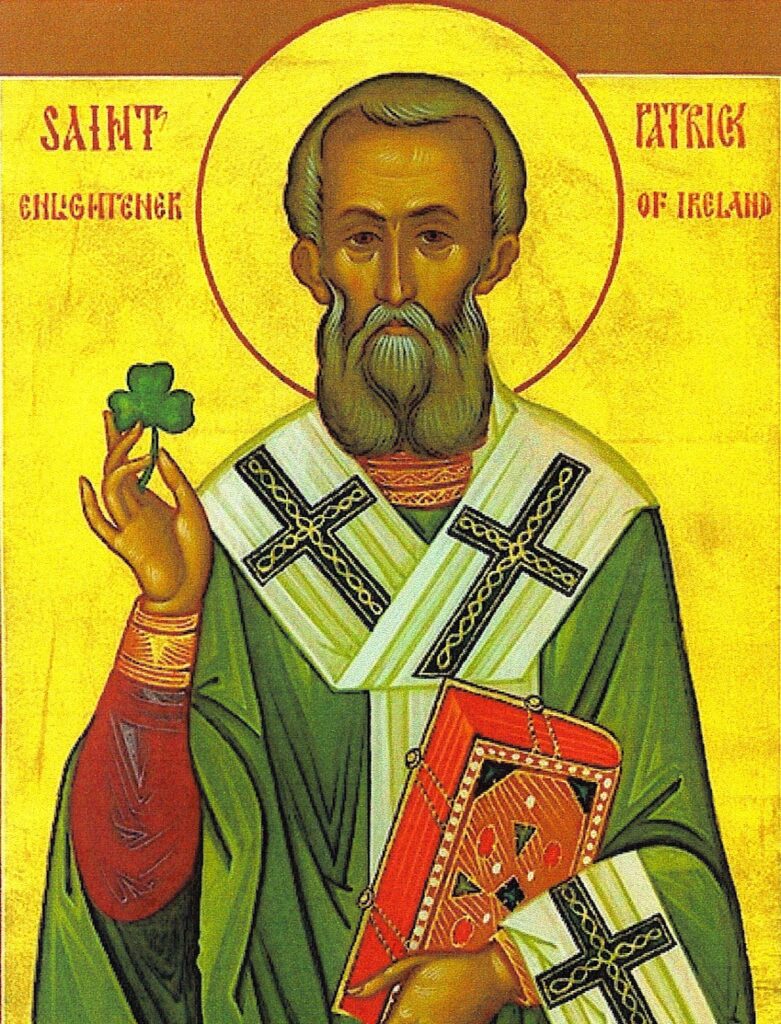
When Saint Patrick arrived on Irish shores in the fifth century, he did not come as a conqueror. He came, famously, as a former slave who knew the land and its people intimately.
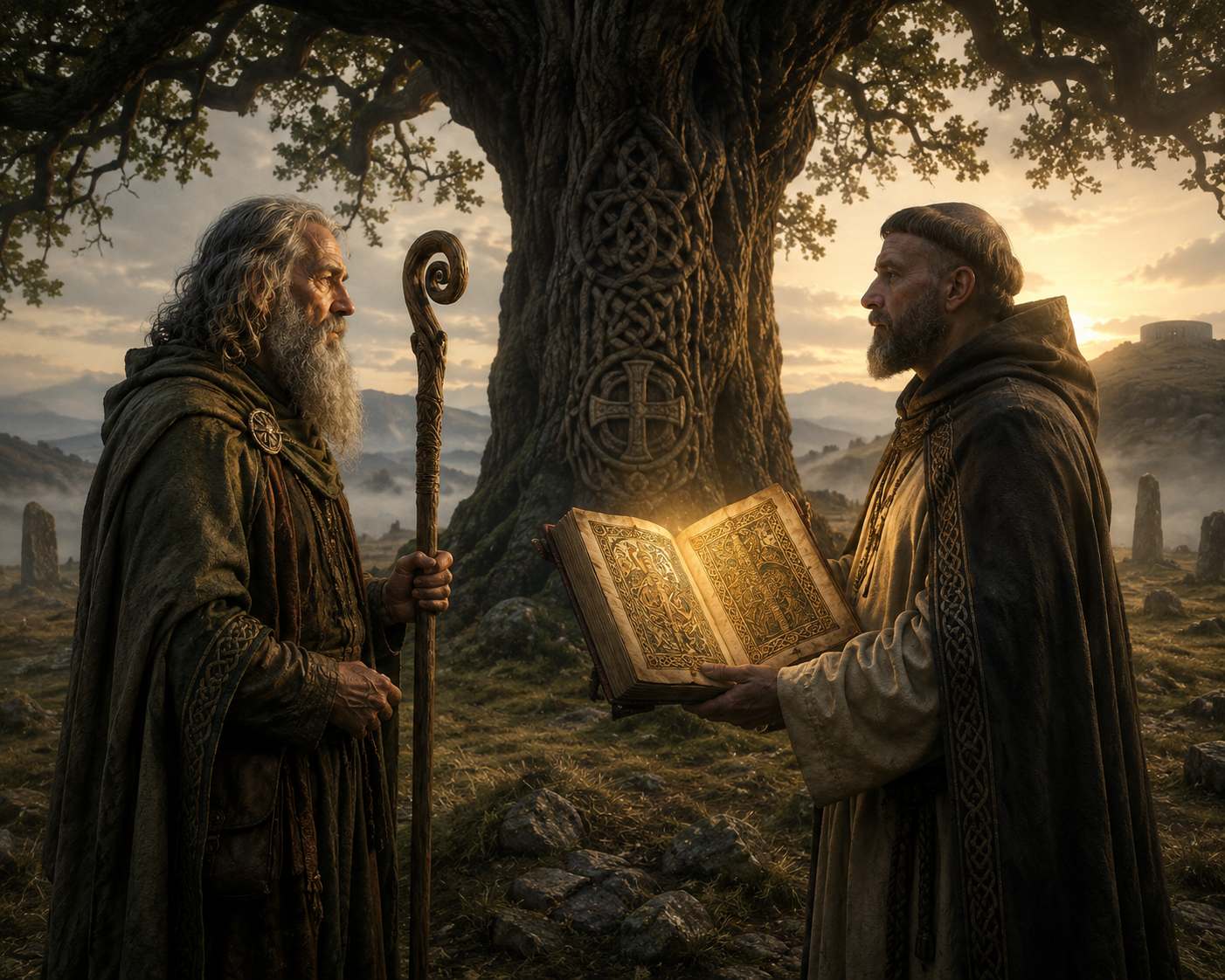
What followed was one of the most remarkable religious transitions in European history — not a violent purge of the old ways, but a slow, organic braiding of Christian Gospel with the deep roots of druidic nature-reverence.
The evidence survives in ink and vellum, wound into the very letters of the most extraordinary manuscripts the medieval world ever produced.
To understand this merger, you must first understand what the druids were.
Far from the caricature of robed figures dancing around standing stones, the druids were Ireland’s intellectual class — poets, judges, astronomers, healers, musicians, and keepers of an elaborate oral tradition stretching back millennia.
They saw the divine embedded in the natural world: in the flight of a raven, in the gnarled patience of an oak, in the serpent that shed its skin and was reborn.
The sacred was not separate from creation.
It was creation.
A Conversion Without the Sword
Perhaps the most striking aspect of Ireland’s Christianisation is how little blood was spilt.
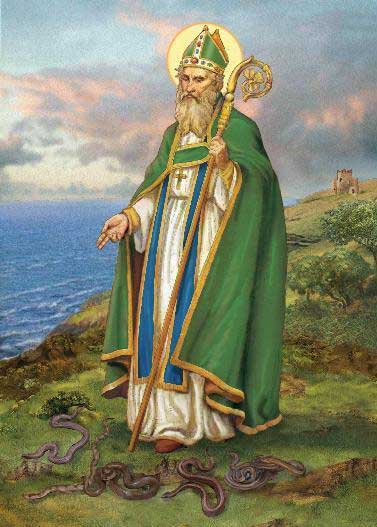
Banishing the “Snakes” from Ireland
Unlike the forced conversions that swept through much of continental Europe under Charlemagne and others, Ireland’s transformation was largely peaceful.
Ancient sources suggest that many druids — already accustomed to concepts of spiritual power, sacred learning, and the otherworld — found Patrick’s teachings philosophically resonant rather than alien.
Some accounts describe Patrick engaging in theological debate with druidic scholars at the court of the High King Lóegaire, winning converts through persuasion rather than coercion.
Patrick was offering one set of mysteries in exchange for another
— and the druids, already fluent in mystery, did not find the exchange difficult.
The Irish church that emerged was famously decentralised and unorthodox by Roman standards — monastic rather than episcopal, profoundly literary, and deeply comfortable with the natural world as a site of revelation.
This was no accident.
The monasteries became the new druidic schools, their abbots wielding a social power not unlike the fili (poet-priests) of old.
The druids did not so much disappear as put on a new habit.
The Animals in the Margins
Open the Book of Kells — that miraculous object created around 800 CE began its journey on the island of Iona off the western coast of Scotland and matured in a monastery at Kells, Co. Meath — and within moments you will encounter something utterly unlike any biblical manuscript produced on the Continent.
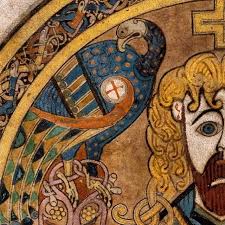
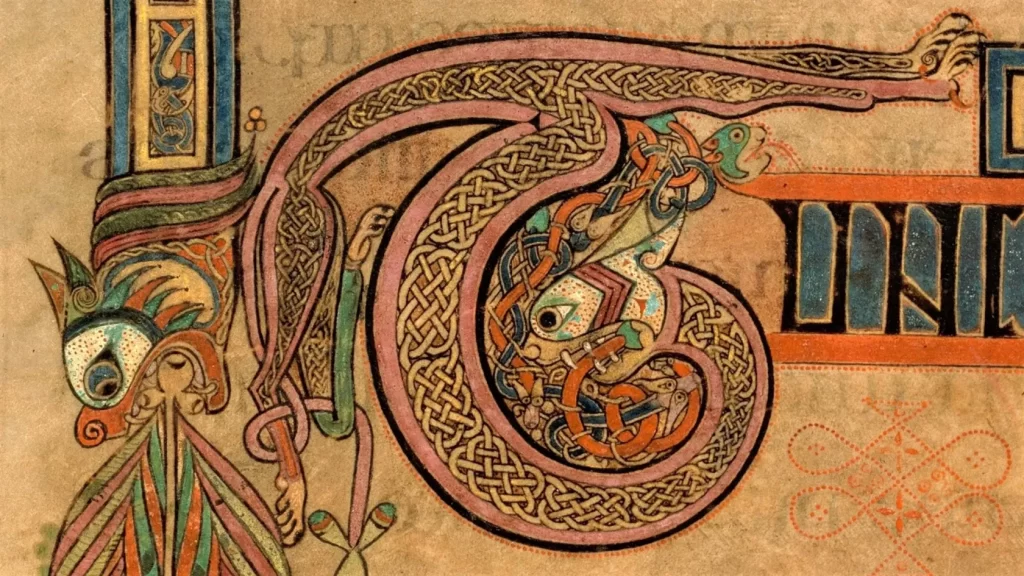
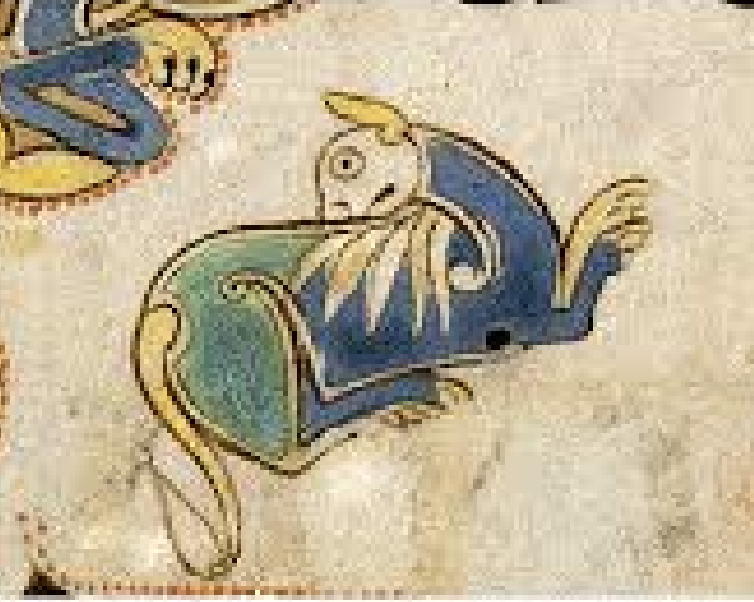
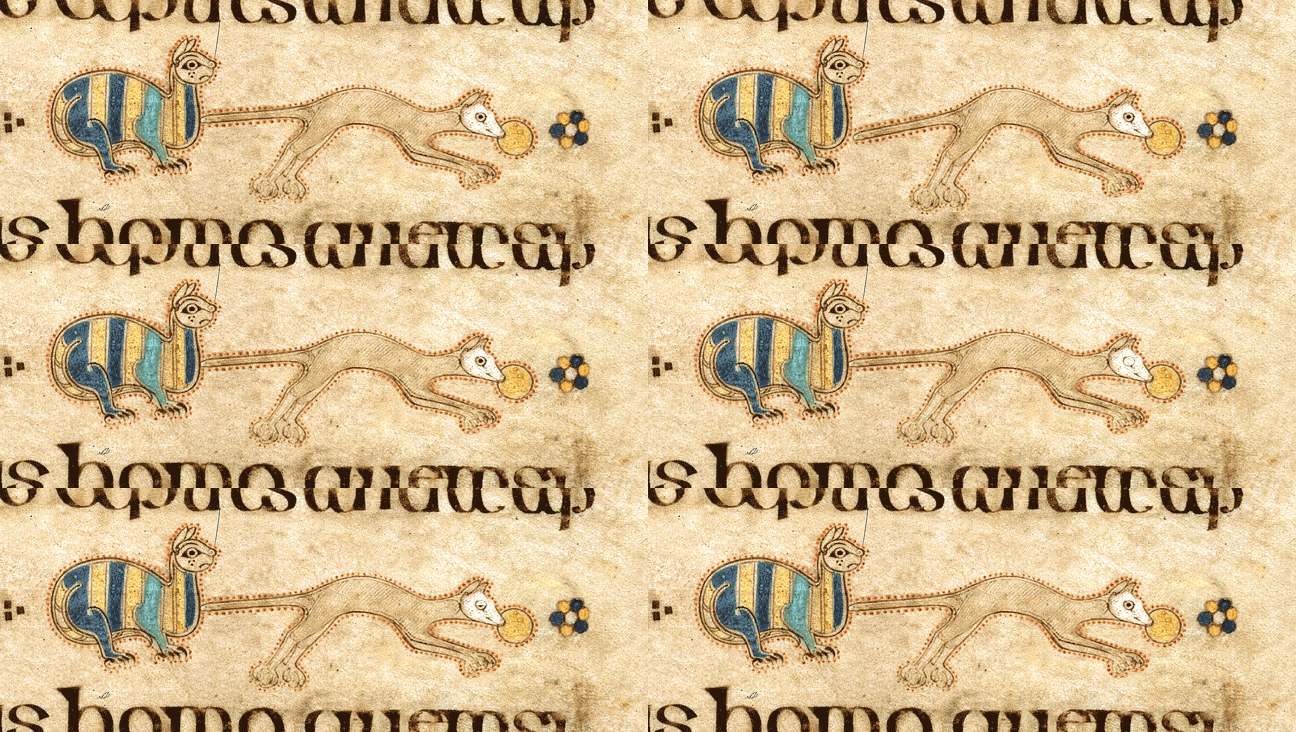
The text breathes with creatures.
Lions dissolve into spiralling knots.
Serpents thread through the letters of the Gospel of John.
Birds interlock wing-to-wing across the entire carpet pages, their beaks biting the tails of their neighbours in an eternal, joyful chase.
These were not idle decorations.
The Lindisfarne Gospels, produced on the holy island of Lindisfarne off the Northumbrian coast around 715 CE, carry the same visual DNA.
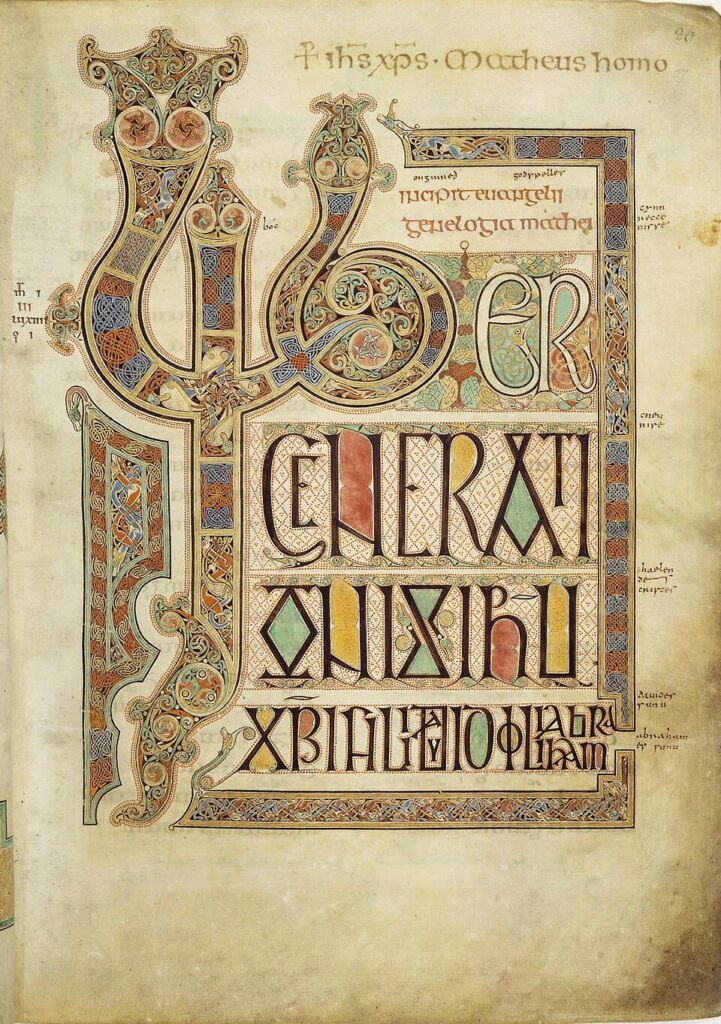
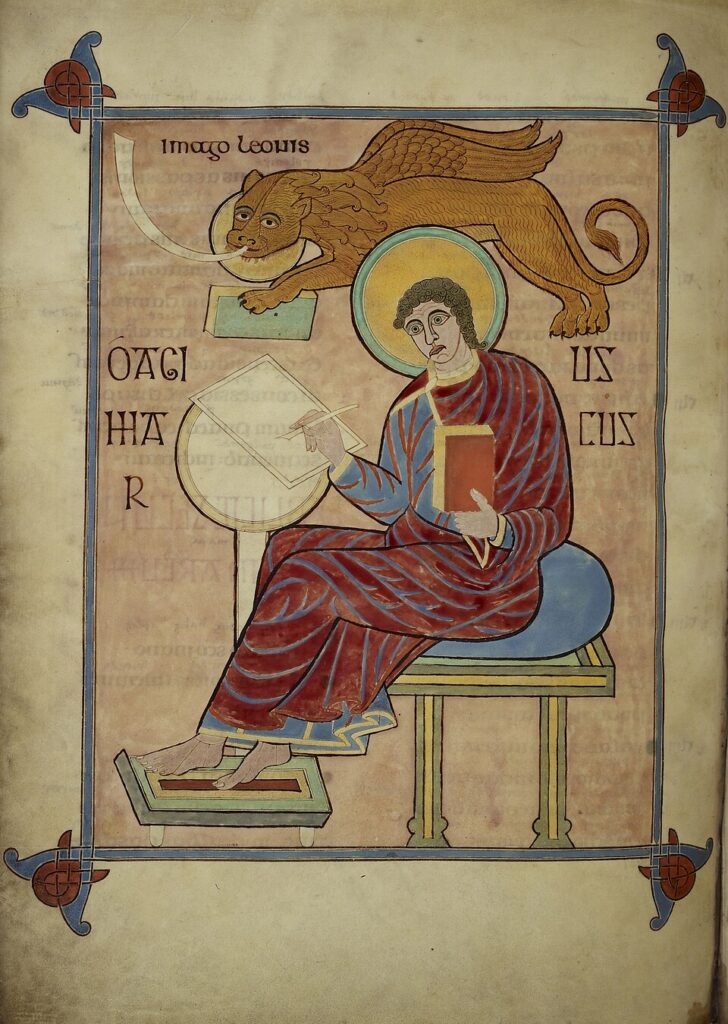
Its carpet pages — intricate full-page designs with no scriptural text at all — are pure meditation in interlace.
They ask the viewer’s eye to follow a single thread through hundreds of crossings, a visual practice not entirely unlike the druidic spiritual discipline of tracing the hidden order beneath apparent chaos.
Zoomorphic motifs in Insular manuscripts
Scholars have identified direct visual continuities between the animal ornament found in Insular manuscripts and the La Tène decorative tradition of pre-Christian Celtic metalwork — particularly in the treatment of animal joints as spiral forms, and in the use of interlacing as a structural grammar.
In the older Celtic tradition, specific animals carried specific spiritual resonances, many of which the Christian scribes repurposed with remarkable fluency:
Celtic sky-messenger, thought to carry prayers between worlds. Reborn as the emblem of John the Evangelist and a symbol of the soul’s ascent to heaven.
A druidic symbol of rebirth and cyclical wisdom. In Christian manuscript art, it carries a double meaning: the serpent of Eden and a symbol of Christ himself, who shed his blood as the serpent sheds its skin.
Power of the otherworld. Becomes the emblem of Mark, the roaring evangelist — and a symbol of Christ’s message proclaimed to the four corners of the earth.
Loyalty, the hunt, guardian of the otherworld. Recast as faithful pursuit of truth, and as a symbol of Christ himself — ever-loyal, ever-faithful to his followers.
Trickster, wily, and cunning. Appears in manuscript margins as a sly commentator on human vanity — but also as a reminder that humans can be both foolish and wise.
Prophetic bird of the Morrigan, goddess of fate and battle. Domesticated into Christian art as a symbol of divine providence — God’s foresight made feathered.
Appears prominently throughout the Book of Kells, often flanking images of Christ. Based on the ancient belief that peacock flesh does not decay, it became a symbol of Christ’s immortality and incorruptibility.
On the famous Chi Rho page, sleek cats crouch in heraldic symmetry — pinning mice that nibble at the Eucharistic host. Scholars read them as symbols of earthly creation, guardians at the threshold of the sacred.
Nestled in the margins of the Chi Rho page alongside the cats, the mice are open to interpretation — perhaps a reminder that even the smallest creatures belong to the world Christ came to redeem.
The Four Faces of the Word
Around 600 BCE, the prophet Ezekiel saw four living creatures emerge from a storm cloud, drawing God’s throne-chariot.
Each bore four faces at once: a man, a lion, an ox, and an eagle. These were later identified as cherubim.
In the Book of Revelation, they appear as four distinct beings encircling God’s throne, ceaselessly crying “holy, holy, holy.”
The imagery has deeper roots.
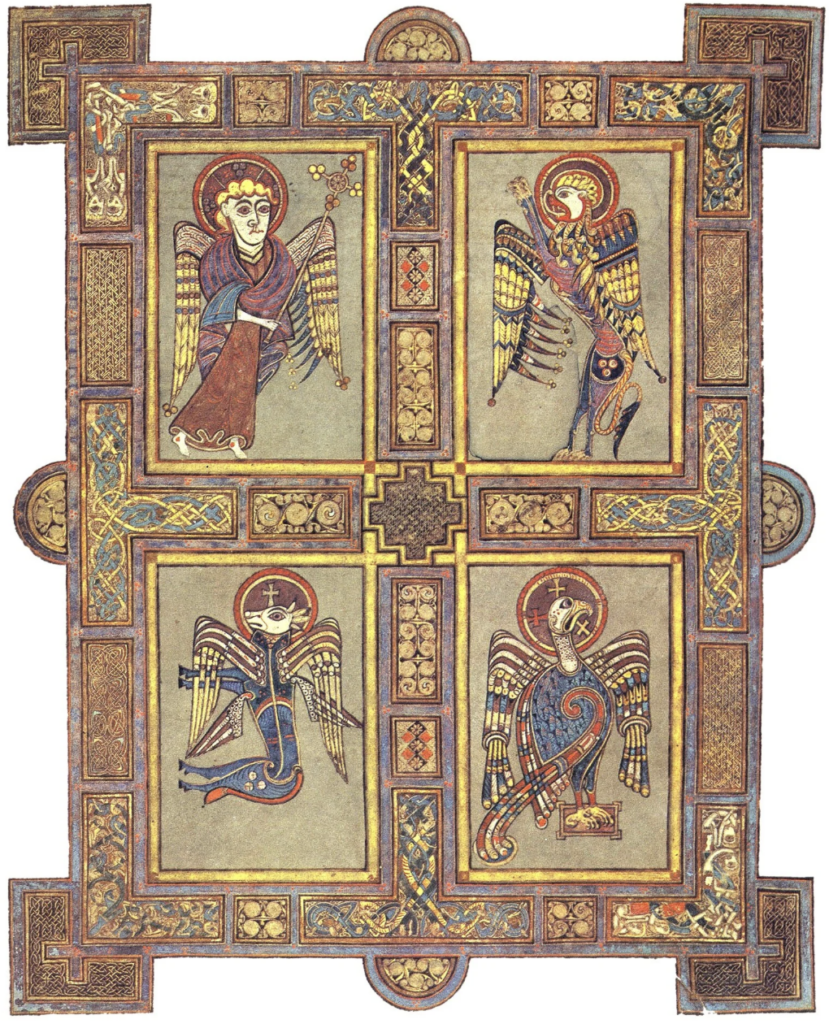
Book of Kells, Trinity College Dublin.
The four faces match the Babylonian symbols of the fixed zodiac signs: ox (Taurus), lion (Leo), eagle (Scorpio), and man (Aquarius).
Living in Babylonian exile, Ezekiel was immersed in these cosmic emblems.
The early Church reinterpreted them with new depth.
In the second century, St. Irenaeus linked the creatures to the four Gospel writers, each revealing a different aspect of Christ:
- The man stands for Matthew: whose Gospel begins with Jesus’ human genealogy — Christ entering history as one of us.
- The lion represents Mark: whose urgent, forceful narrative opens with a voice crying in the wilderness. Christ strides forth like a roaring lion, proclaiming the Kingdom with power.
- The ox (or calf) symbolises Luke: the Gospel of sacrifice and the Temple. It opens at the altar and portrays Christ as the willing victim offered for the world.
- The eagle signifies John, whose soaring vision begins before creation itself: “In the beginning was the Word.” The eagle alone can gaze into the sun; so John’s Christ reveals divine glory and eternal life.
Together, the four creatures portray the complete mystery: a God who became human, preached with leonine authority, offered himself as sacrifice, and ascended in glory.
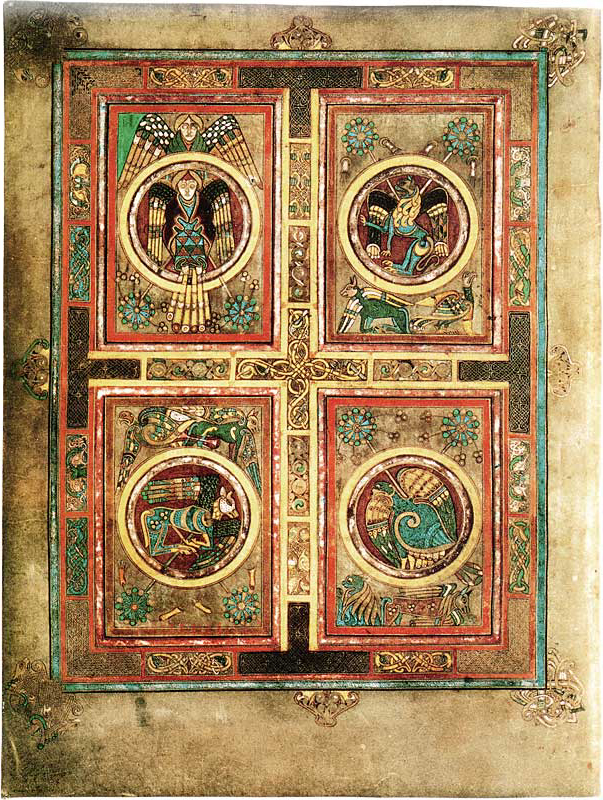
Book of Kells, folio 129v, Trinity College Dublin.
When the scribes of the Book of Kells encircled Christ’s portrait with these symbols, they declared in the shared language of Ezekiel, Revelation, and the Celtic world that this man is the fulfilment of every cosmic sign, of everything the cosmos had been asking since before time began.
Nature as Scripture
The early Irish monks spoke of two books through which God could be known:
the Bible, and the Book of Nature.
This idea — so central to the spirituality of figures like Colmcille (or Columbanus), the ‘dove of the church’, and the author of the great nature-poem Pangur Bán — has no strong equivalent in mainstream Roman Christianity of the period.
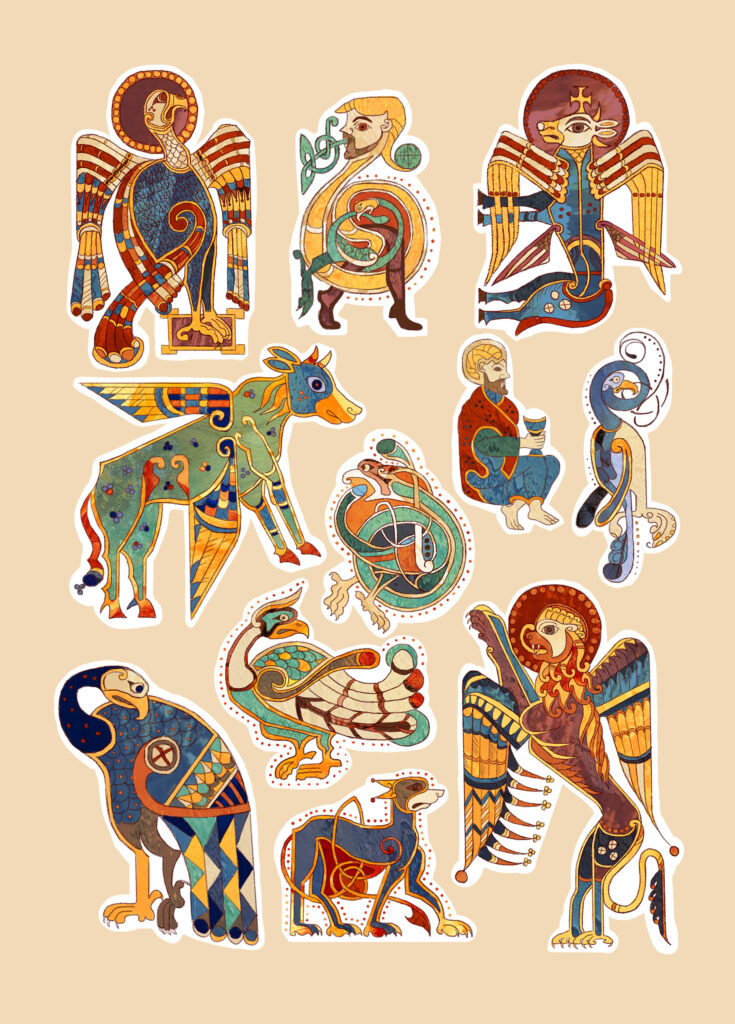
By Olga Tamkovich, Illustrator.
It is, however, entirely continuous with druidic cosmology, in which the natural world was itself a text demanding to be read.
The landscape around Irish monasteries was littered with older sacred sites — holy wells, standing stones, ancient groves — which the monks absorbed rather than demolished.
Many holy wells simply changed their patron from a local god or goddess to a local saint.
The oak groves sacred to the druids reappear in the very name of Kildare: Cill Dara, the church of the oak.
Saint Brigid’s monastery was built, according to tradition, in a druidic sanctuary — and Brigid herself may have been a Christianised form of the goddess of the same name.
The monks absorbed what came before them — not out of confusion, but out of conviction that the Spirit had always been moving in the land.
Even the great illuminated initials of these manuscripts carry this logic.
When a scribe began the Chi Rho page of Matthew’s Gospel — the page announcing the birth of Christ — he did not write plain letters.
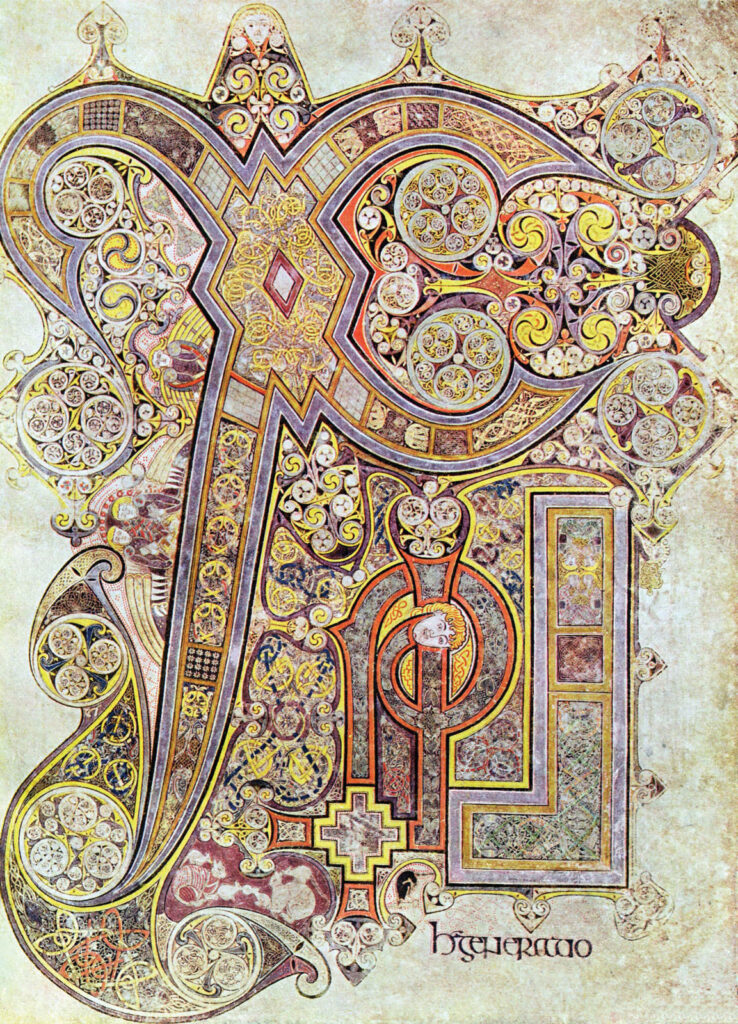
The Book of Kells, Trinity College Dublin
He constructed a gateway of interlocked creatures, spirals, and knots through which the reader must pass to enter the text.
The Word does not stand apart from nature.
It is woven into it, inseparable, as it always was.
A Deliberate Fusion
It would be too simple to call this syncretism accidental or merely the result of habit persisting into a new religious era.
The evidence suggests something more intentional: monastic scriptoria making deliberate choices to speak a visual language their audience would feel in their bones.
The Gospel was being translated not just into Irish vernacular but into Irish aesthetic — dressed in the visual grammar of a people who had always found the sacred in the coil of a serpent and the cry of a bird.
What emerged was something neither wholly Roman nor wholly druidic, but distinctly, gloriously Insular.
A Christianity that prayed outdoors and decorated its holiest books with creatures.
A faith that remembered, even as it transformed, the ancient understanding that the world itself is alive with meaning — and that to trace a line through a knotwork page is, in some sense, to follow the thread of the divine through all created things.
Further Reading and Credits:
Bernard Meehan, The Book of Kells Official Guide. Thames and Hudson, London (2018).
John Minahane, The Christian Druids: On the Filid or Philosopher-poets of Ireland, Howth Free Press, Dublin (2006).
Visit Trinity, Get inspired by the Animals in the Book of Kells. Accessed at: https://www.visittrinity.ie/blog/get-inspired-by-the-animals-in-the-book-of-kells/ on 7 May 2026.
Thank you to Olga Tamkovich, Illustrator, for kindly allowing me to use her stunning artwork “Animals in the Book of Kells”.