Note – Anno mundi, (Latin: “in the year of the world”), abbreviation A.M, the year dating from the year of creation in Jewish chronology, based on rabbinic calculations.
Since the 9th century AD, various dates between 3762 and 3758 BC have been advanced by Jewish scholars as the time of creation, but the exact date of Oct. 7, 3761 BC, is now generally accepted in Judaism.
However, critical dates that underlie the calculations are uncertain.
Rabbis used the genealogy in Genesis to calculate the date of the creation and then added to their calculations the time that had elapsed since the time of Genesis.
Despite the uncertainties, many Jews use this dating system as a sign of attachment to tradition.
Note.—The dates given are those from the Annals of the Four Masters, but they are generally a year or two (or more) in arrears.
All the Annals differ widely amongst themselves as to the Chronology.
For the more important events I have added the accepted dates.
– Eleanor Hull, Epochs of History (Vol.II) “Early Christian Ireland”, Age of the World (1905)
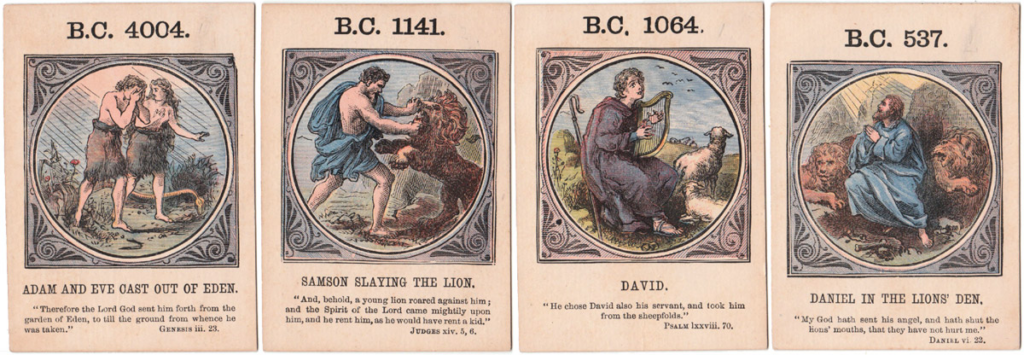
AGE OF THE WORLD: ANNO MUNDI A.M
CHRONOLOGY
2242—This date is given by the IV Masters as that of the coming of Cessair to Ireland—i.e., forty days before the Flood.
2520—Given as the date at which Partholan came to Ireland.
2530—The Fomorians defeated by Partholan at Magh Ithe, Co. Donegal.
2820—Partholan’s people die of the Plague.
2850—Neimheadh came to Ireland.
3066—The Fomorian Tower of Conainn (on Tory Island) is destroyed by the race of Neimheadh; only 30 of the race of Neimheadh escape. They escape and flee the country. Not to return for another 200 years.
3266—Arrival of the Firbolg.
3303—The Tuatha De Danann invade Ireland. Battle of Magh Tuireadh (Moytura, Cong, Co. Mayo).
3304f—Reign of Breas.
3310—Breas resigns the sovereignty to Nuada Airgeadlamh “of the Silver Hand.”
3330—Second Battle of Magh-Tuireadh (Moytura, Co. Sligo). Nuada is slain by the Fomorians.
3331—Reign of Lugh Lamhfhada “Long-handed.” He establishes the Fair of Taillte (Teltown, Co. Meath).
3370—Lugh is slain at Caendruim (Hill of Uisneach, Co. Westmeath).
3371—Reign of the Dagda Mor.
3471—Joint reign of the last three Kings of the Tuatha De Danann—Mac Cuill, Mac Ceacht, and Mac Greine.
3500—Arrival of the Milesians. Battles of Sliabh Mis and Taillte fought, and the three Princes killed.
3501—Emher and Eremon (Heber and Heremon) divide Ireland between them. A battle is fought between them at Geisill (King’s County), and Heber is slain. Heremon gives Tara to his wife, Tea, as her dowry and burial place. It is named from her Teamur (Tara)—i.e., the town or fort of Tea.
3580-3656—Reign of Tighernmas. He first smelts gold in Ireland. He introduces ornaments on dress. He is slain at Samhain when worshipping the Crom Cruach, or chief idol of Ireland.
3664-3667—Reign of Eochaid Eadgadhach. He requires each class to wear different colours in their dress.
3882-3922—Reign of Ollamh Fodhla (i.e., Fodhla the Learned). He first established the Feis of Tara. He appointed chieftains over fixed districts, and bruighfers, or farmers, over each townland, who acknowledged the central authority of Tara.
4532—Macha, a Princess, seizes the sovereignty from Dithorba and Cimbaoth, two brothers, who had reigned in turn. She marries Cimbaoth, and expels Dithorba to Connaught. She forces the captive sons of Dithorba to build the fort of Emain Macha. It was under Cimbaoth that Emain Macha became the capital of Ulster.
4567-4607—Reign of Ugaine Mor. He exacted oaths by all the elements, visible and invisible, that the men of Ireland would never contend with his race for the sovereignty.
4607-4608—Reign of Laegaire Lore, the “Murderer,” son of Ugaine Mor; murdered by his brother, Cobthach, at Carmen (in Wexford).
4658—Cobthach is murdered by Labraid Maen, with 30 chiefs, at Dind Righ, on the Barrow.
5017-5031—Reign of Congal Claringnech, son of Rudraighe (Rury).
5042-5047—Reign of Fachtna Fathach, the “Wise.”
5070-5084—Reign of Eochaid Aireamh, ” the Grave-digger.” He first had graves dug in Ireland. He was burned at Freamhain (Co. Westmeath).
5085-5089—Reign of Eterscel. He is slain at Allen (Co. Kildare) by Nuadha Neacht, who reigns half a year.
6091-6160—Reign of Conaire Mor, son of Eterscel. He is slain by his pirate foster brothers at Bruigben Da Derga.
5166-5191—Reign of Lugaidh Sriabh-na-Dearg, “of the Red Stripes.” He dies of grief for the death of his wife, Dervorgil.
5192-5193—Conchobhar Abhradhruadh, Conor “of the Red Eyebrows.” Slain by Crimthann.
5193-to A. D. 9—Reign of Crimthann. He dies on Howth Hill after returning from a foreign expedition with great spoils.
AGE of CHRIST. [ANNO DOMINI A.D.]
10—Reign of Cairbre Cinncait, “Cat-headed,” the leader of the insurrection of the Aithech Tuatha, in which nearly all the nobility of Ireland were killed. An evil reign for Ireland. Morann the Wise lived at this time and was chief counsellor.
15-36—Reign of Fearadhach Finnfeachnach “the Righteous,” son of Crimthann; he oppressed the Aithech, who, however, were troublesome for some time afterwards and incited rebellion against the succeeding monarchs.
76-106—Reign of Tuathal Teachtmar ” the Legitimate.” He fought many battles against the Aithech and reduced them to obedience. He preserved the province of Meath for the support of the High-King and celebrated the Feis of Tara, at which he caused all his chieftains to swear that they would never contest the sovereignty of Ireland with him or his descendants. In his reign the Boromha was first imposed on Leinster.
111-119—Reign of Feidhlimid Reachtrahar, “Phelim the Legal.” Great wars between Leinster and Munster.
120-123—Reign of Cathaire Mor. He was slain by Conn Cedcathach.
123-157—Reign of Conn Cedcathach “of the Hundred Battles,” son of Feidhlimid Reachtmar. In his time Ireland was divided into two parts, Leth Cuinn (Conn’s half) and Leth Mogha (Mogh’s half). Battle of Magh Lena (Moylena) between Conn and Eoghan Mor (Owen the Great), King of Munster. Establishment of the Fianna Erinn.
166-196—Reign of Art the Solitary, son of Conn of the Hundred Battles. Olioll Olum, King of Munster. Battle of Ceannfeabhrat, in which Maccon is defeated by his step-father, Olioll Olum. Maccon flees to Britain for help, and returns after some time to Galway with auxiliaries. Art meets him and is killed in the Battle of Magh Mucramha. Maccon usurps the throne of Tara.
227—Reign of Cormac mac Airt. Battle of Crinna. Death of Olioll Olum, Cormac wars in Ulster, Connaught, Meath, and Munster. Expulsion of Cormac across the sea.
265—Cormac’s eye put out, and his lawgiver and son mortally wounded by the thrust of a lance by Angus of the Terrible Spear (Gaibhuaibhthach). Cormac fought and gained seven battles over the Deisi in revenge, and he expelled them to Munster, where Olioll Olum gave them a district to settle on. They were descended from the brother of Conn of the Hundred Battles.
266—Cormac died at Cleiteach (Cletty) on the Boyne from, a salmon-bone sticking in his throat.
268-284—Cairbre Liffeachair “of the Liffey,” son of Cormac mac Airt, King of Ireland.
271-276-—Seven battles fought against Munster and Angus of the Terrible Spear killed.
283—Finn, son of Cumhall (Finn MacCool), was killed by Aichleach, a fisherman, with his fishing-gaff, at AthBrea on the Boyne. Caoilte mac Ronain, a follower of Finn, revenged his death on Aichleach.
284—Cairbre Liffeachair fell at the Battle of Gabhra-Aichle (Gaura), near Tara. This battle was fought by Moghcorb, son of Cormac Cas, King of Munster, who came to avenge the death of Mogh Nuadhat, his grandfather, who had been murdered in his tent by Goll, leader of the Clanna-Morna or Fianna of Connaught. With Moghcorb were the Clanna-Baoisgne or Fianna of Leinster, who had taken refuge in Munster. In this battle Osgur, son of Oisin (Ossian), also fell.
323-326 (9)—Reign of Colla Uais, who was expelled into Alba (Scotland) by Muiredhach Tireach.
327-356—Reign of Muiredhach Tireach.
327—The three Collas return to Ireland from Alba. They enter into a friendly treaty with Muiredhach.
331—The three Collas conquer large territories in Ulster, from L. Neagh and the Newry River westwards, and destroy its capital, Emain Macha.
358-365—Reign of Eochaid Mughmheadhoin, son of Muiredhach, who had two wives, Mongfind of Munster and Cairenn, mother of Niall of the Nine Hostages.
366-378—Reign of Crimthan, brother of Mongfind. He was poisoned by his sister in the hope that her son Brian would succeed, but he did not do so. Crimthan wars in foreign lands.
379-405—Reign of Niall of the Nine Hostages. He carried on foreign wars and made incursions into Britain. Stilicho, the General of the Emperor Claudian, was sent against him.
Niall had fourteen sons, some of whom settled in Meath and others in Ulster. It was in his reign and by one of his legions that St. Patrick was carried off to Ireland as a slave.
Niall was treacherously killed by the son of the King of Leinster at the River Loire in Gaul.
405-428—Reign of Dathi, son of Eochaid Mughmheadhoin. He was killed by a flash of lightning on the Alps. His body is said to have been brought home to Ireland and buried at Rathcroghan, in Connaught.
429-458—Reign of Laegaire (Leary), son of Niall of the Nine Hostages.
431—Pope Celestine sent Palladius to preach “to the Scots (i.e., Irish) believing in Christ.” He is said to have landed in Leinster and founded three wooden churches, where he left books and relics. He died on his way back to Rome.
432—St. Patrick came to Ireland.
457—Laegaire taken prisoner by the men of Leinster at Ath-Dara, but released.
457—Ard-Macha (Armagh) founded by St. Patrick.
458—Laegaire killed by the elements.
459-478—Reign of Oilioll Molt, son of Dathi.
461—Death of St. Patrick.
478—Oilioll Molt killed in the Battle of Ocha. He is killed by a flash of lightning at Achadh Farcha. From this time to Malachy II., all the Kings of Tara were of the race of the Hy Neill (O’Neill).
498 (506)—Feargus Mor (Fergus the Great) went with his brothers to Scottish Dalriada.
479–503 —Reign of Lugaidh (Lewy), son of Laegaire.
504-527—Reign of Muirchertach Mor Mac Erca (Murtough the Great). He was drowned and burned at Cleiteach (Cletty) on the Boyne.
520-1—Birth of St. Columcille.
525—St. Bridget, Abbess of Cill-Dara (Kildare), died.
528-538—Reign of Tuathal Mael-qarbh (Toole the “rough bald one”). He is slain by the tutor of Diarmaid Mac Cearbhall (Dermot Mac Karval).
537—Battle of Sligeach (Sligo), in which Eoghan (Owen) Bel, King of Connaught, fell by Fergus and Domhnall, sons of Muirchertach Mac Erca.
538 (?)-558 (565)—Reign of Diarmaid Mac Cearbhall (Dermot Mac Karval).
543—The ” Buidhe Conaill ” or Great Plague, “swept away a third part of the human race.”
545-6—Columcille founded the Church of Doire (Derry).
548—Death of St. Ciaran, Abbot of Clonmacnois.
549 (563)—Death of St. Finnian the Wise, abbot of Clonard on the Boyne.
554—Church of Beannchoir Mor (Bangor the Great), founded by St. Coragall.
554 (560)—The last Feis of Teamhair (Tara) was made by King Diarmaid.
555 (561)—Battle of Cuil-Dreimhne (Cuildrevny) between the Cinel Conaill and Cinel Eoghan (the O’Neills and O’Donnells) with St. Columcille, against King Diarmaid.
557 (563)—St. Columcille leaves Ireland and goes to Hi (lona) in Alba (Scotland).
558 (565)—Diarmaid Mac Cearbhall slain at Rath Beg.
559-561—Joint reigns of Domhnall (Donall) and Fearghus (Fergus), sons of Muirchertach Mac Erca. They gained the Battle of Gabra Liffe over Leinster.
563—Death of St. Laissren or Molaisi of Daimhinis (Devenish, on Loch Erne).
564-567—Reign of Ainmire, son of Setna.
571 (573)—Death of St. Brendan of Birr.
567 (571)—Death of Eochaid (Eochy) the Fair and Baetan, joint Kings.
568 (?)-594 (598) —Reign of Aedh, son of Ainmire.
575—The Convention of Drum-ceat, held by Aedh, s. of Ainmire. Aedan, son of Gabhran, King of Scottish Dalriada, and St. Columcille were present.
576 (577)—Death of St. Brendan of Clonfert.
594 (598)—Aedh, son of Ainmire, slain at Dunbolg in avenging the death of his son, Cumuscach.
597—Death of St. Columcille at Hi (Iona). St. Augustine lands in England.
595 (597)-600 (604)—Joint reigns of Aedh Slaine and Colman Rimidh, slain 604.
600 (601)—Death of St. Comgall of Beannchoir (Bangor, Co., Down).
601-607—Reign of Aedh (Hugh) Uaridhnach “of the Ague.”
608-610—Reign of Maelcobha, son of Aedh Mac Ainmire. Slain by Suibhne Menn.
611-623—Reign of Suibhne (Sweeny) Memi.
617—Death of St. Caemhghin (Kevin) of Glendalough.
622—Battle of Carn Feradaig by Failbe Flann over Guaire Aidne of Connaught.
623 (627)—Suibhne Menn slain at Traigh-Brena by Congal Caech, “squint-eyed,” or Claen “one-eyed,” King of Ulad.
624-639 (642)—Reign of Domhnall (Donell), son of Aedh, son of Ainmire. The Battle of Dun-Ceithern gained by him over Congal Claen.
624—Birth of St. Adamnan.
629—Death of Eochaid Buidhe, son of Aedan, King of Dalriada.
634 (637)—Battle of Magh Rath (Moira, Co. Down), gained by Domhnall over Congal Claen.
640 (642)—Reign of Conall Gael, “the Slender,” and Ceallach, grandsons of Aedh, son of Ainmiri.
N.B. The succession of the Kings hereabouts is very uncertain.
645 (648)—Raghallach, King of Connaught, killed.
645 (648)—Battle of Carn Conaill (Co. Galway), gained by Diarmaid, son of Aedh Slaine, against Guaire Aidne of Connaught.
647—Two sons of Blathmac, son of Aedh Slaine, drowned by men of Leinster in the Mill of Maelodran (Co. Westmeath).
657-664—Joint reigns of Diarmaid Ruadnaidh and Blathmac, sons of Aedh Slaine.
661—St. Cummine Fada, “the tall,” Bishop of Cluain-Fearta-Breanainn (Clonfert), died.
662—Guaire Aidne of Connaught dies.
664—The Great Pestilence decimated Western Europe. Kings Diarmaid and Blathmac died of it, also the Abbots of Clonard, Fore, Clonmacnois, and other monasteries.
665—Reign of Sechnasech, son of Blathmac.
666-669—Fresh outbreak of the Plague, or “Buidhe Conaill.” Four Abbots of Bangor died of it in succession.
670—Reign of Ceannfaeladh, son of Blathmac.
674—Reign of Finnachta Fleadhach, “the Festive,” who slew Ceannfaeladh in the Battle of Aircealtair.
682—Domhnall Breac, King of Dalriada, killed in battle with the Britons.
683—Magh Breagh (East Meath) devastated by Northumbrians under Berchus.
684—Great mortality of cattle.
687—Adamnan brings 60 captives back to Ireland from Northumbria.
694—Reign of Loingseach. Slain with three sons in the Battle of Corann, by Ceallach, son of Raghalach, 701.
697—Adamnan again in Ireland; he promulgates the Cain Adamnain, exempting women from warfare. St. Moling of Luachra died.
702—Reign of Conal of Ceann Maghair.
703—Adamnan induced the South of Ireland to observe the Canonical Easter.
704—Death of Adamnan, Abbot of Hi (lona). Death of Ceallach, son of Raghallach, King of Connaught, after becoming a priest.
709—Reign of Fearghal. Killed in the Battle of Almhain (Allen, Co. Kildare).
719—Reign of Fogartach. Killed in the Battle of Delgean by Cineath (Kenneth), son of Irgalach.
720—Reign of Cineath, son of Irgalach, killed in the Battle of Druim-Corcrain.
723—Reign of Flaithbheartach (Flaherty), son of Loingseach. He sends for a fleet of vessels from Dalriada to fight the men of Ulster.
729—Flaithbheartach resigns his crown and dies in the Monastery of Armagh.
730—Reign of Aedh (Hugh) Allan. He almost extirpates the Leinstermen in the Battles of Ath-Seanaith and Allen.
738—Aedh Allan falls in battle at Magh ‘ Seirigh (near Kells) with Domhnall, s. of Murchadh.
739 (743)-758 (763)— Reign of Domhnall (Donall), first King of Clann-Colmain. He reigns twenty years and dies in his bed.
759—Reign of Niall Frosach. A great famine in his reign.
760—Reign of Donnchadh, son of Domhnall. Reigned twenty- seven years.
790 (794)—The first Gentiles (Vikings) appeared off Reachrainn Isle (Lambay) and plundered.
Source:
- Eleanor Hull, Early Christian Ireland, “Epochs of Irish History,” Vol. 2 (1905).
Available for free download from Brehon Academy’s Members Library: https://brehonacademy.org/docs/early-christian-ireland-by-eleanor-hull-1905/