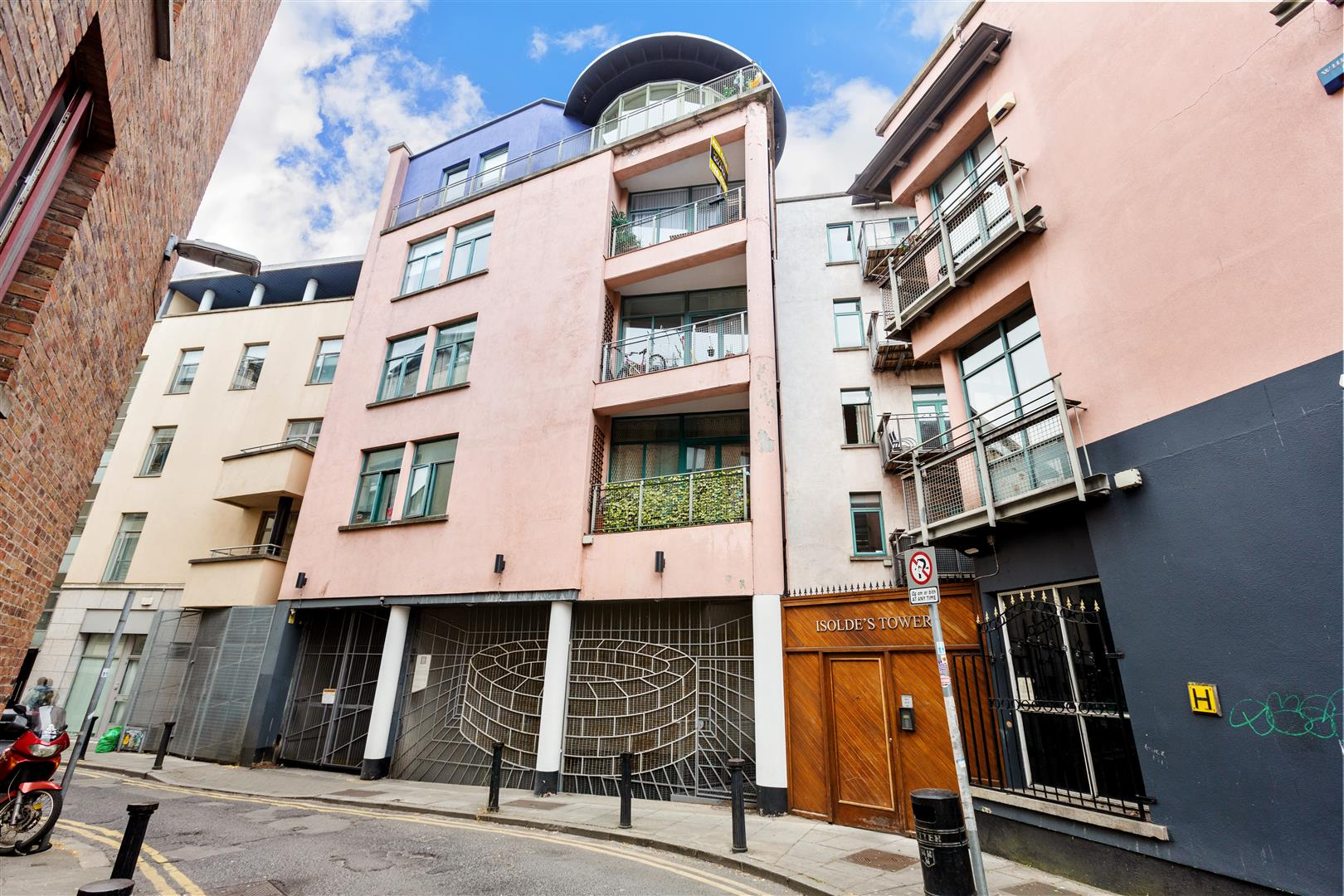
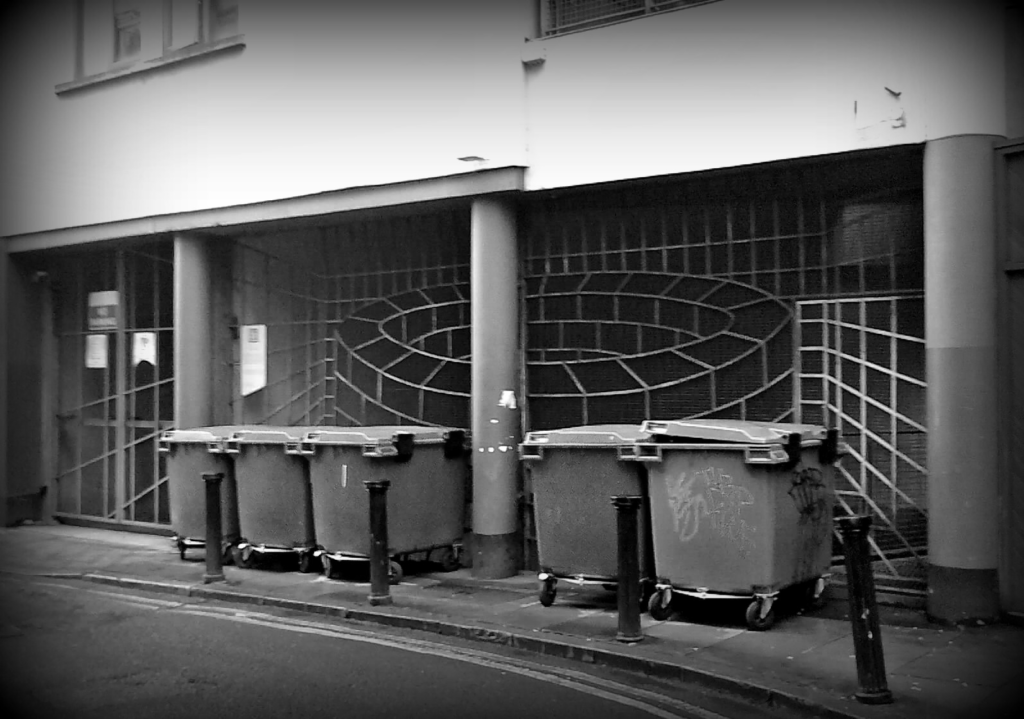
Thousands of people walk past Isolde’s Tower every week without knowing it is there. It sits behind an iron gate on Exchange Street Lower, on the western edge of Temple Bar, underneath a block of apartments that carries its name, and it is so hard to make out from the street that residents have got into the habit of leaving their wheelie bins in front of it. The stones behind those bins are the base of a thirteenth-century tower from the walls of Dublin, and the woman they are named after is the Irish princess at the centre of one of the great love stories of medieval Europe.
How the Tower Was Found
Isolde’s Tower was built around 1260, when the Anglo-Normans extended the city walls to take in land reclaimed from the Liffey. It stood at the north-east corner of the defences, where the Poddle met the Liffey, and it pushed out into the river so that any ship coming upstream would meet it first. It was pulled down in the seventeenth century, houses were built on top of it, and for three hundred years it survived only as a name in old records.
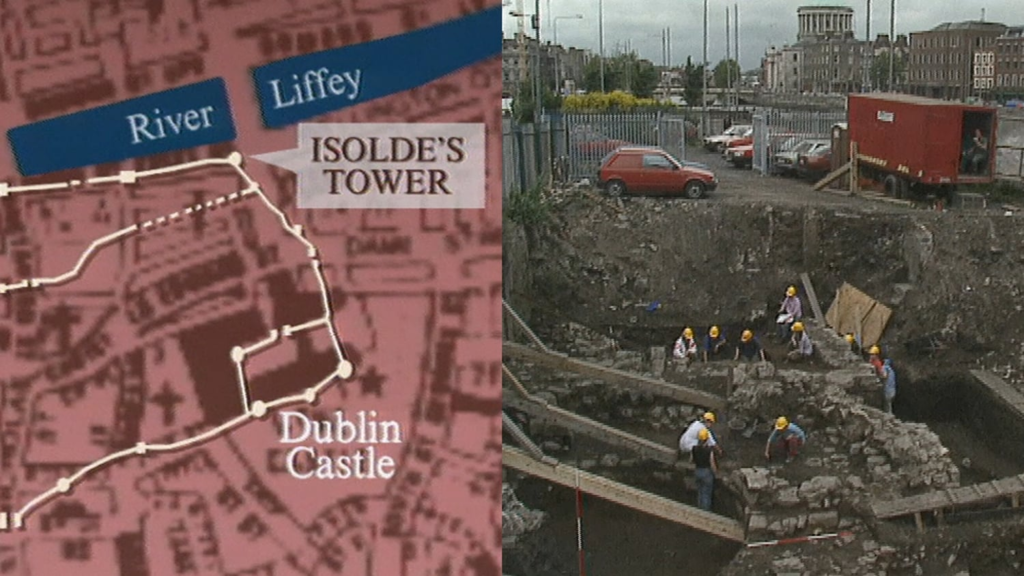
Archaeologists knew roughly where it ought to be. An assessment in 1990 suggested that the remains lay beneath a standing building at the bend in Exchange Street Lower, and when the old houses on the site were demolished in May 1993, as part of the renewal of Temple Bar, the digging began.
The excavation was directed by Linzi Simpson, with Margaret Gowen as consultant archaeologist, and the old maps played a trick on them, because the tower turned up about eight metres from where they expected it.
What they uncovered was a circular tower with an internal diameter of 4.5 metres and walls almost 4 metres thick, built of coursed limestone and sitting directly on the river gravels. At its highest point it still stood to almost 2.5 metres.
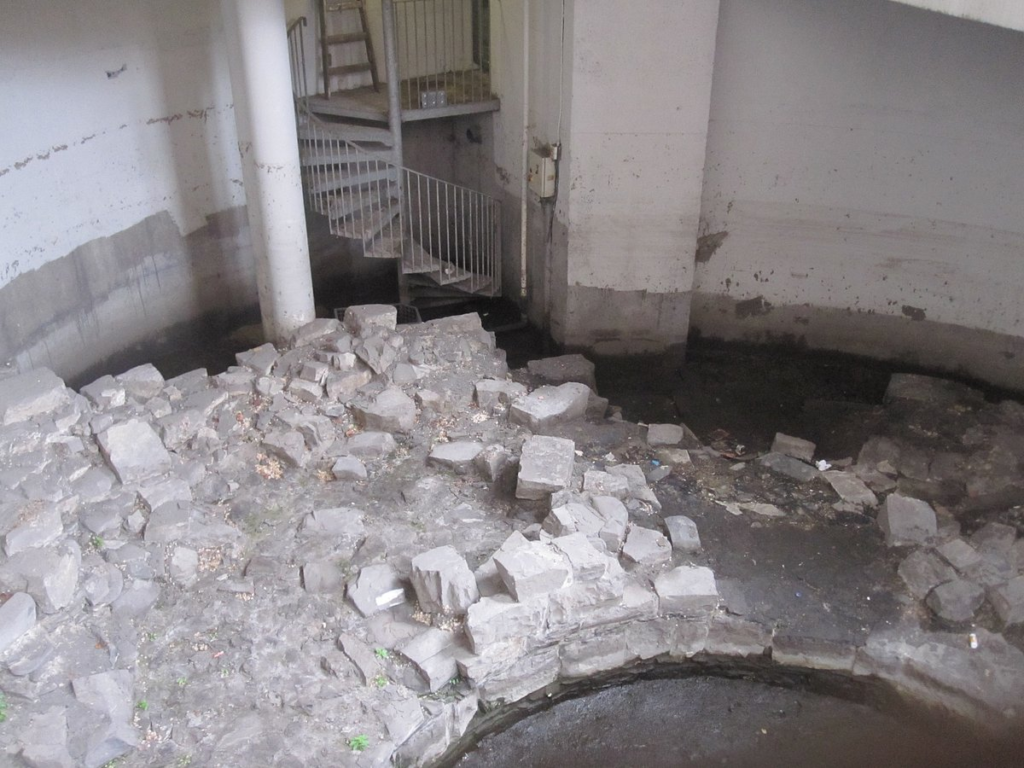
Pottery of Anglo-Norman date came out of the silts beside it, and at the base of the city wall the team found several human skulls embedded in the river mud, which had probably once been hung from the wall above.
The find sent the developers back to the drawing board.
Temple Bar Properties agreed to build around the remains and leave them on view, and so the apartments went up over the tower.
The stonework is still there behind its gate at street level, though it is hard to see from the pavement, which is how one of the oldest pieces of the city’s defences came to be a parking spot for bins.
Why Isolde?
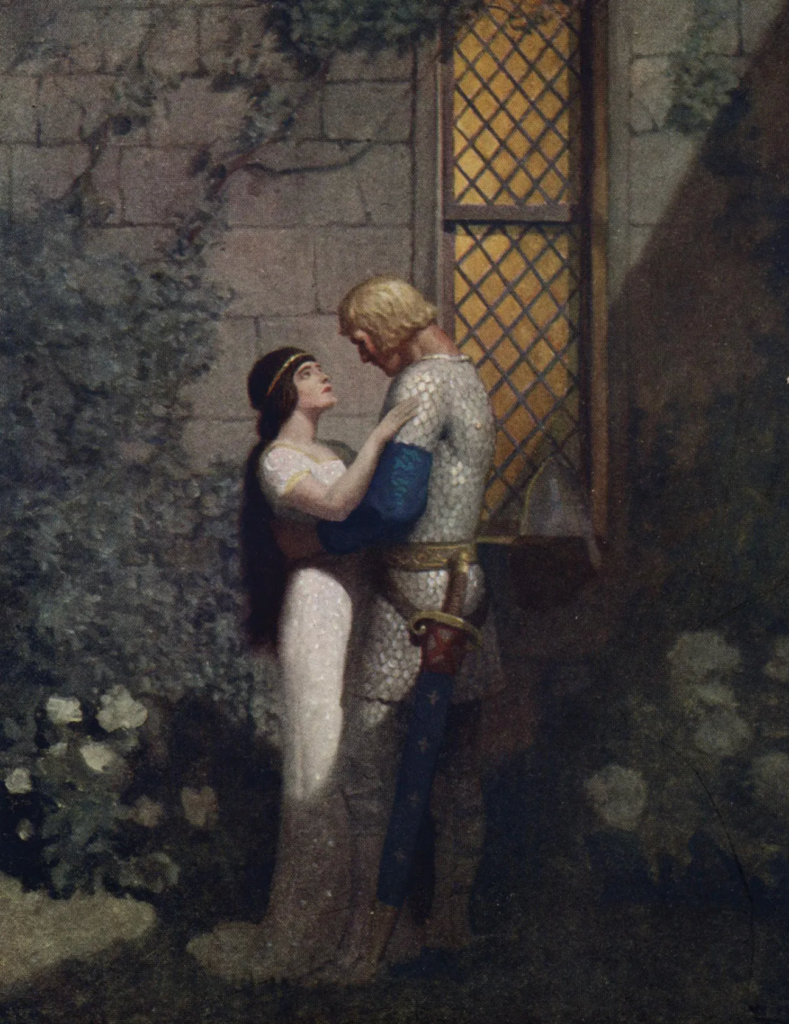
N.C. Wyeth in The Boy’s King Arthur, 1917.
The name is far older than the excavation. Richard Stanihurst, writing in 1577, described a tower near Dublin Castle called “Isoudes tower” and explained that it was named after La Beale Isoude, daughter of Anguish, king of Ireland.
A few miles upriver the village of Chapelizod carries the same name, Séipéal Iosóid, the chapel of Isolde, and it appears in records as early as 1212.
Iosóid is the Old French name Iseut in Irish dress, which tells us that it arrived with the Anglo-Normans, the same people who built the tower and who carried the romance of Tristan across Europe.
Whether a real woman named Isolde stands behind either place we cannot say, but Dubliners have been tying both of them to the princess of the legend for the better part of 450 years.
Who Were Tristan and Isolde?
Tristan is a knight of Cornwall and nephew to King Mark, and Isolde is the daughter of the king and queen of Ireland. Their story begins with a killing.
Ireland is taking tribute from Cornwall, collected by a champion named Morholt, who is the Irish queen’s brother. Tristan meets him in single combat and kills him, leaving a splinter of his sword in Morholt’s skull and carrying away a poisoned wound that nobody in Cornwall can heal.
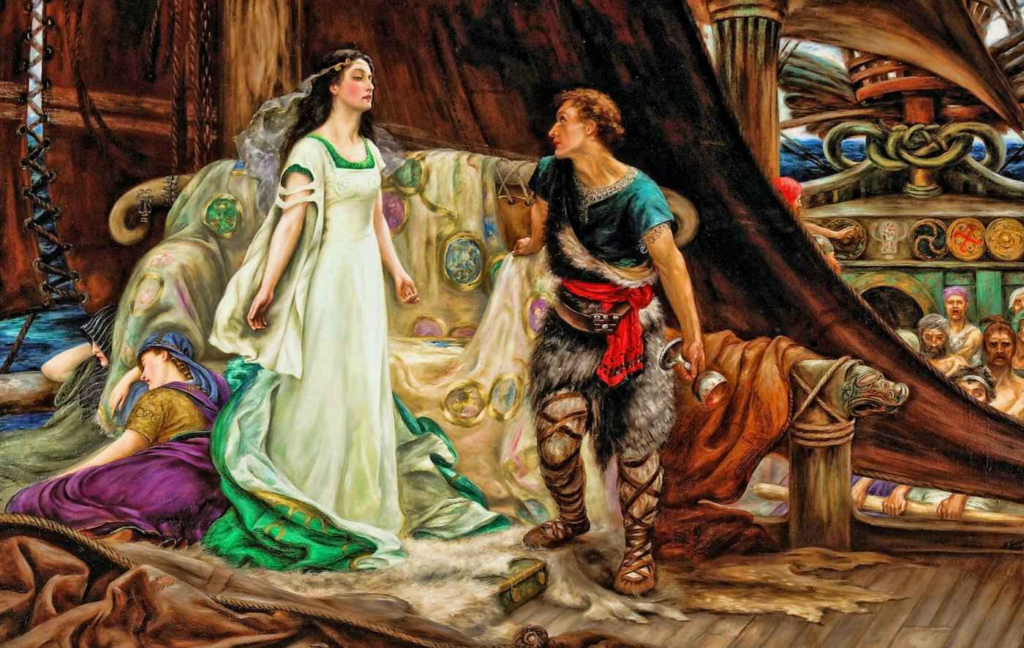
by Herbert Draper (1901)
The cure lies in Ireland, so Tristan sails there under the false name Tantris and is nursed back to health by the queen and her daughter. Isolde later notices that the notch in her patient’s sword matches the splinter taken from her uncle’s head, and she stands over him with the blade raised before she lowers it.
Anyone who has studied Brehon law will recognise what is at stake in that moment. Under early Irish law a killing created a debt to the dead man’s kin, payable as éraic, the body-fine, along with honour-price, and where no payment was made the kin were entitled to take vengeance. Isolde with the sword in her hand is a kinswoman facing her uncle’s killer.
That reading is my own, since the poets who wrote the story down were French and German and say nothing of Irish law.
The Irish relatives of the tale are on firmer ground. Scholars have long pointed to Tóraigheacht Dhiarmada agus Ghráinne, the Pursuit of Diarmuid and Gráinne, which has the same triangle of an ageing ruler, a young bride and his most trusted warrior, and the story of Deirdre and Naoise covers similar ground.
The Potion and the Sails
Tristan returns to Ireland to win Isolde as a bride for his uncle. Her mother, wanting the marriage to be a happy one, brews a love potion for the wedding night and entrusts it to Isolde’s maid, Brangien.
On the crossing to Cornwall the flask is mistaken for wine, Tristan and Isolde drink it together, and by the time they land they are lovers.
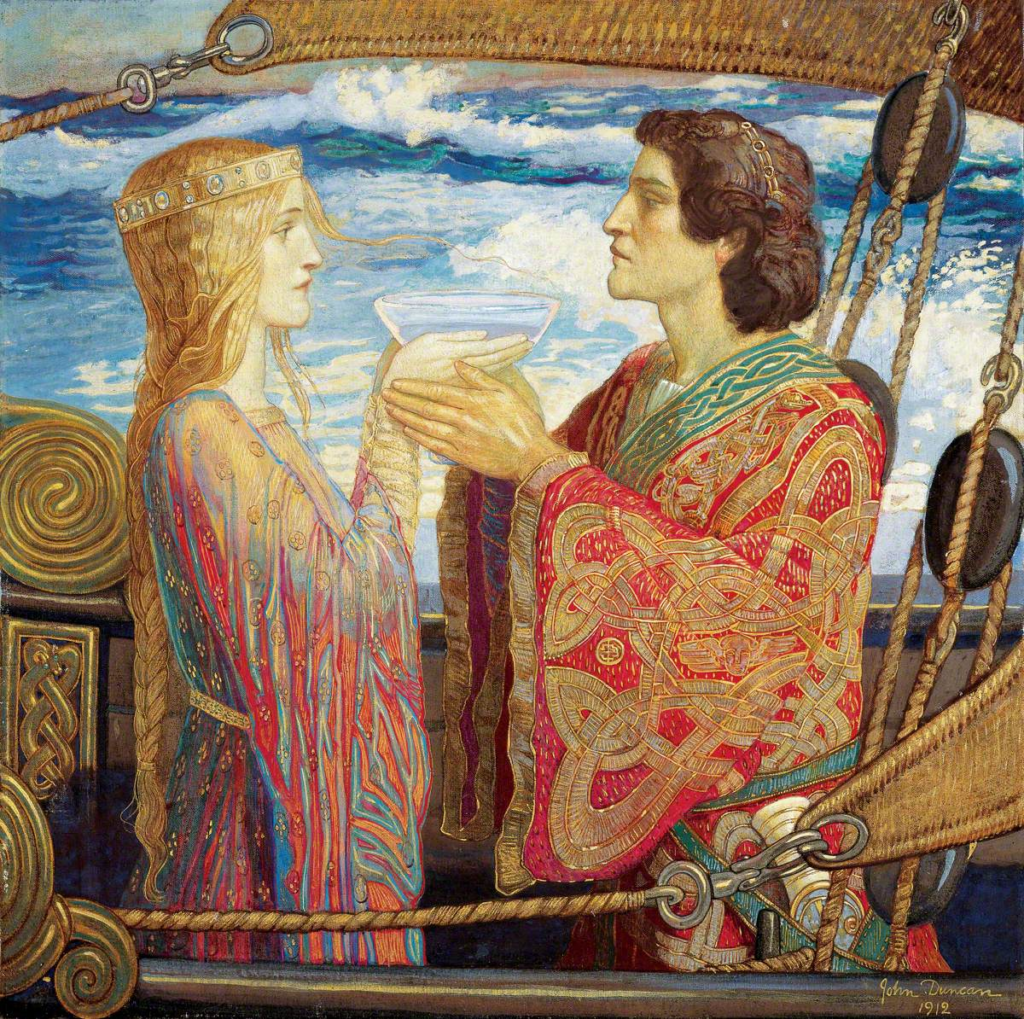
by John Duncan (1912)
Isolde marries Mark all the same, and what follows is a long run of secret meetings, traps and narrow escapes. Flour is scattered on the bedchamber floor to catch Tristan’s footprints, the lovers are condemned to death, and Tristan escapes by leaping from a chapel window on a cliff before rescuing Isolde.
They live rough in the forest until Mark finds them asleep with a sword lying between them and, taking it as a sign of innocence, leaves them unharmed.
The two oldest versions were both written in French around 1170, and they disagree about the potion. Béroul has it wear off after three years, while Thomas of Britain has it last a lifetime, and the details shift from one telling to the next.
The ending hardly changes at all. Tristan leaves Cornwall for Brittany, where he marries another woman named Isolde, known as Isolde of the White Hands, largely for the sake of her name.
When he is wounded again by a poisoned weapon he sends for Isolde of Ireland, the only one who can heal him, and he agrees a signal with the messenger.
White sails will mean she is aboard, and black sails will mean she is not coming.
His wife, watching the ship come in, tells him the sails are black. Tristan dies of grief, and Isolde comes ashore to find him dead and dies beside him.
In some versions a briar grows from his grave and roots itself in hers, and it grows back every time King Mark has it cut.
From Dublin to Verona
Tristan and Isolde went on to become one of the most retold stories in Europe. It passed into German, Norse, Italian and English, and into Malory’s Le Morte d’Arthur, where Tristan sits at the Round Table. Richard Wagner turned it into the opera Tristan und Isolde, first performed in 1865, and its opening chord, known ever since as the Tristan chord, changed the direction of Western music.
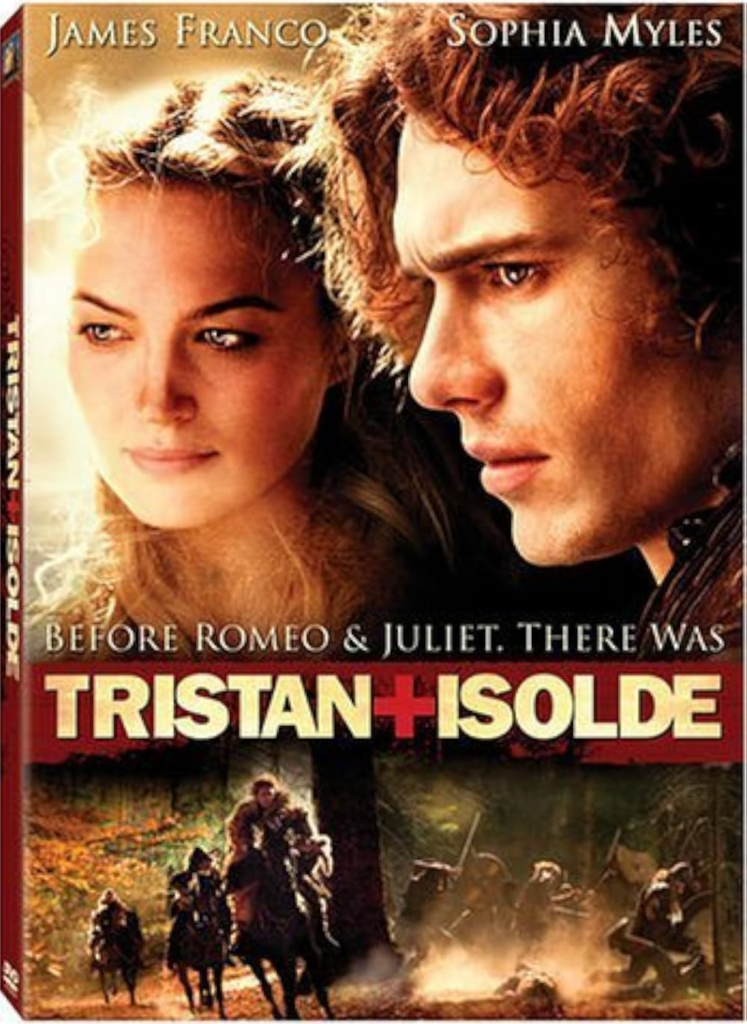
“Before Romeo & Juliet, There Was…”
James Joyce set Finnegans Wake in Chapelizod and wove the lovers through it. On screen, the story goes back to a French silent film of 1909, and it includes Lovespell, an Irish production released in 1981 with Richard Burton as King Mark and Kate Mulgrew as Isolde, and the 2006 film Tristan & Isolde, with James Franco and Sophia Myles.
It is also a forerunner of the far better-known Romeo and Juliet. Shakespeare took his plot from an English poem of 1562 by Arthur Brooke, which had come to England from Italian storytellers, and those storytellers were working in a tradition of doomed lovers that Tristan and Isolde had done more than any other tale to shape. Lovers kept apart by loyalty and family, a message that goes astray, and two deaths side by side were all in place four centuries before Verona.
All of which makes a few courses of limestone under a Dublin apartment block worth a second look.
The next time you are in Temple Bar, walk down to the bend in Exchange Street Lower, look past the bins (if they are there) and peer through the gate, allow your eyes to adjust to the darkness, and remember that the heroine of Wagner’s opera, and the ancestor of Juliet, was an Irishwoman.
If this has given you a taste for the Irish tales that stand behind the romance, Diarmuid and Gráinne is the place to start, and you will find plenty more on Irish mythology and Brehon law here at the Brehon Academy.
Further Reading
The tower and the excavation
- Linzi Simpson, “1993:070, Isolde’s Tower, Exchange Street Lower, Dublin”, Excavations.ie. https://excavations.ie/report/1993/Dublin/0001448/
- Margaret Gowen, “1990:047, Exchange Street Lower/Parliament Street/Essex Quay, Dublin”, Excavations.ie. https://excavations.ie/report/1990/Dublin/0000982/
- Linzi Simpson, Excavations at Isolde’s Tower, Dublin, Temple Bar Archaeological Report 1 (Temple Bar Properties, 1994).
- “Isolde’s Tower Dublin”, RTÉ Archives, RTÉ News report by Una O’Hagan, broadcast 23 July 1993. https://www.rte.ie/archives/2018/0717/979330-isoldes-tower-dublin/
- Eileen Battersby, “Ms Temple Bar”, The Irish Times, 11 January 1996. https://www.irishtimes.com/culture/ms-temple-bar-1.20882
- “Isolde’s Tower blocked from view on Exchange Street Lower”, Come Here To Me!, 23 January 2013. https://comeheretome.com/2013/01/23/isoldes-tower-blocked-from-view-on-exchange-street-lower/
The name
- “Séipéal Iosóid / Chapelizod”, Logainm.ie, the Placenames Database of Ireland, which gives the early forms of the name and Stanihurst’s note of 1577 on the tower. https://www.logainm.ie/en/57123
The legend
- “Tristan and Isolde”, Encyclopaedia Britannica. https://www.britannica.com/topic/Tristan-and-Isolde
- “Tristan and Iseult”, Wikipedia. https://en.wikipedia.org/wiki/Tristan_and_Iseult
- “Tristan and Isolde”, Gods and Monsters. https://godsandmonsters.info/tristan-and-isolde/
- “Arthur Brooke”, Encyclopaedia Britannica, on the source of Shakespeare’s Romeo and Juliet. https://www.britannica.com/biography/Arthur-Brooke
- Fergus Kelly, A Guide to Early Irish Law (Dublin Institute for Advanced Studies, 1988), for éraic and honour-price.