Ireland’s many stone ring forts are an enduring mystery for the scholar of ancient Ireland. Numbering in the tens of thousands, with some estimates of their numbers reaching over fifty thousand, these enigmatic structures are usually described as cattle enclosures or a form of fencing for other livestock.
They are some of the most common ancient monuments remaining in Ireland today, once home to many different clans and families, but why do we tend to assume they were originally constructed as they were rebuilt?
Although we look at ring forts today and see nice, neat, levelled walls, it’s important to remember, when considering this question, that many, if not all, of the modern reconstructions we’re familiar with were put together by poorly educated enthusiasts and people who followed and tried to copy their work.
For example, the reconstruction of the famous Grianán of Aileach in the 19th century by Dr. Walter Bernard is considered by archaeologists to be of poor quality, particularly regarding the inner restoration. While the outer walls were more or less rebuilt to convey the grandeur of the original fortification, the inner details are questionable, and most archaeologists question the accuracy of the reconstruction.
However, these structures were built by people just like us, whose goals and ways of reasoning should not be insurmountably difficult for us to understand today.
Why, for example, would you build a small and confined circular enclosure with comparatively low, thick walls to protect livestock, which even a wolf could easily scramble over?
Why would you add an entrance far too low and narrow for cattle to easily enter?
Indeed, the narrowness of these entrances at times became a point of dispute in Irish history, even leading to war between Saints and Druids, and the fall of High Tara itself!
“King Diarmuid paid the monastery in Clonmacnoise well and looked after their needs, but he kept to the old faith and courted the dark wisdom of Druids in his halls. Strict were their ways and so they counselled the high king, until one day he tore from the arms of Saint Columcille a youth accused of murder but guilty only of sad mischance.
The lands of the north were angered by the king’s actions and rose up against him in war, leading to his brutal defeat at the battle of Cuildreimhne, but he was humbled not. His servant and herald travelled the land to ensure the king’s power and authority were respected, and this individual had the habit of carrying his spear crosswise on his chest – if he couldn’t enter a building so, he’d have it pulled down.
Well he went into the wrong building when he came to the newly built fort of Aedh Guaire! Aedh had just finished strengthening his home, planting a stout wooden palisade around the place for his new wife, and keeping the entrance narrow, all the better to fend off enemies. As you might imagine, when the herald arrived and couldn’t pass, he said “Tear it down!”
Aedh told him to tear it down himself, and with that cut the head clean off his shoulders. This was treason, Aedh knew, so he fled the scene to his relation Bishop Senach, and then to Saint Ruadhan, but he was told he’d be best to get out of the country and go to Wales.
Even there the king followed at the bidding of his Druids, demanding Aedh’s return, so in fear he flew back once again to Saint Ruadhan. The king arrived in person shortly after to demand the criminal, but Ruadhan said, “If he’s not beneath this thatch I’ve no idea where he is.” The king couldn’t find him and was about to head off when he recalled that Ruadhan couldn’t lie, so he knew the fugitive was in the building after all. He searched more thoroughly and found Aedh, hauling him in chains back to Tara.“
Source: https://emeraldisle.ie/the-cursing-of-tara
Why have we found few traces of livestock or their associated accoutrements inside any of these ring forts, although their former inhabitants have left behind items associated with every other human endeavour, from craftsmanship to trade to raising a family? Why build multiple small stairways inside the walls, leading to – apparently – nothing?

We could talk about raiders from other clans but again, how would you fit the cattle into the ring forts to begin with?
Why not put a wooden stockade or crenellations on top of the walls to shelter behind when casting spears and slings, yet nary a post-hole is in sight?
There are far better ways to protect cattle than any benefits ring forts might present.
Upon consideration, none of the modern interpretations makes much sense.
Many ring forts also have a central stone platform, which is usually listed as a “building” despite being only a meter or two across.
Rather tight quarters for a building, but an excellent foundation for the central pillar or roof tree of a tower hall!
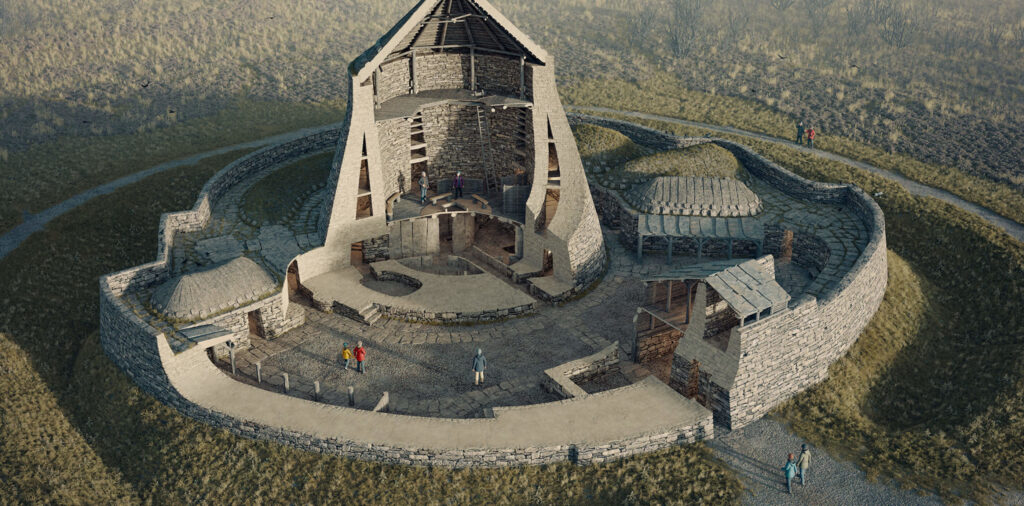
What if we consider the possibility that Irish ring forts were not as we see them today, but were instead taller and usually roofed halls, similar to Scottish brochs, constructed around the same time and by an almost identical culture?
This would also explain frequent and inexplicable mentions of a “roof-tree” with reference to Irish halls in folklore and mythology, a tall pillar supporting the roof overhead with great inward-leaning walls.
The idea that many of these ring forts might have been brochs or tower halls is founded upon several observations.
To begin with, a ruined broch and an Irish ring fort are almost identical, right down to the hollow walls in several examples – a feature not usually associated with defensive walls. Almost all of the Scottish brochs look like supposed ring forts now, besides the most remote examples, because locals carted away their plentiful unmortared drystone and used it for field walls, farmhouses and other buildings.
It is reasonable to assume a similar fate befell Irish round halls.

These broch-ring-forts could easily have been designed with internal wooden stairs and walkways, which would not have survived either their demise or the intervening millennia and centuries. And then we have the continued references to towers in Irish mythology, such as at Tory Island, Túr na Rí, the Tower of the king.
Some may have had earthen banks built up around them, complete with a wooden wall above that, lending further credence to the idea that these were closer to brochs in their original shape. The architectural skill involved would have been very easily within the reach of people who also built round towers.
It is a proposal well worth considering, and further considering that these halls could be of far greater antiquity than we assume today, with some of them perhaps having been originally constructed during the Bronze Age – the similarities between ring forts and Dún Aonghasa in the Aran Islands cannot be overlooked.
Claiming the ancient Irish built enormous numbers of cumbersome and pointless cattle pens at this point would seem rather like claiming ruined Irish abbeys never had roofs, simply because we have never found any roofs over ruined Irish abbeys.