I don’t usually discuss history this recent on Brehon Academy, as most of what we explore here belongs to the world of the brehons, the kings of Tara and the tales of the Otherworld.
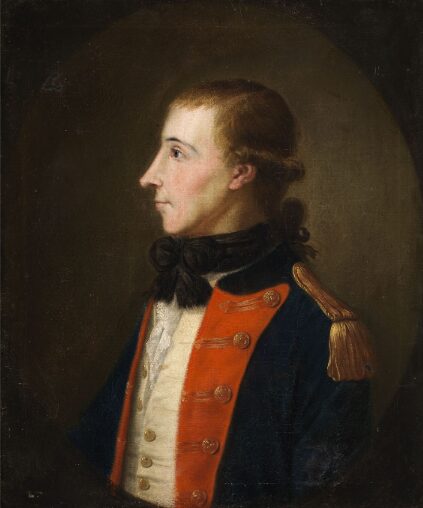
Today, though, 19 November, marks the anniversary of the death of Theobald Wolfe Tone in 1798, and his story deserves a place here.
Tone imagined an Ireland where people of every faith would share one name and one citizenship, and that idea still shapes how we think about what it means to be Irish.
A Dublin Barrister
Tone was born in Dublin on 20 June 1763, the eldest son of Peter Tone, a coachmaker, and he was baptised in the Church of Ireland parish of St Mary’s.
He studied at Trinity College Dublin and trained for the bar at the Middle Temple in London and at King’s Inns, although the law never held his heart for long.
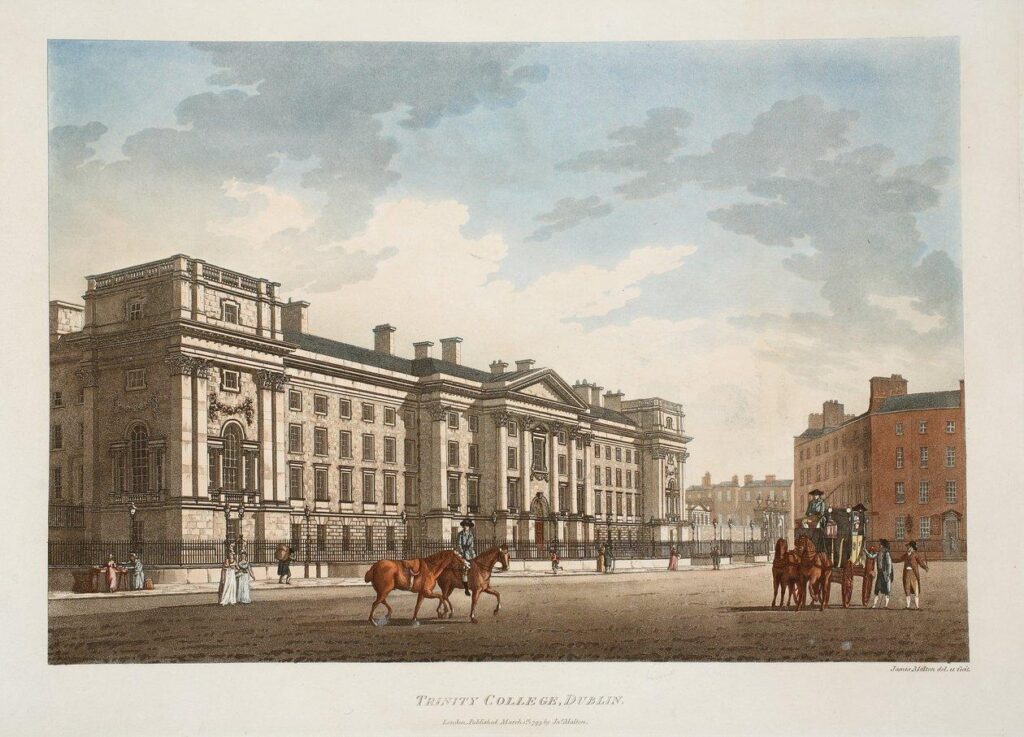
At Trinity, Tone found his voice in the College Historical Society, known to generations of students simply as the Hist.
Founded in 1770, the Hist was recognised by Guinness World Records in 2023 as the oldest student society in the world, a title Trinity’s own Philosophical Society still disputes.
Tone was elected auditor in 1785, with Thomas Addis Emmet, a future United Irish leader, serving on the committee beside him.
The society’s habit of nurturing radicals did not escape the college authorities, and in 1794 the Board expelled the Hist from Trinity, readmitting it only on condition that “no question of modern politics shall be debated.”
The condition did little to cool things, as Robert Emmet joined in 1797, and in the purge of the college before the Rising, eight members of the Hist were expelled.
The Ireland he grew up in was governed by a parliament on College Green that answered to a small Anglican landed elite.
Catholics, who made up the great majority of the people, could neither vote nor sit in that parliament.
Presbyterians, strongest in Ulster, paid tithes to a church that was not their own and had little real voice in government.
An Argument on Behalf of the Catholics
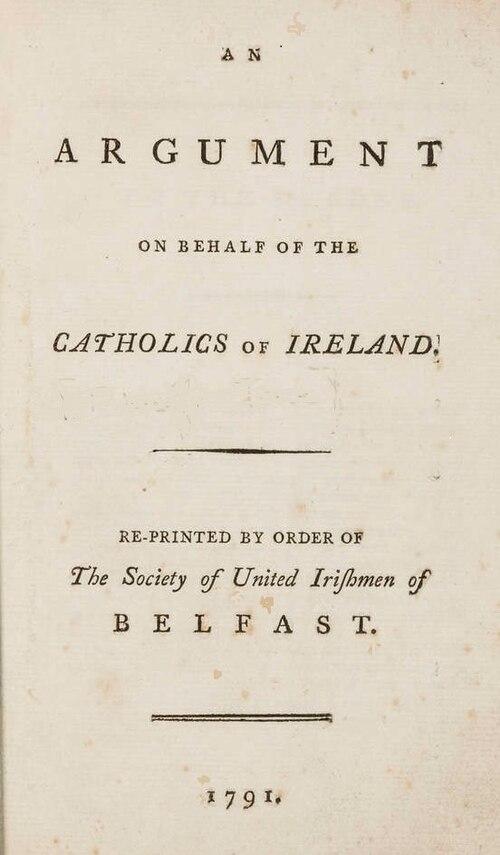
Catholics of Ireland (1791)
In 1791 Tone wrote a pamphlet under the pen name “A Northern Whig”, titled An Argument on Behalf of the Catholics of Ireland.
His case was simple and bold for its day, holding that Protestant reformers would never win a fair parliament while they left their Catholic neighbours outside the door, because a divided people could always be ruled by the few.
The pamphlet found an eager audience in Belfast, where Presbyterian radicals had celebrated the anniversary of the fall of the Bastille that July with great enthusiasm.
The Society of United Irishmen
That autumn Tone and his close friend Thomas Russell were invited north, and on 18 October 1791 the first Society of United Irishmen was founded in Belfast alongside Samuel Neilson and a group of Presbyterian reformers.
It was Tone who suggested the name, and a Dublin society followed within weeks.
The society began as a reform movement, calling for equal representation of all the people in parliament and an end to the laws against Catholics.
Tone’s own ambitions ran further, and in 1796 he set them down in his journal in words that are still quoted at Bodenstown every year.
“To subvert the tyranny of our execrable government, to break the connection with England, the never failing source of all our political evils, and to assert the independence of my country, these were my objects. To unite the whole people of Ireland, to abolish the memory of all past dissensions, and to substitute the common name of Irishman in place of the denominations of Protestant, Catholic and Dissenter, these were my means.”
What strikes me most is that Tone separated his ends from his means, with independence as the goal and a shared identity, built on a shared home rather than a shared church, as the way to reach it.
He also looked beyond the gentry, writing in 1796 that if the men of property would not support the cause, the movement would rest on “that numerous and respectable class of the community, the men of no property.”
A Gaelic Thread
The United Irishmen’s newspaper, the Northern Star, printed Bolg an tSolair in Belfast in 1795, a collection of Irish grammar, vocabulary, songs and Fenian verse that is regarded as the first Irish-language periodical.
Russell and the Irish scholar Patrick Lynch (Pádraig Ó Loingsigh) were behind it, and the paper also advertised Lynch’s Irish classes in the town.
Tone himself was less enchanted by the old culture, and when he heard the harpers gathered at the Belfast Harp Festival in July 1792, he wrote in his journal, “The harpers again. Strum, strum and be hanged.”
The revival of Irish music and language in those years owed more to Russell, Lynch and the young collector Edward Bunting than to Tone.
From Reform to Revolution
Britain went to war with revolutionary France in 1793, and the government moved against the society, which was suppressed in 1794 and reorganised as a secret, armed movement.
In December 1796 a fleet carrying around 14,000 soldiers under General Lazare Hoche reached Bantry Bay, but storms scattered the ships and no landing was ever made.
Tone, compromised by his contact with a French agent, left for America in 1795 and then travelled to Paris, where he persuaded the French Directory to send an army to Ireland.
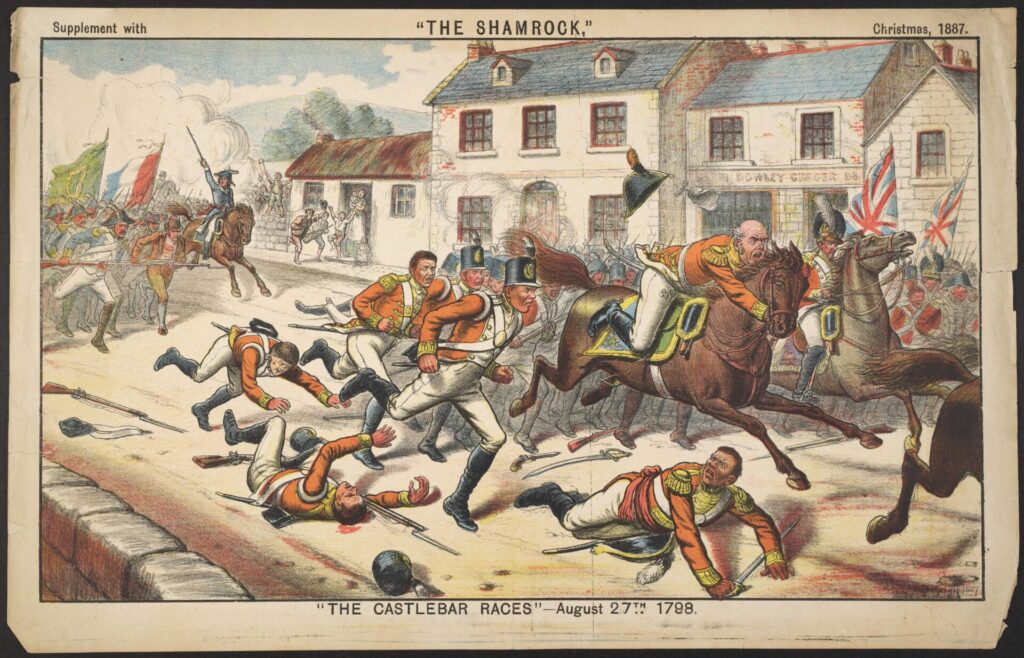
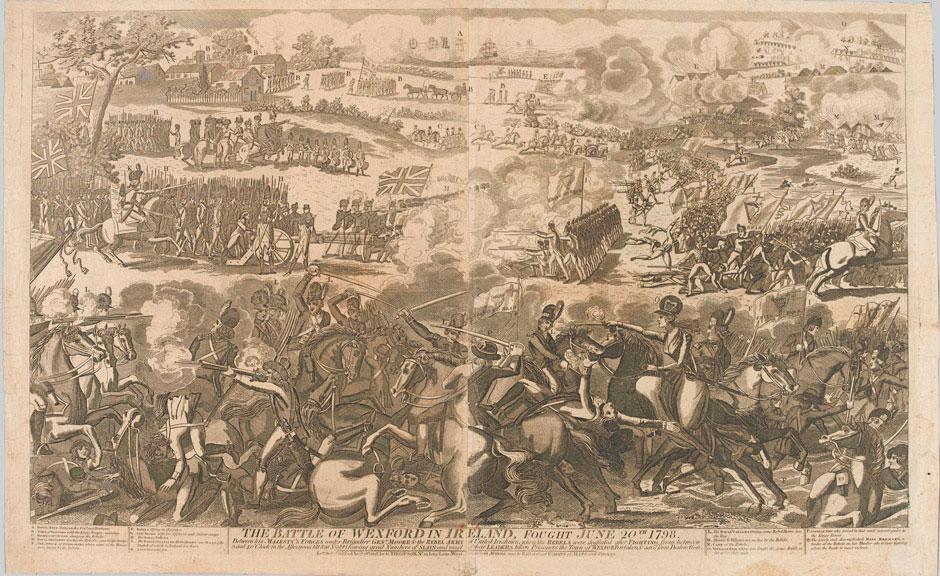
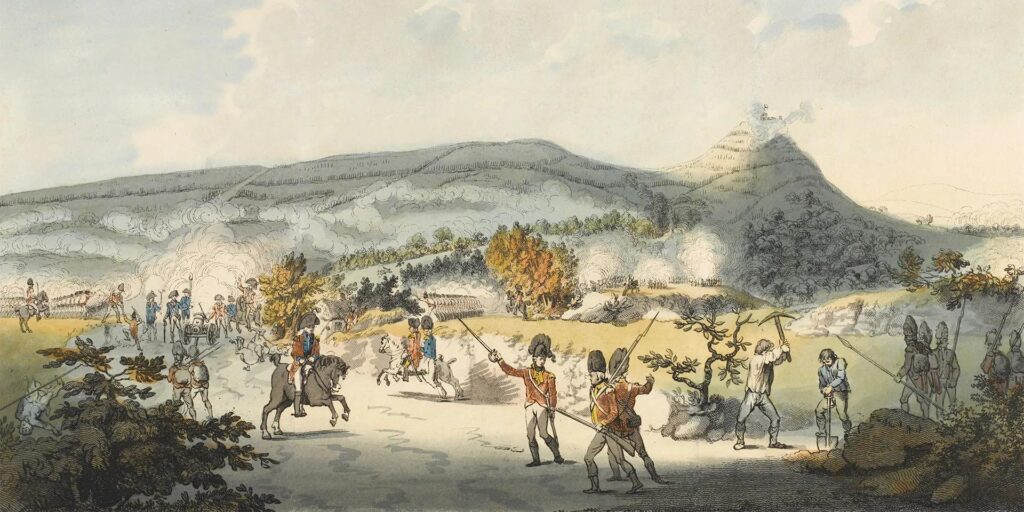
The Rising broke out in May 1798 while Tone was still in France, and it was crushed at enormous human cost across Leinster, Antrim and Down.
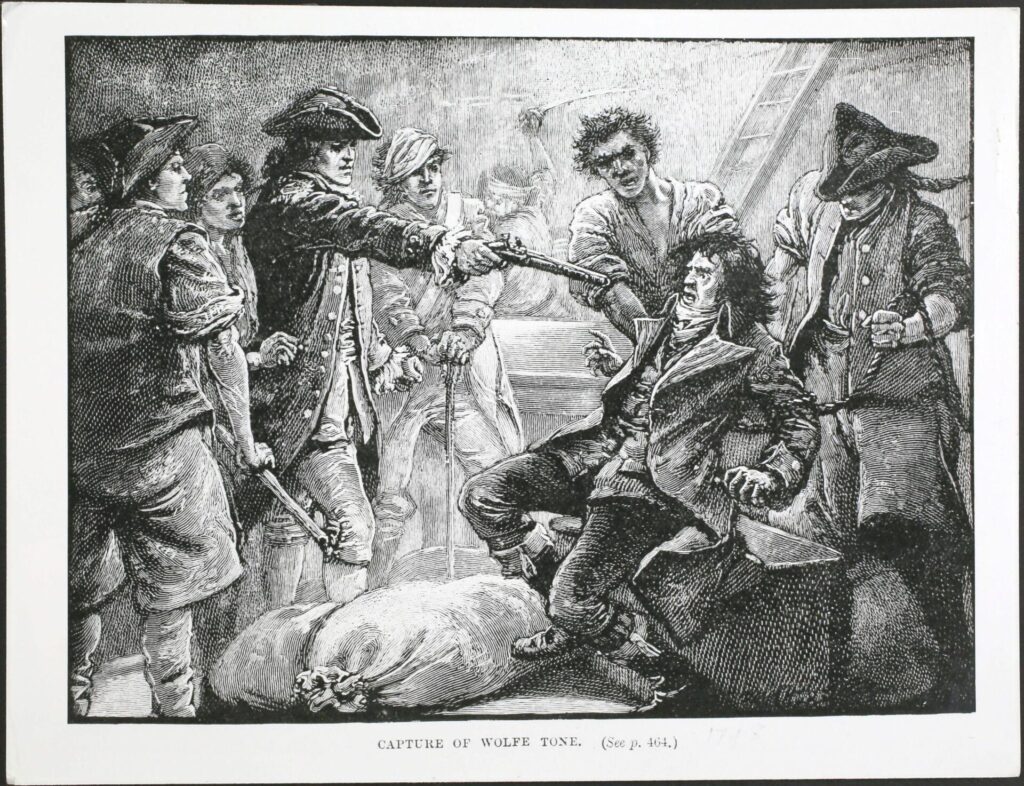
Tone sailed with a smaller French squadron that autumn, and after a naval battle off Tory Island in October 1798 he was captured aboard the Hoche in Lough Swilly.
He was recognised on landing by Sir George Hill, an old acquaintance from his Trinity days.
The Trial and the Provost’s Prison
Tone faced a court-martial in Dublin on 10 November 1798, wearing the uniform of a French officer.
He asked to be shot as a soldier, and the request was refused, and he was sentenced to hang on 12 November.
On the morning set for his execution, he was found with a severe wound to his throat, and while his friends worked through the courts to have the sentence suspended, he lingered for a week in the Provost’s Prison.
He died on 19 November 1798, aged thirty-five, and was buried at Bodenstown in County Kildare.
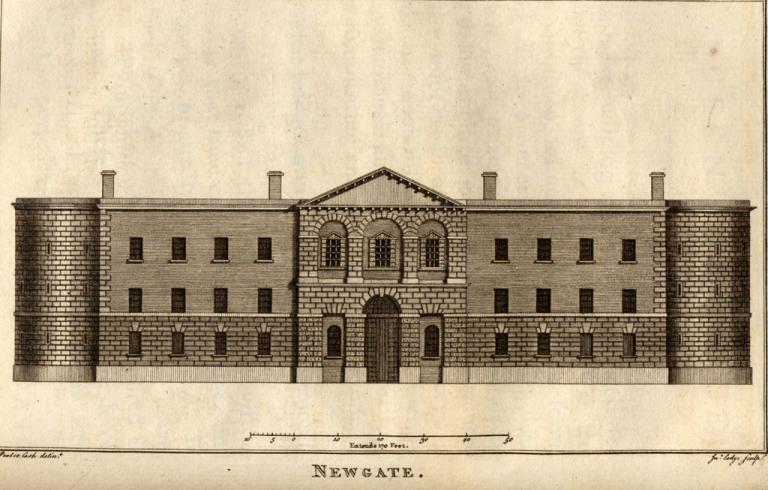
The wound is generally accepted as self-inflicted, though his son William later complained that nobody had been allowed near his father in his final days, and some writers have questioned the official account ever since.
A Patriot’s Eulogy for a Patriot
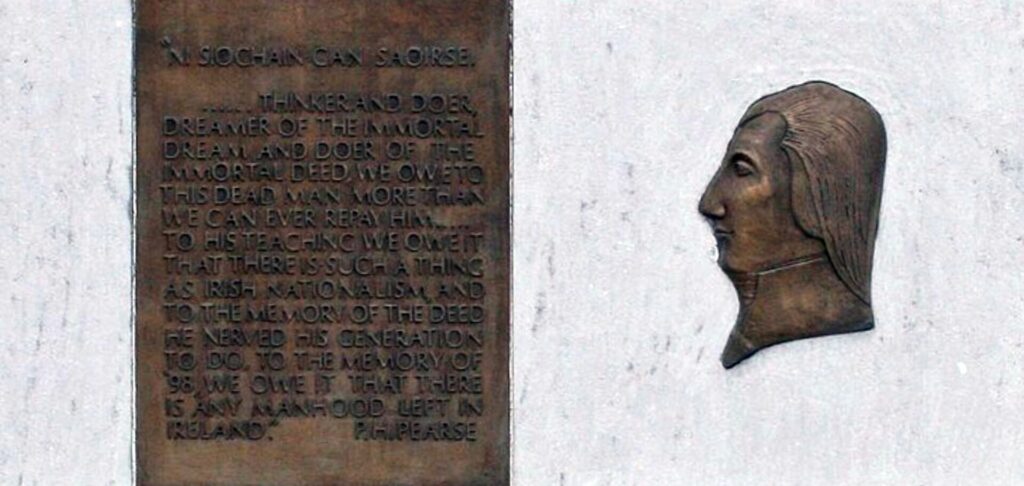
On 22 June 1913, Padraig Henary Pearse made a rousing speech at the grave of Wolfe Tone in Bodenstown Churchyard.
We have come to the holiest place in Ireland; holier to us even than the place where Patrick sleeps in Down. Patrick brought us life, but this man died for us. . . . He was the greatest of Irish Nationalists; I believe he was the greatest of Irish men.
. . . He made articulate the dumb voices of the centuries, he gave Ireland a clear and precise and worthy concept of Nationality. But he did more than this: not only did he define Irish Nationalism, but he armed his generation in defence of it. Thinker and doer, dreamer of the immortal dream and doer of the immortal deed—we owe to this dead man more than we can ever repay him by making pilgrimages to his grave or by rearing to him the stateliest monument in the streets of his city. To his teaching we owe it that there is such a thing as Irish Nationalism, and to the memory of the deed he nerved his generation to do, to the memory of ’98, we owe it that there is any manhood left in Ireland.
. . . I do not ask you to venerate him as a saint; I ask you to love him as a man. For myself, I would rather have known this man than any man of whom I have ever heard or ever read.
. . . Think of how he put virility into the Catholic movement, how this heretic toiled to make free men of Catholic helots, how, as he worked among them, he grew to know and to love the real, the historic Irish people, and the great, clear, sane conception came to him that in Ireland there must be, not two nations or three nations, but one nation, that Protestant and Dissenter must be brought into amity with Catholic, and that Catholic, Protestant, and Dissenter must unite to achieve freedom for all.
. . . Then the last scene in the Provost Prison, and Tone lies dead, the greatest of the men of ’98. To this spot they bore him, and here he awaits the judgment; and we stand at his graveside and remember that his work is still unaccomplished after more than a hundred years.
. . . We need not re-state our programme; Tone has stated it for us: ‘To break the connection with England, the never-failing source of all our political evils, and to assert the independence of my country—these were my objects. To unite the whole people of Ireland, to abolish the memory of all past dissensions, and to substitute the common name of Irishmen in place of the denominations of Protestant, Catholic, and Dissenter—these were my means.’
I find here implicit all the philosophy of Irish Nationalism, all the teaching of the Gaelic League and the later prophets. Ireland one and Ireland free—is not this the definition of Ireland a Nation? . . . We pledge ourselves to follow in the steps of Tone, never to rest, either by day or by night, until his work be accomplished.
Why Tone Still Matters
Tone’s Ireland never came to pass in his lifetime, and the Act of Union followed only two years after his death.
The phrase “the common name of Irishman” outlived him all the same, and it was taken up by Young Ireland, the Fenians and the men and women of 1916, each of whom looked back to Tone as a founding figure.
More than two centuries on, his vision is still unfinished.
Since partition in 1921, six of Ulster’s counties have remained cut off from the rest of the island under British rule, and the old divisions between Protestant, Catholic and Dissenter that Tone hoped to abolish have shaped life in the North ever since.
Every November, then, Tone’s anniversary is a reminder of the work that remains, as well as a moment to honour a remarkable Dubliner.
If you are ever in Kildare, visit his grave at Bodenstown, and better still, read his journals, which are lively, funny and deeply human.
Further Reading
Marianne Elliott, Wolfe Tone (2nd ed., Liverpool University Press, 2012).
Life of Theobald Wolfe Tone, edited by his son William Theobald Wolfe Tone (1826), available on the Internet Archive, https://archive.org/download/tonelife00tonerich/tonelife00tonerich.pdf
National Army Museum, “The Irish Rebellion of 1798”, https://www.nam.ac.uk/explore/irish-rebellion-1798
History Ireland, “The death of Theobald Wolfe Tone, suicide or murder?”, https://historyireland.com/?p=34869
History Ireland, “Wolfe Tone (singular and plural)”, https://historyireland.com/?p=34031
Maura Valenti, “Strum, strum and be hanged: reassessing the 1792 Belfast Harp Festival”, https://ora.ox.ac.uk/objects/uuid:bc810ea8-e6a9-4bdf-a197-be8c0d2299cb
Cartlann, Bolg an tSolair (1795), https://cartlann.org/authors/united-irishmen/bolg-an-tsolair/
P. H. Pearse at the grave of Wolfe Tone in Bodenstown Churchyard, 22 June 1913.
Full text from How Does She Stand? Three Addresses (Dublin, 1915), CELT edition, https://celt.ucc.ie/published/E900007-002/text001.html