Imagine a political idea so old and so serious that a king who told a lie could, in theory, cause the harvest to fail.
That was fír flaithemon (pronounced roughly feer FLAH-hev-on, and sometimes written fír flathemon) — one of the central ideas in early Irish thinking about kingship.
The phrase means “the ruler’s (flaith) truth (fír),” and it wasn’t a metaphor or a nice turn of phrase for a king’s good character. Medieval Irish writers meant it literally.
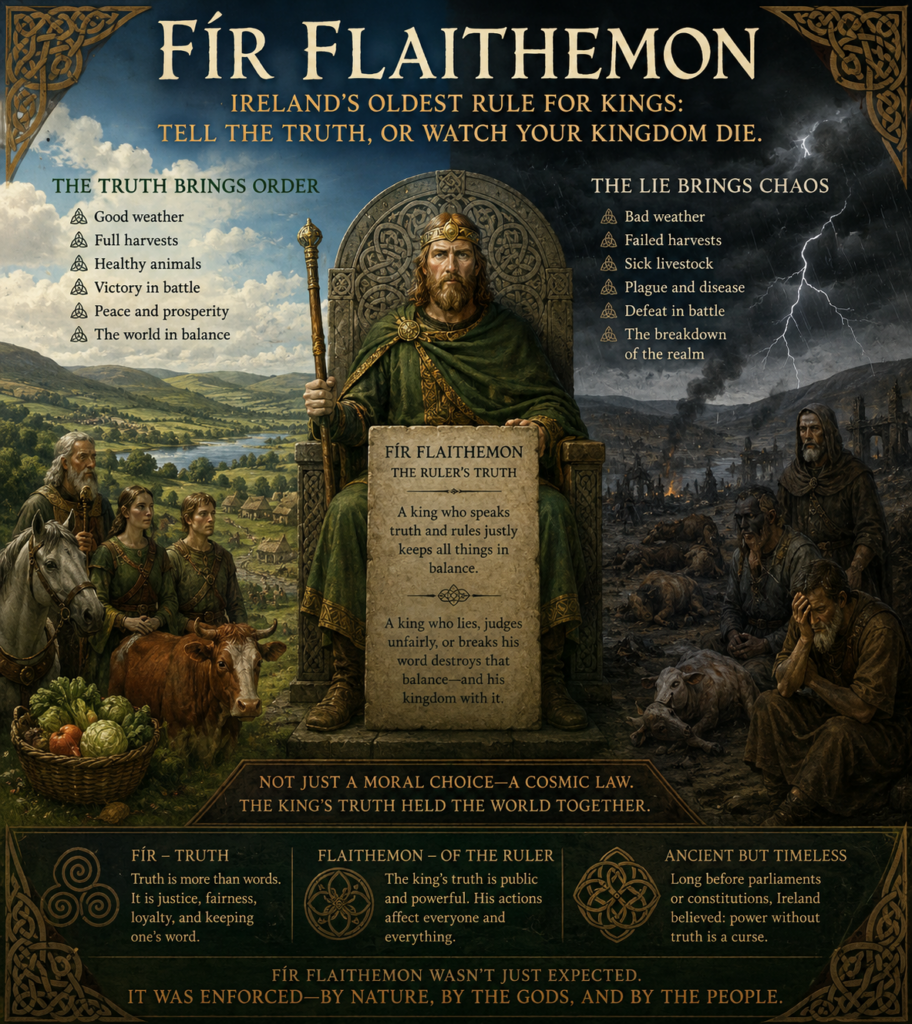
- A king who ruled with justice and spoke the truth kept the whole world in balance: weather, harvests, animals, even the safety of his people in battle.
- A king who lied, judged unfairly, or broke his word could bring the opposite: bad weather, sick livestock, plague, and defeat.
It’s a strange, beautiful, and slightly terrifying idea, and it sat right at the heart of how the early Irish thought about power.
What Fír Flaithemon Actually Meant
At its simplest, fír flaithemon holds that a just and honest ruler’s conduct is directly, causally connected to the prosperity of his kingdom.
Rule truthfully, and good things follow almost automatically:
- Rich harvests and healthy livestock
- Fertile land and fertile people
- Calm seas and good weather
- Peace at home and victory in war
Break that truth — through injustice, false judgment, or a broken promise — and the opposite kicks in: gáu flathemon, or “the ruler’s falsehood,” which was believed to bring famine, disease, bad weather, and defeat in its wake.
This wasn’t framed as superstition on the fringes of Irish culture.
It was written into serious texts intended to train future kings, and it shaped how storytellers explained why some reigns flourished and others collapsed.
Where the Idea Comes From: Advice for a Young King
The clearest statement of fír flaithemon survives in a text called Audacht Morainn — “The Testament of Morann” — one of a genre of early Irish writings called tecosca, meaning “instructions” or “teachings.”
These texts are framed as advice given by a wise older figure to a young king about to take the throne. In Audacht Morainn, the speaker is Morann, a legendary judge, and the advice is addressed to a young king named Feradach Finnfechtnach (the “fair-blessed”).
The text repeats a kind of refrain, again and again:
“It is through the ruler’s truth that…”
— and then lists the good things that follow.
It’s through the ruler’s truth that the land is fruitful.
It’s through the ruler’s truth that great artists and craftsmen reach the height of their skill.
It’s through the ruler’s truth that peace and calm weather are secured.
Let him magnify Truth, it will magnify him.
Let him strengthen Truth, it will strengthen him.
Let him preserve Truth, it will preserve him.
Let him raise up Truth, it will raise him up.For so long as he preserves Truth, good will not be lacking to him, and his reign will not fail.
For by the prince’s truth great peoples are ruled.
By the prince’s truth great mortality is warded off from men.
By the prince’s truth great battles are driven off into the enemies’ country.
By the prince’s truth every right prevails and every vessel is full in his reign.By the prince’s truth fair weather comes in each fitting season,
winter fine and frosty,
spring dry and windy,
summer warm with showers of rain,
autumn with heavy dews and fruitful.
For it is the prince’s falsehood that brings perverse weather upon wicked peoples,
and dries up the fruit of the earth.— Auraiccept Moraind, ed. Thurneysen, Zeitschrift fiir celtische Philologie, XI (1917), 80
The style is almost like a spell, repeated with small variations to hammer home a single idea: everything good in the kingdom flows from the king’s own honesty.
Audacht Morainn is thought to date back, in its oldest form, to around the seventh century — meaning this idea was already old and established by the time most of the Irish sagas we now read were being written down.
There’s a whole small library of these tecosca texts, not just one.
Tecosca Cormaic (“The Instructions of Cormac”) is another famous example, cast as a dialogue between the legendary wise king Cormac mac Airt and his son Cairpre, where Cormac answers questions about what makes a good ruler — everything from justice to the value of listening to wise counsel.
Together, these texts amount to a kind of early Irish “mirror for princes,” a genre of political education that other medieval cultures also produced, but which the Irish gave a distinctly supernatural twist.
The “Act of Truth”: When Speaking Truly Bends Reality
Fír flaithemon is really one expression of a bigger and even stranger idea found throughout early Irish literature: the belief that a solemn, truthful statement could have a direct effect on the physical world.
Scholars call this the “Act of Truth.”
You can see smaller versions of it scattered through the sagas: objects that are said to test truthfulness directly, like the fabled “Collar of Morann,” or like an axe or an iron bar that will burn a liar but leave an honest person unharmed, or a magical drinking cup that shatters when three lies are told over it and reassembles when three truths are spoken.
These aren’t just fun fairy-tale details — they’re small demonstrations of the same underlying belief that sits behind fír flaithemon: that truth itself is a kind of force, one that acts on reality rather than just describing it.
Applied to kingship, this meant a king’s judgments weren’t simply legal decisions.
A truly just verdict was believed to actively support the natural order, while a false one damaged it — which is exactly why a king’s truthfulness mattered so much more than we might expect from a purely political or legal system.
A Cautionary Tale: The King Who Ruled Perfectly, Then Didn’t
The best way to feel the weight of fír flaithemon isn’t through the theory texts — it’s through the story that shows what happens when it breaks down.
That story is Togail Bruidne Dá Derga, “The Destruction of Dá Derga’s Hostel,” one of the great tragic sagas of early Irish literature, centred on the legendary king Conaire Mór (to read the full account, see Whitley Stokes in the Further Reading section below).
Conaire begins as close to the ideal Irish king as any character in the literature gets. His reign opens with a lush description of peace, abundance, and good weather — precisely the blessings that fír flaithemon promises a truthful ruler.
But before he took the throne, Conaire was bound by a set of unusual prohibitions, or geasa (singular geis) — sacred pledges, agreements for things he must never do, imposed on him by otherworldly forces. Among them: he must never allow plundering in his reign.
The trouble starts small.
Conaire’s foster-brothers take up petty thieving, and rather than judging them with the strict fairness his role demands, Conaire lets it slide — a first crack in his fír flathemon, his commitment to true judgment.
That one compromise doesn’t stay contained.
His foster-brothers escalate to full-scale raiding, Conaire is forced to banish them, and from there his protective taboos begin falling one after another, almost as if the story itself is enforcing the rule that a king’s small failures of justice open the door to much larger disasters.
The saga ends with Conaire’s death at Dá Derga’s hostel, besieged by his own former foster-brothers and killed by thirst and the sword in one of the most vivid death scenes in Irish literature.
Read against the backdrop of fír flaithemon, Togail Bruidne Dá Derga isn’t really a story about bad luck or an unlucky set of taboos.
It’s a story about what one small failure of a king’s justice can set in motion — a slow-motion demonstration of gáu flathemon, the ruler’s falsehood, undoing everything the ruler’s truth had built.
Not Just an Irish Idea: The Indo-European Connection
Here’s where the story gets genuinely surprising.
This idea — that a ruler’s or a virtuous person’s truthful word carries real, world-altering power — isn’t unique to Ireland. It shows up, independently recorded, in ancient India.
In Sanskrit tradition, this is called satyakriyā, the “Act of Truth”: a device found throughout Indian religious and narrative literature, where a person of unquestionable virtue makes a solemn declaration and the sheer truth of the statement produces a real effect in the world — fire refuses to burn them, poison loses its potency, and so on.
Vedic religious poetry expresses a closely related idea through the concept of ṛta, a kind of cosmic and moral “right order” upheld by truthfulness, which the Rig Veda associates especially with the gods Mitra and Varuna — said to sustain the sky and the earth themselves through their commitment to Truth.
The scholar who first drew this connection out in detail was the Irish Celticist Myles Dillon (1900–1972) — a fascinating figure in his own right, who trained as a Sanskrit specialist before he ever specialised in Old Irish, and who spent much of his career comparing the two traditions.
In a short 1947 article called “The Hindu Act of Truth in Celtic Tradition,” (see sources below) Dillon laid out just how closely the Irish and Vedic material echo each other: two societies, separated by thousands of miles and well over a thousand years of independent development, both arriving at the idea that a ruler’s honesty is a literal engine of the world’s wellbeing.
Whether this is because Ireland and India both inherited the idea from a shared, much older Indo-European ancestor-culture, or because two societies simply arrived at a similar idea on their own, is still genuinely debated by scholars.
But either way, it’s a striking reminder that fír flaithemon wasn’t a purely local Irish quirk — it may be one surviving branch of a much older and wider way of thinking about truth, power, and the natural world.
Why This Idea Still Matters
Fír flaithemon tells us something important about how the early Irish understood leadership.
A king wasn’t simply a political or military figurehead — he was, in a very real sense, the hinge between his people and the natural order itself.
His personal integrity wasn’t a private virtue; it was public infrastructure, as essential to the harvest as the weather.
It’s also a genuinely useful lens for reading the sagas.
Once you know about fír flaithemon, stories like Togail Bruidne Dá Derga stop looking like random collections of taboos and curses and start looking like carefully built arguments about what happens when justice slips, even by degrees.
And knowing about its Sanskrit cousin, satyakriyā, opens up an unexpected door from Irish mythology straight into the world of the Vedas — two ancient literatures, on opposite sides of the world, both insisting that truth is not just something you say, but something you do.
Further Reading
- Kelly, Fergus, ed. and trans. Audacht Morainn. Dublin: Dublin Institute for Advanced Studies, 1976. See: https://library.celt.dias.ie/bib/105949
- Meyer, Kuno, ed. and trans. Tecosca Cormaic: The Instructions of King Cormac Mac Airt.
Royal Irish Academy Todd Lecture Series 15. Dublin, 1909.
Full text available at CELT: celt.ucc.ie/published/T503001.html - Stokes, Whitley, ed. and trans. Togail Bruidne Dá Derga – The Destruction of Dá Derga’s Hostel.
Available from the Brehon Academy Members’ Library here: https://brehonacademy.org/docs/togail-bruidne-da-derga-the-destruction-of-da-dergas-hostel-translated-by-whitley-stokes/ - Dillon, Myles. “The Hindu Act of Truth in Celtic Tradition.” Modern Philology 44, no. 3 (February 1947): 137–140. See: https://www.jstor.org/stable/435296
- Dillon, Myles. “The Archaism of Irish Tradition.” Proceedings of the British Academy 33 (1947): 245–264. Available from the Brehon Academy Members’ Library here: https://brehonacademy.org/docs/the-archaism-of-irish-tradition-by-myles-dillon-1948-in-proceedings-of-the-british-academy-1947/
- Togail Bruidne Dá Derga (“The Destruction of Dá Derga’s Hostel”) — Overview and Synopsis: en.wikipedia.org/wiki/Togail_Bruidne_Dá_Derga
- “Geis” (on taboos and Conaire Mór’s downfall): en.wikipedia.org/wiki/Geis
- Ó Cathasaigh, Tomás. The Heroic Biography of Cormac mac Airt. Dublin: Dublin Institute for Advanced Studies, 1977. (Builds on Dillon’s Act of Truth concept in relation to Cormac mac Airt.)
- “Tecosca Cormaic,” CODECS: Online Database and e-Resources for Celtic Studies: codecs.vanhamel.nl/Tecosca_Cormaic