
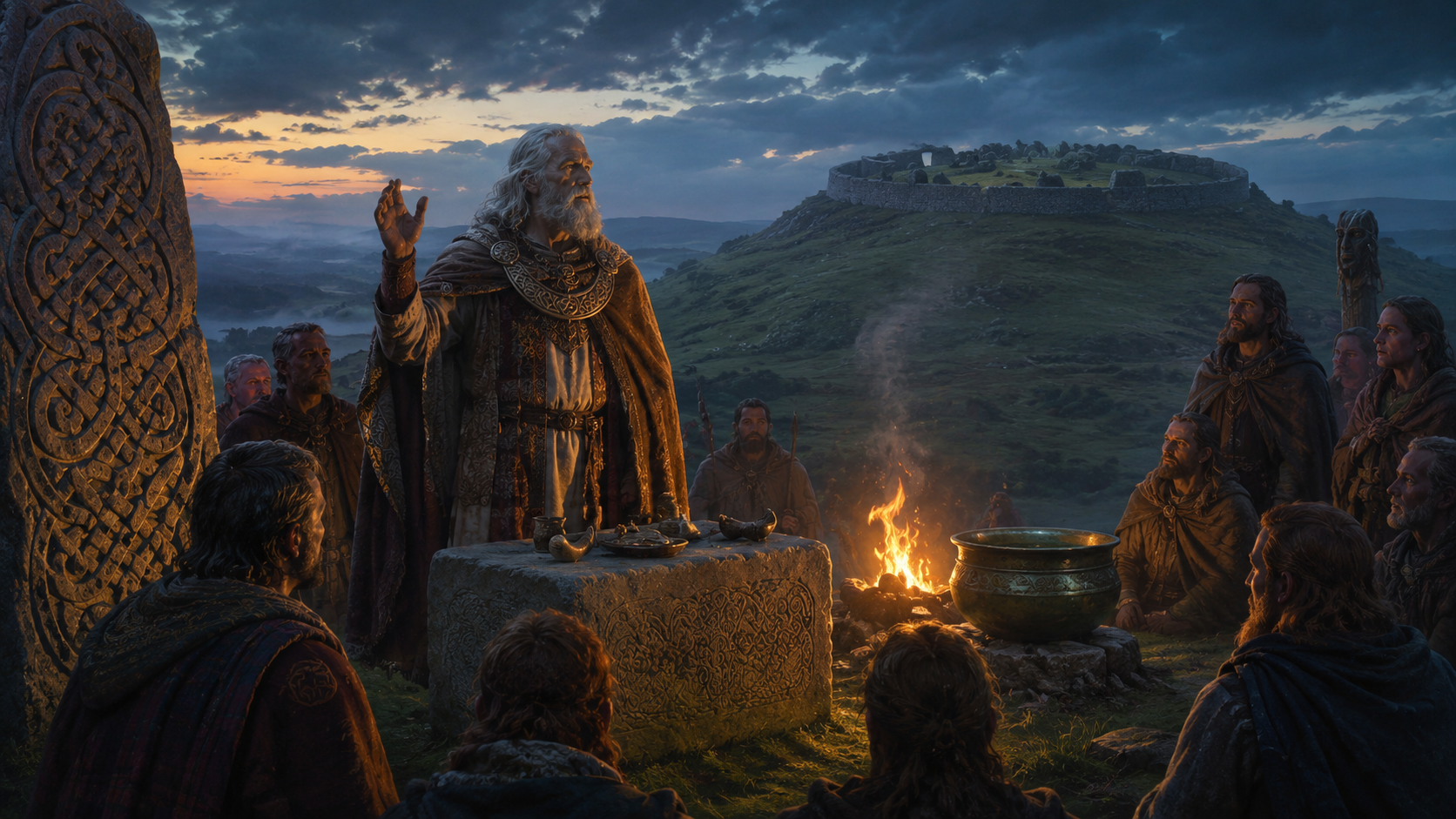
When people imagine early Irish law, they usually picture the brithem — the brehon — weighing evidence and handing down a careful judgement based on precedent.
That’s true enough for most cases.
But what happened when the evidence simply wasn’t there?
When it was one person’s word against another’s, with no witnesses and no way to break the deadlock?
According to a list preserved in the medieval Book of Ballymote, the answer in pre-Christian Ireland was to fall back on one of twelve ordeals — physical tests meant to force the truth to the surface, whether the parties liked it or not.
Some of these ordeals are dry legal record; others survive to us wrapped in full-blown saga narrative, complete with fairy mounds, otherworld cups and a judge born without a face.
A note on the sources
Two very different kinds of source lie behind this post, and they deserve to be told apart rather than blended silently:
- P. W. Joyce’s A Smaller Social History of Ancient Ireland (1906) gives a sober academic digest of the Ballymote list — seven of the twelve ordeals, described briefly and without embellishment, clearly working from the manuscript tradition.
- A modern popular retelling on emeraldisle.ie covers all twelve, but folds in a great deal of saga colour — the birth-story of the judge Morann, the fairy-mound origin of a second collar, the well-vision of King Badurn’s wife, Cormac Mac Airt’s otherworld cup.
- Some of this reflects genuine strands of early Irish literature (sagas like Echtrae Chormaic do send Cormac to the otherworld), but as presented it’s a storyteller’s synthesis rather than a sourced translation, so treat the finer narrative details as retelling rather than settled manuscript fact until you’ve chased them back to a scholarly edition.
With that caveat in place, here’s what the twelve ordeals actually were.
Who was Morann?
Several of the ordeals are attached to a single figure: Morann, remembered as the greatest of all brehons, “he of the Great Judgements.”
The legend behind his name is a strange one — his father, Cairbre Cinnchait, was said to have a disfigured “cat’s head” and killed every blemished child born to him, since an Irish king had to be whole in body.
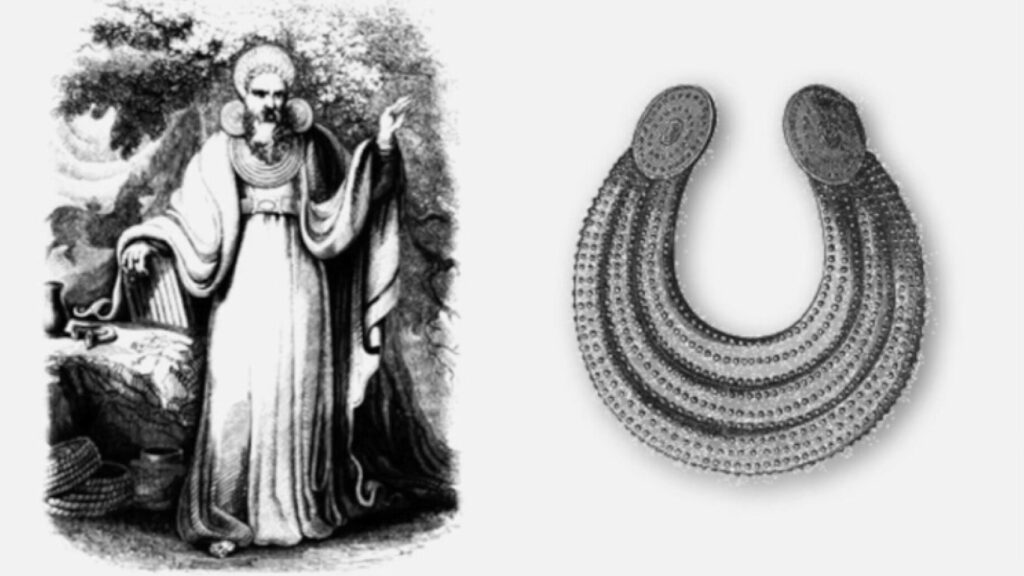
Morann was born without visible eyes, ears, nose or mouth, and was only saved by being held in the sea until the ninth wave washed over him, at which point the membrane covering his head separated and settled around his shoulders as a collar.
That collar became, in legend, the famous Collar of Morann — and gave rise to at least three related ordeals in the Ballymote list.
THE TWELVE ORDEALS
1–3. The Collars of Morann.
The first collar was the golden-and-silver-covered membrane from Morann’s birth: placed around the neck of a judge or witness, it tightened on a false judgement or false testimony and only loosened once the truth was told.
A second collar, a wooden hoop, was said to have come from a fairy mound and worked the same way on a hand or foot rather than the throat.
A third, the Sín Morainn, was linked in legend to an epistle Morann supposedly brought back from Paul the Apostle — the story that gave the word sín (“collar”) its lasting association with his name.
4. The Adze of Mochta.
A brass woodworking tool, its head heated red-hot in a fire of blackthorn.
The accused’s tongue was passed over it: it burned the guilty and spared the innocent.
5. Sencha’s Lot-Casting.
The poet Sencha would hold burning twigs and cast lots to the ground, one marked for the king’s side and one for the accused — reciting a poem over the fire as he did to protect his own hand.
This practice is said to have carried on into Christian times in the form of drawing lots from reliquaries.
6. The Vessel of Badurn.
A crystal cup, said to have come from a fairy mound at a holy well:
Three false words spoken over it would shatter it in three while three true words would make it whole again.
7. The Three Dark Stones.
A bucket of bog-dust and charcoal held three hidden stones — white, black and speckled.
Whichever the accused drew out decided the verdict: innocent, guilty, or half-guilty.
8. The Cauldron of Truth.
A silver-and-gold vessel of boiling water.
The guilty hand scalded; the innocent hand came out unharmed.
9. The Lot of Sen.
Three marked twigs — for chieftain, poet and accused — were thrown into water.
A floating lot meant innocence; a sinking one, guilt.
10. Luchta’s Iron.
Said to have been brought back from Brittany by the druid Luchta, this was an iron blessed by druidic incantation and heated until red-hot, then grasped by the accused with the same burn-or-don’t-burn logic as the other fire ordeals.
11. Waiting at an Altar.
The accused walked nine times around a pagan altar and then drank water over which a druid had spoken an incantation. Guilt was expected to show itself as some visible bodily mark; innocence left the person unharmed.
Both P.W. Joyce and the later retelling point out the obvious parallel here with the Biblical ordeal for a woman suspected of infidelity in the Book of Numbers, Ch 5.
12. Cormac Mac Airt’s Golden Cup.
Said to have been brought back by King Cormac from a visit to the otherworld: like Badurn’s vessel, it broke into three pieces at three false words and reunited at three true ones.
Taken together, the pattern across all twelve is strikingly consistent: fire, water, or a crafted object becomes a kind of lie-detector, responding to truth and falsehood as though truth itself had a physical weight.
Whether or not any of these were ever actually used — and there’s genuine scholarly debate about how much of this is real legal practice versus retrospective saga-making — the ordeals tell us plenty about what truth meant to the culture that imagined them.
The Other Morann: The Testament for a King
Confusingly — or perhaps fittingly — Morann’s name is also attached to a completely different, and much better attested, piece of early Irish literature: the Audacht Morainn, the “Testament of Morann.”
This isn’t about ordeals at all. It’s a work of wisdom literature, framed as advice sent by the dying judge Morann to a young king, Feradach Find Fechtnach, on how to rule well.
Rather than testing truth in individuals, the Audacht Morainn is concerned with truth in the ruler — a concept scholars call fír flathemon, “the ruler’s truth.”
The text argues that a king’s justice and truthfulness aren’t just personal virtues; they’re the load-bearing pillar of the whole natural and social order.
According to the testament, it is through the truth of the ruler that plagues are kept away, that cattle give milk, that corn grows tall, that rivers run full of fish, that peace holds at the borders, and that children are well-born.
Get the ruler’s truth wrong, and the world itself is said to suffer for it.
The text goes on to lay out concrete qualities a good king needs — mercy, justice, impartiality, firmness, generosity, honesty.
It also sketches out four types of ruler:
- the true ruler, moved naturally toward what is good;
- the wily ruler, who holds his borders through cunning;
- the ruler by force, who depends on outside power;
- and the bull ruler, who simply fights whatever comes at him.
Only the first of these, the testament makes clear, is a ruler in the fullest sense.
Two Sides of the Same Idea
It’s worth pausing on the fact that both of these traditions — the ordeals and the testament — orbit the same legendary name.
Whether or not one historical “Morann” lies behind both, the pairing isn’t an accident of storytelling.
Brehon law, at its root, treated truth as something almost physical: something that could choke a false witness through a collar, or starve a kingdom through a false king.
The ordeal and the testament are really the same idea, applied at two different scales — one to the individual under suspicion, the other to the sovereign whose word held the whole tribe together.
Modern References to Morann’s Collar
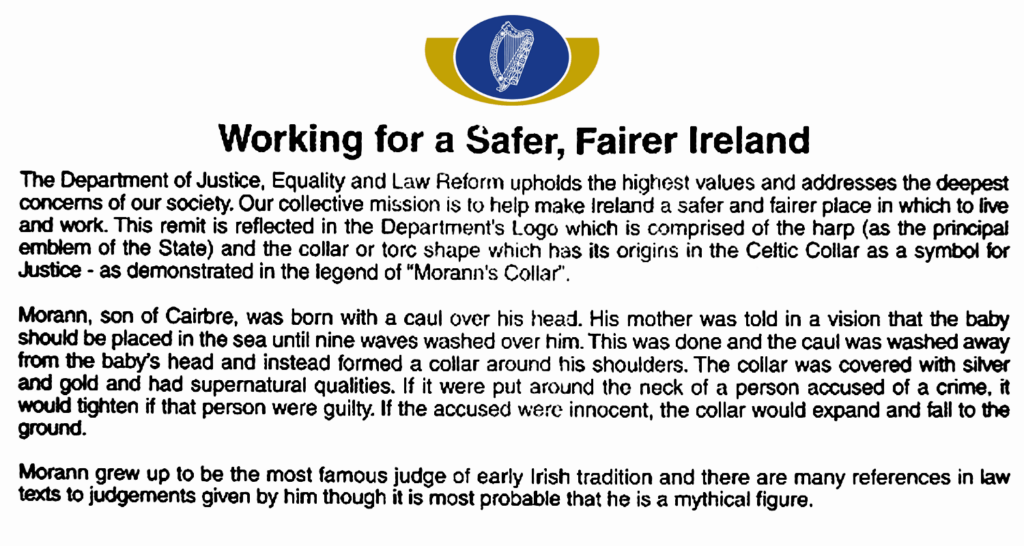
Below is a now-defunct logo for the Department of Justice, Equality, and Law Reform, along with an explanation that demonstrates they knew who Morann was and the significance of his “collar”.
In 2017, then Taoiseach (prime minister) of Ireland, Leo Varadkar, announced a rebranding initiative aimed at unifying the visual identities of the Irish government’s departments and agencies.
I wrote about this, and the shame of its removal, here.
SOURCES:
- P. W. Joyce, A Smaller Social History of Ancient Ireland (1906), via libraryireland.com;
- “The Twelve Ordeals of Ireland,” emeraldisle.ie;
- A transcription of the Audacht Morainn hosted at cranebookofwisdom.wordpress.com.
As ever, anyone wanting to cite this material for scholarly purposes should chase it back to Fergus Kelly’s or Myles Dillon’s editions of the Audacht Morainn and to the Ballymote manuscript tradition directly rather than relying on secondary retellings.


Pingback: Ireland's Oldest Rule for Kings: Tell the Truth, or Watch the Kingdom Die - The Brehon Academy