Muirbretha, the “sea-judgements,” is the main surviving Brehon law text on maritime affairs, and it survives only because a handful of scribes thought it worth copying fragments of it into other collections.
There is no complete manuscript. What we have is scattered across five fragmentary witnesses, labelled A to E by the scholar who edited them, plus a run of quotations preserved in O’Davoren’s Glossary and a scattering of citations in Cormac’s Glossary. One of those five fragments, witness C, is actually an excerpt copied out of a different law tract altogether, Bretha Éitgid, which shows how thoroughly these texts were cut up, quoted, and redistributed by the time the manuscripts we now hold were written.
The tract itself sits within the Senchas Már, the great compilation of Old Irish law assembled somewhere in the north midlands in the late seventh or early eighth century, and Muirbretha is the thirty-eighth text in that collection, placed in the final third alongside a run of other specialist tracts.
That fragmentary survival is worth pausing on, because it shapes everything else in this piece. Early Irish law was never written down as a single code handed down from a central authority. It grew out of the judgements of professional jurists, the brithemain (hence the name “brehon” law), whose rulings and reasoning were recorded, copied, and glossed by later generations of legal scholars, and reused as teaching material for centuries after they were first set down.
Muirbretha shows that process at its most visible.
We are not reading a finished statute on maritime law. We are reading the surviving fraction of a much larger discussion, filtered through however many scribes found a passage on shipwreck worth preserving.

What the Fragments Actually Cover
The subject matter itself is straightforward enough once you strip away the manuscript history. A ship wrecks, or cargo breaks loose and drifts, and the law has to answer two questions:
1. Who has a duty to do something about it.
2. Who gets to keep what comes ashore.
The duty side comes first.
Someone who came across a wreck, or came across property drifting in a stream, an estuary, or the open sea, had an obligation to report it rather than simply pocket it. The reward for that honesty, and for the actual physical effort of recovering the goods, scaled with how dangerous the recovery was.
Pulling a barrel out of a calm stream earned a smaller share than pulling the same barrel out of a rough sea, because the law was rewarding risk as much as honesty.
In the highest-risk recoveries, where a salvager genuinely put himself in danger to bring something ashore, the law allowed him to keep the item outright rather than divide it up at all.
The text also distinguishes between local people and strangers, which fits the wider pattern in Brehon law of treating a person’s rights and duties as bound up with their place in a known community, rather than as an abstract, universal category that applies the same way to everyone regardless of who they are or where they are from.
The Nine Waves and the Singing Sea
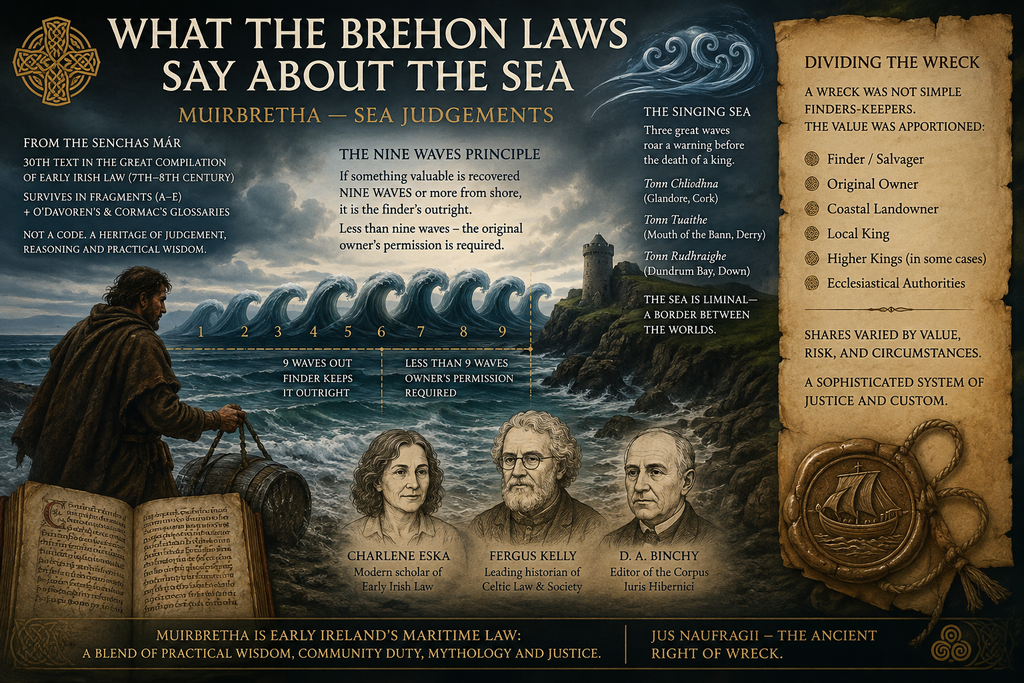
The single most quoted rule from this tract, and the one most likely to survive in popular retellings, is the tonn or “nine waves” principle. If a person recovered something valuable floating at sea, nine waves or more out from the shore, the item was his outright, regardless of who had owned it and without needing anyone’s permission. Bring the same item ashore from less than nine waves out, and the original owner’s permission was required before the finder could claim it as his own.
What makes this rule worth dwelling on is how naturally it sits alongside the mythology of the Irish coastline, rather than standing apart from it as a piece of dry legal technicality.
Early Irish tradition names three great waves, or Tonna, around the coast, each believed to roar out a warning before the death of a king or great chieftain. Tonn Chliodhna sounds in Glandore harbour in Cork, Tonn Tuaithe outside the mouth of the Bann in Derry, and Tonn Rudhraighe in Dundrum Bay off County Down. These were not treated as separate from the practical business of shipwreck and salvage.
The sea in early Irish thought was a genuinely liminal space, a border zone between the world of the living and the Otherworld, and the nine waves rule reads as a legal boundary drawn directly onto that mythological geography.
Ownership itself changes character once you cross into water, the tradition already regarded as uncanny.
Dividing the Wreck
Once something had actually been recovered and claimed, the law set out how it was to be shared, and that division is where Muirbretha shows its full character as a piece of Brehon jurisprudence rather than a simple finders-keepers rule.
A wreck did not belong outright to whoever happened to find it, except in those highest-risk cases already mentioned. Instead, the value was apportioned among the finder, the original owner where he could be identified, the landowner along that stretch of coast, the local king, and in some circumstances higher kings and ecclesiastical authorities as well, with the exact share depending on rank and on the circumstances of the recovery.
This is the same logic that runs through the rest of the Brehon corpus.

Compensation and entitlement in early Irish law were consistently scaled to social status and to the practical facts of a case, rather than fixed at a flat rate for everyone.
The system was built to head off disputes before they escalated into feud, spreading the benefit of a lucky recovery across everyone with a legitimate stake in that stretch of coast, and treating restitution and fair sharing as more important than simple reward.
There is no sense in the surviving fragments that the sea’s gifts belonged, by right, to whoever was strongest or best connected. They belonged to the community that shared the shore, apportioned by a rigid formula aiming at outcomes of fairness and justice.
An Old Law Facing a New Comparison
Set Muirbretha against how other medieval societies handled the same problem, and the contrast is striking.
Across much of continental Europe, the custom known as jus naufragii, the “right of wreck,” gave the lord or the inhabitants of a coastal territory the right to seize everything that washed ashore from a wreck: the ship, its cargo, and in the earliest period even its surviving crew, who could be taken as slaves.
The theological justification offered at the time was that a shipwreck was an act of God punishing the crew for some unnamed vice, which meant the vessel and its contents had already been forfeited by divine judgement and were fair game for anyone who found them.
The practice was resilient. Successive Holy Roman Emperors tried to suppress it in the fourteenth century, the Catholic Church condemned it repeatedly from the twelfth century into the sixteenth, and individual territories and trading cities negotiated one-off treaties abolishing it between themselves because a general law could not make it stick.
England developed its own version of the same instinct, the right of wreck, granted by the Crown to the lords of coastal manors and hundreds and still remembered in Cornwall through the folklore of the “wreckers.”
Where it survives at all in modern law, it survives inverted. Under the Merchant Shipping Act 1995, unclaimed wreck around the United Kingdom belongs to the Crown by default, unless the Crown has granted that right to someone else, which is the same underlying claim to a windfall on the shore, just relocated from the local lord to the state.
Muirbretha never framed the wreck as anyone’s spoil in that sense. There is no equivalent in the surviving fragments of a lord’s blanket right to seize whatever the sea delivers, and there is a positive duty to report a find rather than a licence to plunder it.
What the Brehon jurists built instead looks far closer to something we would now call a structured salvage award, a system that pays a rescuer in proportion to the risk and effort involved while still respecting the original owner’s claim wherever that owner could be identified.
That is, strikingly, close to the logic behind the Rhodian sea law of the ancient Mediterranean and the salvage provisions of Justinian’s Digest, and it anticipates by well over a thousand years the central principle of the modern International Convention on Salvage of 1989, which rewards a salvor according to the danger and skill involved in the rescue rather than simply handing the property to whoever got there first. Modern admiralty law still distinguishes between the “law of salvage,” which assumes an owner exists and rewards the rescuer with a share, and the much rarer “law of finds,” which treats genuinely abandoned property as belonging outright to whoever recovers it. Muirbretha was already drawing that same distinction, in its own vocabulary, over a thousand years earlier, and reserving the finders-keepers outcome for the cases where the risk to the salvager was greatest.
The Wider Family of Texts
Muirbretha does not stand entirely alone. Fergus Kelly’s Guide to Early Irish Law places it within a wider cluster of tracts dealing with lost, found, and disputed property, and Charlene Eska’s 2022 edition treats Muirbretha alongside two closely related texts, Aidbred, on lost and stolen property generally, and Heptad 64, on property found on land, arguing that the three together give a fuller picture of how early Irish law handled the whole question of things separated from their owners, whether by theft, accident, or the sea. Separately, private and family rights to fishing waters turn up elsewhere in the Brehon corpus, usually balanced against a degree of communal access, which suggests the jurists treated the open sea and a settled fishery as two different kinds of property with two different sets of rules, rather than folding everything coastal into a single maritime code.
Why It Still Matters
None of this survives as a complete, tidy code, and anyone working with Muirbretha has to build an argument out of fragments, glosses, and quotations rather than a finished text. That incompleteness is itself informative. It shows a legal culture confident enough in its oral and professional transmission that a great deal of maritime law never needed to be written down in full, only referenced, glossed, and taught by jurists who already knew the substance. What has survived still gives a coherent picture of a coastal society that treated the sea’s unpredictability as a shared risk to be managed fairly rather than a windfall to be seized, and that picture holds up remarkably well against nine hundred years of later European law arriving, by very different routes, at some of the same conclusions.
Further Reading
D.A. Binchy, Corpus Iuris Hibernici (Dublin Institute for Advanced Studies, 1978)
Fergus Kelly, A Guide to Early Irish Law (Dublin Institute for Advanced Studies, 1988)
P.W. Joyce, A Social History of Ancient Ireland, “The Sea in Ancient Ireland” — Library Ireland
“The Right of Wreck,” The National Archives blog — nationalarchives.gov.uk
Merchant Shipping Act 1995, Part IX, s.241 — legislation.gov.uk
“Rhodian Sea Law” — RomanGeek.com
“The Digest Of Justinian” — Archive.org