Patriots of any nation are, generally speaking, well versed in the history of their people. It is through the knowledge of the story of one’s own people that deep love and often sorrow is inculcated within.
It is from this deep pool that warriors have drawn their strength, poets found their words, and musicians found inspiration for their joys and laments.
This is certainly the case when it comes to Ireland.
It is generally well accepted that the Irish are lovers of their history, and not only for the depth and magnitude from which they can draw, having a written record dating back to the 5th century. and an oral tradition dating much further than even that, but also because their history has always served as a reminder of their sorrowful saga, a fall from nobility into slavery, and as a way to give context and meaning to their lamentable position.
The history of the Irish, found in their manuscripts, poetry, and prose, has been a never-ending source of strength throughout the ages – providing the rebel fallen kings much reason and justification for the never-ceasing rebellion that was carried on by each generation to the next.
Ireland’s history and the story of her people has been an anchor to the past that helped to make sense of the bitter religious and political tyrannies she has suffered, but also as a cloak over all of her people, once disunited by tribal territorial division and clan feuds of their own, only to be united in their common suffering and struggle against the oppressor from over the seas who came and snatched their ancestral lands from them, regardless of clan or race.
This bitterness lingers even today in Ireland.
And why shouldn’t it?
When six of her counties in the noble province of Ulster, the last of the great Gaelic strongholds, still sits in the clutches of a foreign government. One of the last ragged vestiges of the British Empire, and perhaps the only fragment that still, even centuries later, has a significant portion of the native population standing in opposition to it; at least in mind and spirit if not always in deed and act.
The British Queen Elizabeth II’s first (and last) visit to Irish shores happened in 2011, almost 100 years to the day since a previous British monarch last set foot on this ancient island. The coverage was streamed live on RTÉ News, all of it. While listening to the pundits fawning over her majesty, one of them quipped that “Anglo-Irish relations would be a lot better if English people knew Irish history a little bit more and Irish a little bit less.”
There is some truth to this statement, but I would say it is only a half-truth. Why should the Irish know their history any less than they do when it has been an anchor for Irish identity amidst a turbulent sea of strife, as well as a cloak to comfort and cover all of her people, a small shelter from the harshness they have faced?
But it is true that the relationship would be better if English people knew Irish history a little bit more – beyond a mere footnote or opening paragraph in the chapters of their schoolbooks as an opening prelude to the glorious age of imperialism that, in fact, followed centuries later.
I have spoken before of my own experience while pursuing a master’s degree in Politics, Philosophy, and Economics, in an elective class called “United Kingdom on the Map,” where Ireland was not even mentioned during the lengthy, in-depth discussion of British imperialism.
Having English relatives, I can also attest to the stunning lack of knowledge of Irish history, which is to say English history, on the part of our closest of neighbours. This fact seems to be an anomaly for neighbouring nations, as reason would presume; the proximity of countries to one another would naturally give cause for a deeper knowledge of each other’s histories and the relationship between their peoples.
But alas, this is not the case for England when it comes to Ireland. For every line referring to the history of Ireland in English history books, and of England’s role played here, the Irish have seven books, if not more…
Even still, it is not just the English who could do with knowing Irish history a little more; it is the Irish themselves – even though they are lovers of their history, in the modern era at least there is so much they have forgotten or have never learned of.
So much more depth and context to add to the story.
Since knowledge of one’s own history can serve as a light into the past, it can also serve as a light for understanding the present and, if wielded correctly, can act as a beacon to help guide a nation’s course into the future – being aware of both its glories and its mishaps, it can help to better navigate the world and human nature.
By illuminating some lesser-known facts of Irish history, facts that were not taught in our schooldays and are all but forgotten to most Irish, we will begin to capture some of the light of the past and use its shine to make better sense of the Ireland of today.
The topic of our discussion is the “plea of the Irish chieftains to the Pope.”
A little-known event that took place in 1317 — a document today known to historians as the Remonstrance of the Irish Princes, and one of the earliest and most remarkable assertions of Irish nationhood ever committed to parchment.
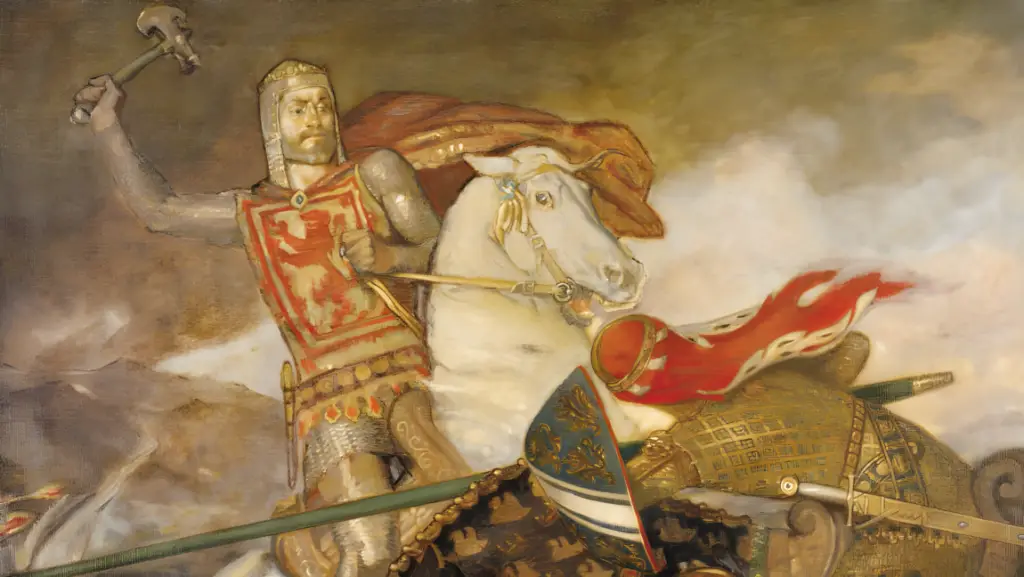
Edward II vs Robert the Bruce at the Battle of Bannockburn
Setting the Scene: Bannockburn and the Bruce Invasion
To understand why such a document came to be written, we must first set the scene. Three years earlier, at Bannockburn in 1314, Robert the Bruce had dealt Edward II of England a humiliation from which the crown of England would take a generation to recover.
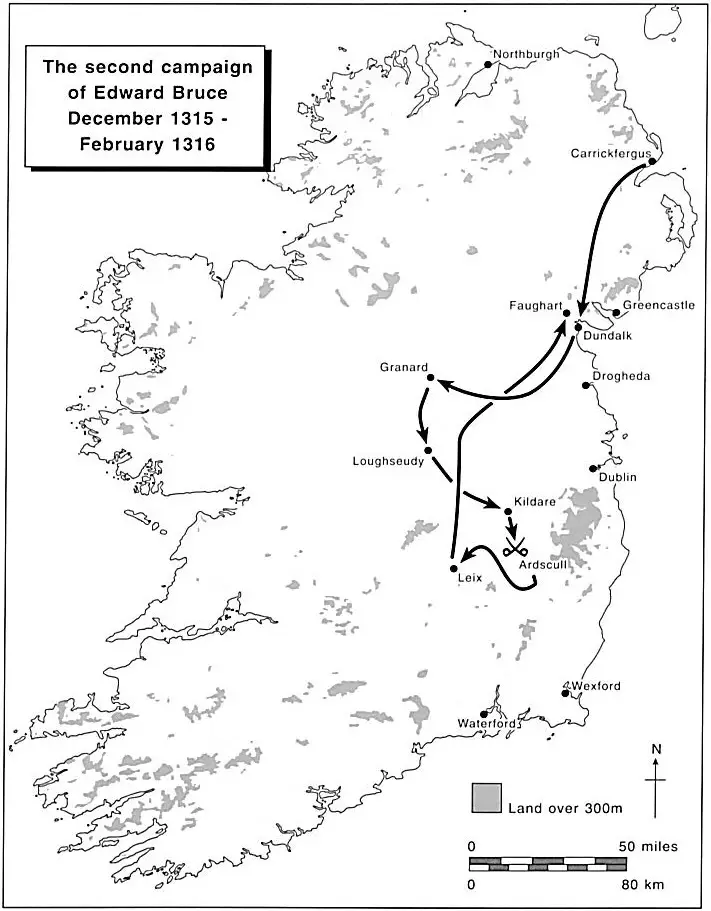
Flushed with that victory, and mindful of the ancient kinship between the Gaels of Scotland and the Gaels of Ireland — a shared blood, a shared tongue, a shared law, a shared heritage — Robert wrote to the Irish chieftains urging them to rise together and throw off the common enemy.
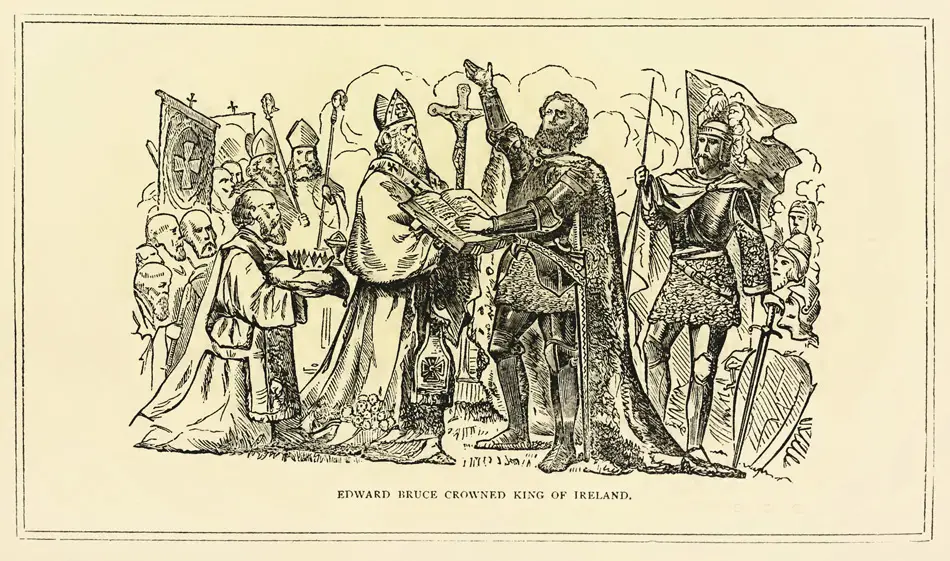
It was Domhnall Ó Néill, King of Tír Eoghain and by hereditary right the rightful claimant to the High Kingship of Ireland, who answered that call. In an extraordinary act, Ó Néill set aside his own ancient claim and offered the kingship of Ireland to Robert’s brother, Edward Bruce, who was inaugurated High King at Dundalk in 1315.
An Appeal to the Highest Court in Christendom
It was in the wake of this rebellion, as Edward Bruce’s campaign began to falter, that Ó Néill and his fellow chieftains determined to make their case not on the battlefield alone, but before the highest court in Christendom.
In the latter part of 1317, through the hands of two papal nuncios then in England attempting to broker peace between England and Scotland, the Irish princes sent their Remonstrance to Pope John XXII at Avignon.
The Case Against the Crown
The document itself is a piece of extraordinary rhetoric, equal parts legal brief, national epic, and indictment.
It opens by tracing an unbroken line of native kingship stretching back to the coming of St. Patrick in the fifth century, insisting that for centuries the Gael had governed himself under law, without the admixture of foreign blood, and had enriched and defended the Irish Church long before any Englishman set foot on the island.
Then it turns to its central grievance:
The bull Laudabiliter, by which Pope Adrian IV — an Englishman, the Remonstrance pointedly notes, “not so much by birth as by feeling” — had granted the lordship of Ireland to Henry II in the twelfth century.
That grant, the chieftains argued, had been obtained by deceit, and its terms broken from the very outset. Henry and his successors had sworn to extend the rights of the Irish Church, to govern the people justly, and to root out vice; instead, the Remonstrance charges, they and their ministers had done precisely the opposite, seizing land, enslaving the native population, and plundering the very churches they were sworn to protect.
Crafty Foxes and Ravening Wolves
What follows is not abstraction but atrocity, catalogued case by case. The Remonstrance names names: Thomas de Clare, who lured Brian Ruadh, prince of Thomond, to his table under the sacred bond of fosterage only to have him dragged to death behind horses and beheaded; Geoffrey de Pencoyt, who murdered his Irish guests in their beds after feasting them in his own home; John FitzThomas, Earl of Kildare, who sold the severed head of an Irish nobleman for profit.
These were not the actions, the chieftains insisted, of a civilising mission sanctioned by God, but of men they called crafty foxes and ravening wolves dressed in the outward semblance of holiness.
If Henry II’s charter had been granted on the promise of good governance and the protection of the Church, then a century and a half of broken faith had voided that promise many times over.
On these grounds, Domhnall Ó Néill — heir, as he saw it, to sixty-one unbroken generations of native kings — asked the Pope to recognise the transfer of Ireland’s kingship to Edward Bruce, a prince of the same ancient Milesian blood as the Gael himself.
A Plea Refused, A Prince Slain
It is a document remarkable not only for its fury but for its sophistication — grounded in canon law, steeped in scripture, and shaped with a diplomat’s understanding of how to appeal to a pontiff in Avignon who owed England no particular loyalty.
And yet, for all its eloquence, it failed.
Pope John XXII received the Remonstrance coolly, and gave the Irish chieftains no satisfaction. Within a year, at the Battle of Faughart in October 1318, Edward Bruce was killed and his army broken, and with him died the last real prospect of a Gaelic high king ruling a free Ireland in the medieval period.
Saved by a Scottish Hand
And yet the Remonstrance did not die with Edward Bruce.
It survives today only by a quirk of fate, preserved not in an Irish manuscript but in the Scotichronicon of the Scottish chronicler John Fordun, copied out more than half a century after it was written.
That an Irish document of such importance owes its survival to a Scottish monk’s chronicle is, in itself, a small parable of how much of Ireland’s early history has come down to us only by accident, scattered across foreign libraries and forgotten shelves, waiting to be found again.
An Old Nation’s Argument
What strikes me most, reading it now, is how modern its argument feels.
Here, four hundred years before the Enlightenment gave Europe its vocabulary of nationhood and self-determination, an Irish king was already arguing — in the language of law, ancestry, and justice — that a people with their own unbroken line of kings, their own laws, and their own faith had every right to govern themselves, and that no charter obtained by deceit and broken by its own grantees could bind them forever.
It is the same argument, in different clothing, that would be made again and again over the following six centuries, down to the men of 1798, of 1916, and beyond.
The Opening Chapter, Not a Footnote
This, perhaps, is the real value in returning to a document like the Remonstrance of 1317.
It is not merely a historical curiosity, buried in the footnotes of the Bruce invasions.
It is proof that the Irish sense of themselves as a nation — distinct, ancient, and wronged — did not begin with the Famine, or the Penal Laws, or even the Flight of the Earls. It was already fully formed, and already being argued before the Pope himself, within a century and a half of the Anglo-Norman landing.
To forget it, as most of us were never taught it in school, is to forget just how deep and how old the root of that grievance truly runs — and how long the Irish have understood, and been willing to argue, that their history was never a footnote to someone else’s story, but the opening chapter of their own.