Ask most people, even most Irish people, to name a famine, and they’ll give you one answer: the Great Hunger of the 1840s (or An Gorta Mór; though a growing number of Irish people today who know their history would refer to this atrocity as a genocide).
Fewer have ever heard of Bliain an Áir — the Year of Slaughter — a famine that struck a full century earlier, in 1740–41, and by some measures killed a larger proportion of the population than the potato blight ever did. It has almost entirely fallen out of national memory.
And buried in that forgetting is something genuinely strange: unlike the 1840s, this earlier catastrophe produced almost no emigration at all.
People didn’t flee.
They died where they stood.
A World Already Cooling
Bliain an Áir didn’t come out of nowhere.
Ireland in the 1740s sat deep inside what climate historians call the Little Ice Age, a long, uneven cooling of the North Atlantic world running roughly from 1300 to 1850.
It wasn’t a single event but a climate regime — centuries in which Europe’s winters ran colder and its growing seasons shorter and less reliable than in the medieval warm period before it.
Ireland had already felt its bite more than once: a catastrophic famine accompanied the Cromwellian wars of the 1650s, and cold, wet years in the 1690s brought hunger that helped push tens of thousands of Scots into Ulster.
By the time the eighteenth century’s own crisis arrived, cold-driven famine was not an unfamiliar shape for Irish life to take.
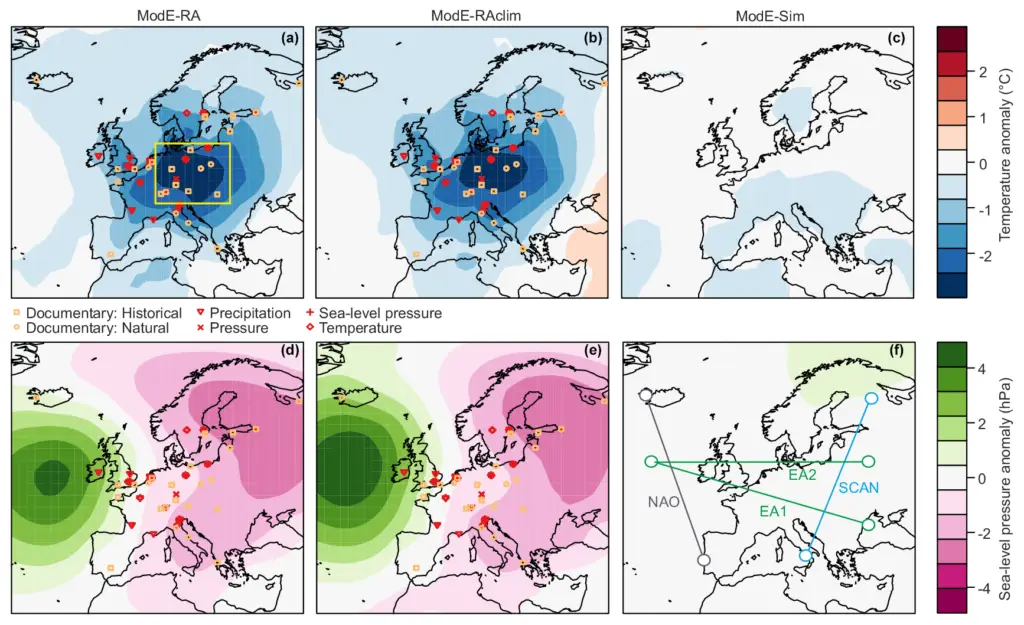
What made 1739–41 exceptional was its sheer severity.
The “Great Frost” set in in December 1739, after a run of unusually mild winters had lulled the country into a false sense of security.
Temperatures plunged to depths with no living memory to compare them to — indoor readings as low as -12°C, outdoor cold savage enough that the Foyle froze solid enough for a crowd to roast an ox on the ice.
Mills seized up.
Seed potatoes froze solid in their storage pits.
Livestock died by the thousand in the fields.
When spring finally came, there was no relief in it: 1740 turned into one of the driest, hottest summers in living memory, scorching what little had survived the frost, and a second brutal winter followed on its heels.
The Toll
The numbers, patchy as eighteenth-century record-keeping was, are staggering.
Best estimates put excess mortality at somewhere between 13 and 20 per cent of Ireland’s 2.4 million people — perhaps as high as 480,000 dead, from a base population roughly a third the size of Ireland at the height of the Great Famine a century later.
Proportionally, in terms of deaths, that makes Bliain an Áir the more lethal event of the two.
County Waterford, ironically the very county that would soon send thousands of young emigrants to the Newfoundland fishery, was among the worst affected: contemporary accounts describe fifteen or sixteen burials a day in the town of Lismore at the crisis’s height, with one estate agent reporting flatly that half the labouring people of the district were already dead.
Landlords, largely absentee or indifferent, mounted no organised relief.
Rents, tithes, and the ordinary machinery of extraction largely continued regardless.
Why Nobody Fled
Here is the puzzle. A century later, comparable suffering sent well over a million Irish people across the Atlantic in a matter of years.
In 1740–41, almost nobody left.
Several things seem to explain it.
- There was no ship, and no fare. Transatlantic and even short-sea passenger traffic in the 1740s was nothing like the dense commercial shipping network of the 1840s.
Regular emigrant routes barely existed for the Catholic poor of the south and east; a labourer with nothing left could not simply buy a berth, because in most of the country there was no berth to buy, and no money either way. - The emigration channel to Newfoundland was still forming. The seasonal cod fishery out of Waterford was already drawing young men across the Atlantic in this period, but as short-term migratory labour, not yet as an established route for whole families fleeing catastrophe.
It would take further decades of settlement before Waterford’s Newfoundland trade could function as an escape valve on the scale the Famine-era emigration would later exploit. - Where a route did exist, people used it. Tellingly, Ulster tells a different story. Ships already ran regularly from Belfast, Derry, and Newry to Pennsylvania, carrying the ongoing wave of Presbyterian emigration that had been building for decades.
When Bliain an Áir hit, thousands of Ulster families used that existing channel to leave. The lesson seems to be that famine alone doesn’t create emigration — it accelerates flight down routes that are already open. In 1740, the south and east simply didn’t have one yet. - Nobody framed it as an injustice to escape. The 1840s were shot through with a political narrative — articulated by figures like John Mitchel — that London’s policy, not merely potato blight, was killing Irish people, and that leaving was itself a form of protest and survival. Tonnes of food were being shipped out of Ireland annually, while Irish people were left starving and rotting.
In 1740–41, the famine was overwhelmingly read through a providential lens, an act of God and a freak of nature that had struck all of Europe, not a uniquely Irish injustice.
There was, as yet, no politics of exile to give leaving meaning.
What Else Was Happening…
The famine landed on a country still being reshaped by the previous century’s defeats.
The Penal Laws, tightened through the 1690s and early 1700s, excluded the Catholic majority from land ownership, public office, and education.
Memory of the Jacobite cause was still alive and taken seriously by the Protestant Ascendancy — it would not be fully broken until Culloden in 1746 — which meant the government of the day had every incentive to keep the Catholic population disarmed, landless, and politically powerless rather than invested in relieving it.
In the famine’s aftermath, the old “moral economy” — the tacit expectation that landlords eased demands in hard years — collapsed in many districts, feeding directly into the rise of agrarian secret societies like the Whiteboys a generation later.
Bliain an Áir left no exile literature and no diaspora to keep its memory alive abroad. It simply passed into local memory and largely out of the national one.
A Distant Mirror
It’s tempting, looking at a famine driven by an anomalous, multi-year run of extreme cold, drought, and crop failure, to draw a straight line to today’s conversations about climate volatility.
Historians of the Little Ice Age do increasingly treat Bliain an Áir as a case study in what happens when a society already stretched thin by inequality and bad governance meets a genuine climate shock: the weather is only ever half the story, and how exposed a population already is tends to decide who survives it.
Whether that amounts to a lesson for how we should think about climate risk today is a live and contested question, and reasonable people land in different places on it — but the underlying pattern, that vulnerability is manufactured long before the weather turns, is hard to argue with either way.
Bliain an Áir deserves to be better known, not as a rival to the Great Famine, but as its dark precursor — proof that catastrophe on this scale had already visited Ireland once, met by silence rather than exodus, a full century before the world was watching.
Further Reading
- David Dickson, Arctic Ireland: The Extraordinary Story of the Great Frost and Forgotten Famine of 1740–41
- Cormac Ó Gráda and Diarmaid Ó Muirthe, ‘The Famine of 1740–41: Representations in Gaelic Poetry’, Éire-Ireland, 45.3/4 (2010)
- Leslie Clarkson and Margaret Crawford, Feast and Famine: Food and Nutrition in Ireland 1500–1920
Sinéad O’Connor – Famine Lyrics
Okay, I want to talk about Ireland
Specifically I want to talk about the famine
About the fact that there never really was one
There was no famine
See Irish people were only allowed to eat potatoes
All of the other food
Meat, fish, vegetables
Were shipped out of the country under armed guard
To England while the Irish people starved
And then, in the middle of all this
They gave us money not to teach our children Irish
And so we lost our history
And this is what I think is still hurting we