Shrouded in the mists of early medieval Ireland, Ogham remains one of the most enigmatic writing systems of the ancient world.
Its slender strokes and notches, cut along the edges of standing stones or whispered onto wood, seem less like ordinary letters and more like a secret code entrusted only to the initiated.
Linked in tradition to the druids, the bards, and poets and the sacred lore of trees, this arcane alphabet carries an air of deliberate mystery—part practical script, part guarded knowledge—inviting us to wonder what hidden meanings still linger in its silent, branching lines.
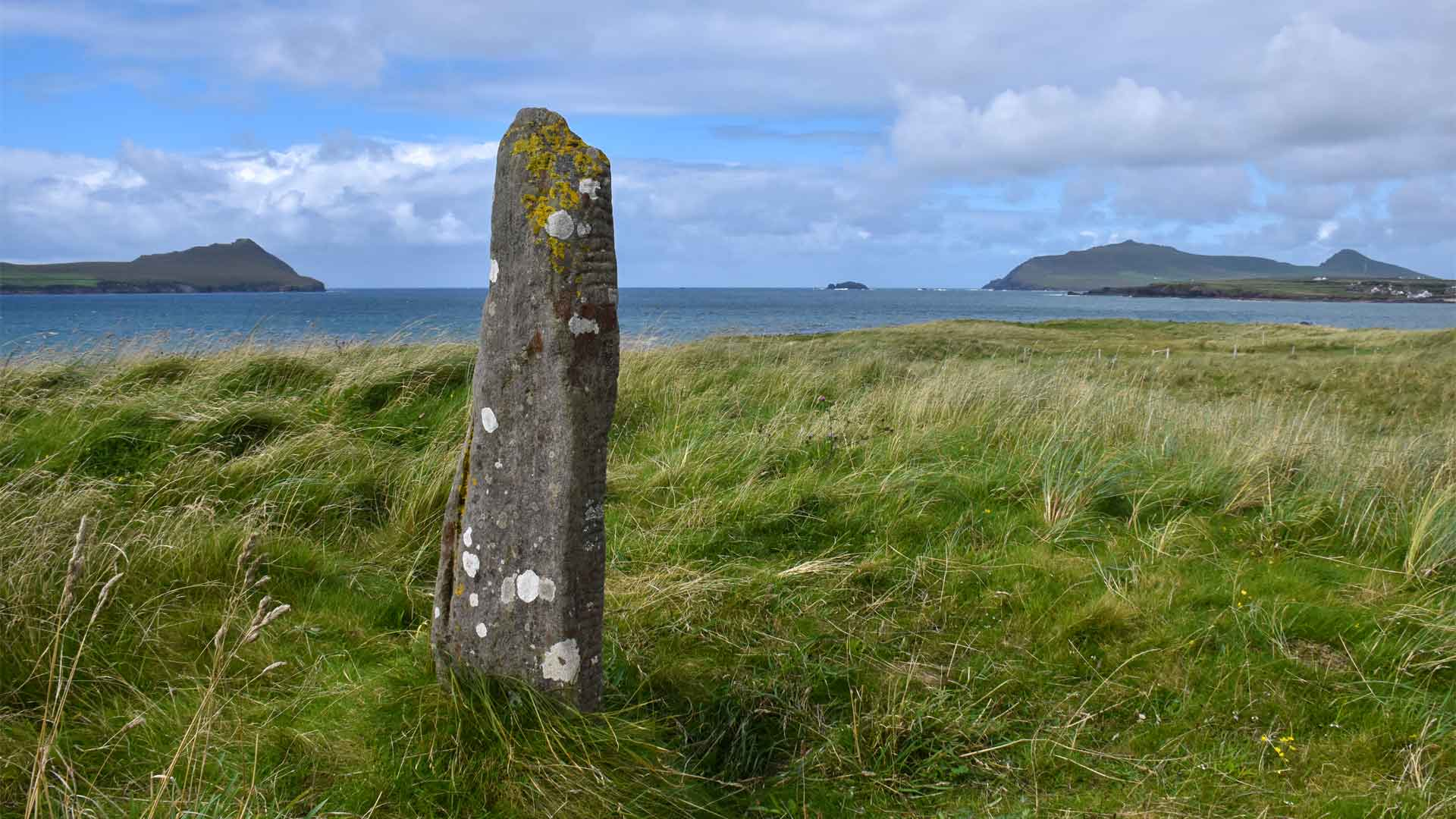
In truth, Ogham stones are ancient stone monuments carved with vertical lines and notches at the edge of the stones. They reliably date back to the time between the 4th and 9th centuries. The inscriptions on the stones record the names of people, territories, names of tribes, and tribal connections.
𝗪𝗵𝗮𝘁 𝗶𝘀 “𝗢𝗴𝗵𝗮𝗺” 𝗮𝗻𝗱 𝗵𝗼𝘄 𝗰𝗮𝗻 𝘆𝗼𝘂 𝘂𝘀𝗲 𝗶𝘁…
𝘖𝘨𝘩𝘢𝘮 (also spelled 𝘰𝘨𝘢𝘮) is an early medieval alphabet used primarily to write Primitive Irish and later Old Irish.
It consists of a series of notches and strokes arranged along a central stem-line.
Most scholars place its invention in Ireland in the fourth century AD, though some allow for a slightly earlier origin or limited influence from southern Britain, where Irish settlers were present.
It was designed specifically for the sounds of early Irish rather than borrowed wholesale from another system, although its creators almost certainly knew the Latin alphabet and basic grammatical principles.
Several theories exist; among those are:
1. that it began as a deliberate cipher so that those familiar only with Latin could not easily read it;
2. that it adapted the idea of alphabetic writing to Irish phonology; or that it developed from practical tally or marking systems.
Its name likely relates to the god Ogma or, perhaps, to an Irish phrase referring to a “pointed seam,” but the precise etymology remains uncertain.
The script appears as an Irish cultural innovation linked to scholarly and poetic circles.
It served as a specialised form of writing, sometimes associated with secret or restricted communication among the learned classes, and formed part of wider efforts to refine and systematise the Gaelic language in the early medieval period.
The basic alphabet is known as 𝘉𝘦𝘪𝘵𝘩𝘦-𝘓𝘶𝘪𝘴-𝘕𝘪𝘯 (from the first three letters: B-L-N, traditionally linked with birch, rowan and ash). A common variation is 𝘉𝘦𝘪𝘵𝘩𝘦-𝘓𝘶𝘪𝘴-𝘍𝘦𝘢𝘳𝘯 (B-L-F, associated with birch, rowan and alder).
In its classical form, the alphabet contains twenty letters; five additional supplementary characters (the forfeda) were added later, mainly in manuscript tradition, to represent further sounds.
𝗛𝗼𝘄 𝗢𝗴𝗵𝗮𝗺 𝗪𝗼𝗿𝗸𝘀 (𝗦𝘂𝗺𝗺𝗮𝗿𝘆 𝗼𝗳 𝘁𝗵𝗲 𝗥𝘂𝗹𝗲𝘀)
It is conventionally described as a tree-based alphabet: each letter (𝘧𝘪𝘥, “wood” or “tree”) carries a traditional name, many of which refer to trees or plants, though not every name is unambiguously arboreal and the full tree associations developed over time in later lore.
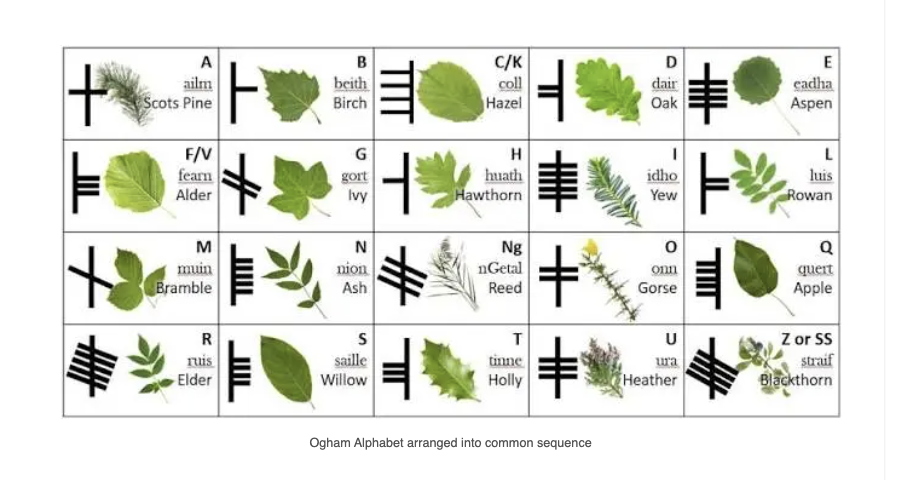
The core alphabet comprises twenty letters grouped into four 𝘢𝘪𝘤𝘮𝘪 (singular 𝘢𝘪𝘤𝘮𝘦: families or classes of five). Each 𝘢𝘪𝘤𝘮𝘦 is named after its first letter. A fifth group of 𝘧𝘰𝘳𝘧𝘦𝘥𝘢 appears in later sources.
Writing runs along a central stem-line (often the natural edge or 𝘢𝘳𝘳𝘪𝘴 of a stone when carved vertically):
– Strokes to the right of the line form one group
– Strokes to the left form another
– Strokes crossing the line diagonally form a third
– Notches or strokes on or through the line itself form the fourth (the vowels)
On standing stones the inscription is normally read from bottom to top (as if one were climbing a tree). Horizontal arrangements also occur in manuscripts.
Ogham was used mainly for short inscriptions, especially on standing stones. Roughly four hundred examples survive, the great majority in Ireland (particularly the south-west provinces of Munster—Kerry, Cork and Waterford).
Others appear in Wales (frequently bilingual with Latin), Cornwall, Devon, the Isle of Man and Scotland (a few possibly in Pictish).
Most classical inscriptions date from the fifth to seventh centuries and consist of personal names in the formula “X son of Y,” serving as memorials, markers of identity, ownership or territorial claims.
Literary sources also mention writing on wood for messages, records, or other practical and occasional magical purposes.
After the classical monumental period, the script continued in scholarly (“scholastic”) use within manuscripts.
There it acquired additional letters, numerous variant and cryptographic forms, and a rich body of associated lore, remaining a valued element of Irish learned tradition for centuries.
Further Reading:
- Damian McManus, A Guide to Ogam (Maynooth Monographs, 1991) – the standard scholarly introduction to the script and its inscriptions. https://archive.org/details/guidetoogam0000mcma
- Nora White et al., Ogham in 3D project (Dublin Institute for Advanced Studies) – online corpus of Irish (and later expanded) ogham stones with 3D models, photographs and readings. https://ogham.celt.dias.ie/
- OG(H)AM Project (University of Glasgow & Maynooth University) – comprehensive digital resource covering ogham from Ireland, Britain and beyond, across all media. https://ogham.glasgow.ac.uk/
- Katherine Forsyth – various articles and publications on Scottish, Pictish and Insular ogham.
(See Google Scholar search results: https://scholar.google.com/scholar?hl=en&as_sdt=0%2C5&q=Katherine+Forsyth+ogham&btnG=). - In Lebor Ogaim (The Ogam Tract) – the principal medieval manuscript tract on the alphabet, its variants and cryptographic forms.
The earliest substantial copy is preserved in the Book of Ballymote (Royal Irish Academy MS 23 P 12, late 14th century), which also contains related ogham material and illustrations.
Digital images available via Irish Script on Screen: https://www.isos.dias.ie/RIA/RIA_MS_23_P_12.html - Ogham Transliterators: Learn how to write your name (or anything else) with these online Ogham generators:
- https://ogham.co/ – Clean and popular tool. Type a word or name and it shows the Ogham version (with options for vertical display). It also lists common Irish names and phrases.
- https://ogh.am/ – Simple interface. Type in the box and the Ogham appears immediately. It can also generate downloadable images of the result.
- https://oghamlore.com/ogham-translator/ – Free converter with extra features such as downloading a PNG of the Ogham text and a list of popular names already converted.
- https://www.dcode.fr/ogham-alphabet – More technical converter that works in both directions (Latin → Ogham and Ogham → Latin) and shows both horizontal and vertical forms.
NOTE: Ogham was designed for early Irish sounds, so it does not have exact equivalents for every modern English letter (e.g. J, K, V, W, X, Y). Most tools use sensible phonetic substitutions. For the most authentic results, it is best to convert an Irish-language version of the word or name first.