The old stone bridge at Doonbeg in West Clare carries the N67 across the Doonbeg River, right in the middle of the village, with the ruins of Doonbeg Castle looking down on it from the seaward side. Most people cross it without a second glance, but tucked into the masonry between two of its arches is a small chamber (not the arches, but a sort of doorway into a small room that can be seen next to the two left arches in the image below), and in the winter of 1849 that chamber was home to two evicted widows and eight children.
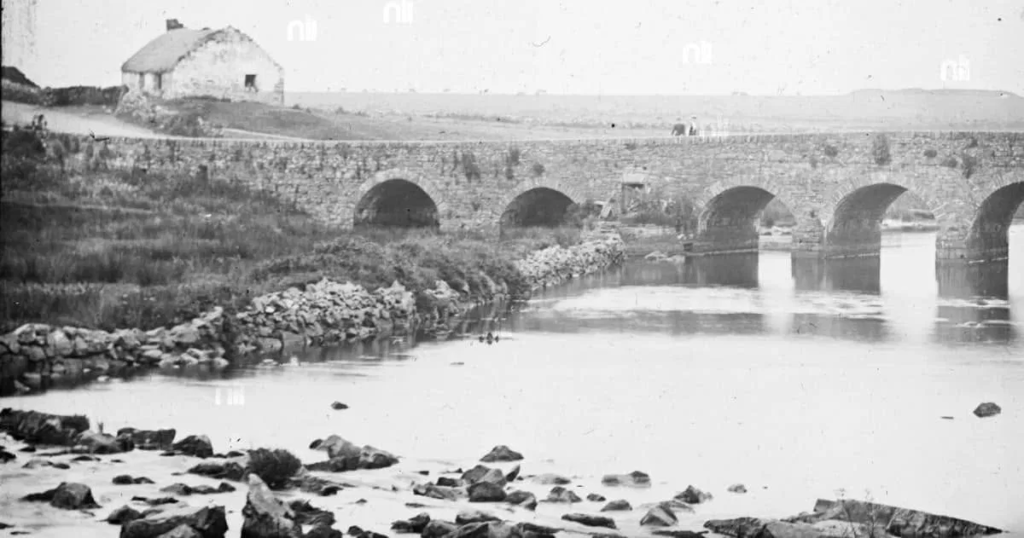
By Thomas Mason for the National Library of Ireland.
One of those widows was Judy O’Donnel. We know her name, and something of her story, because a reporter and artist from The Illustrated London News passed through Doonbeg that December, stopped at the bridge, and wrote down what she told him.
It is one of the very few accounts from the era of the Great Hunger in which an ordinary Clare woman is named, sketched and allowed to speak for herself, and the place where it happened is still standing today.
I want to tell her story properly here, because it shows the Great Hunger at the scale of one family, and because it shows how much of the suffering in West Clare was driven by eviction as well as by blight.
Kilrush Union in 1849
Doonbeg lay within the Kilrush Poor Law Union, which covered most of south-west Clare and became one of the worst-hit districts in Ireland.
By 1849 the potato had failed repeatedly, rents had gone unpaid, and the Poor Law rates on land were rising, so many landlords and middlemen found it cheaper to clear their holdings than to carry destitute tenants. The houses were “tumbled” so that the families could not creep back in.
Captain Arthur Kennedy, the Poor Law Inspector at Kilrush from 1847, documented these clearances in detail. His returns to the Poor Law Commissioners, later printed in the Parliamentary Papers, list townland after townland, with the head of each evicted household and the number of men and women in it.
In June 1849 a letter of his describing the scale of the evictions in the Union was read in the House of Commons, which debated the matter but changed nothing.
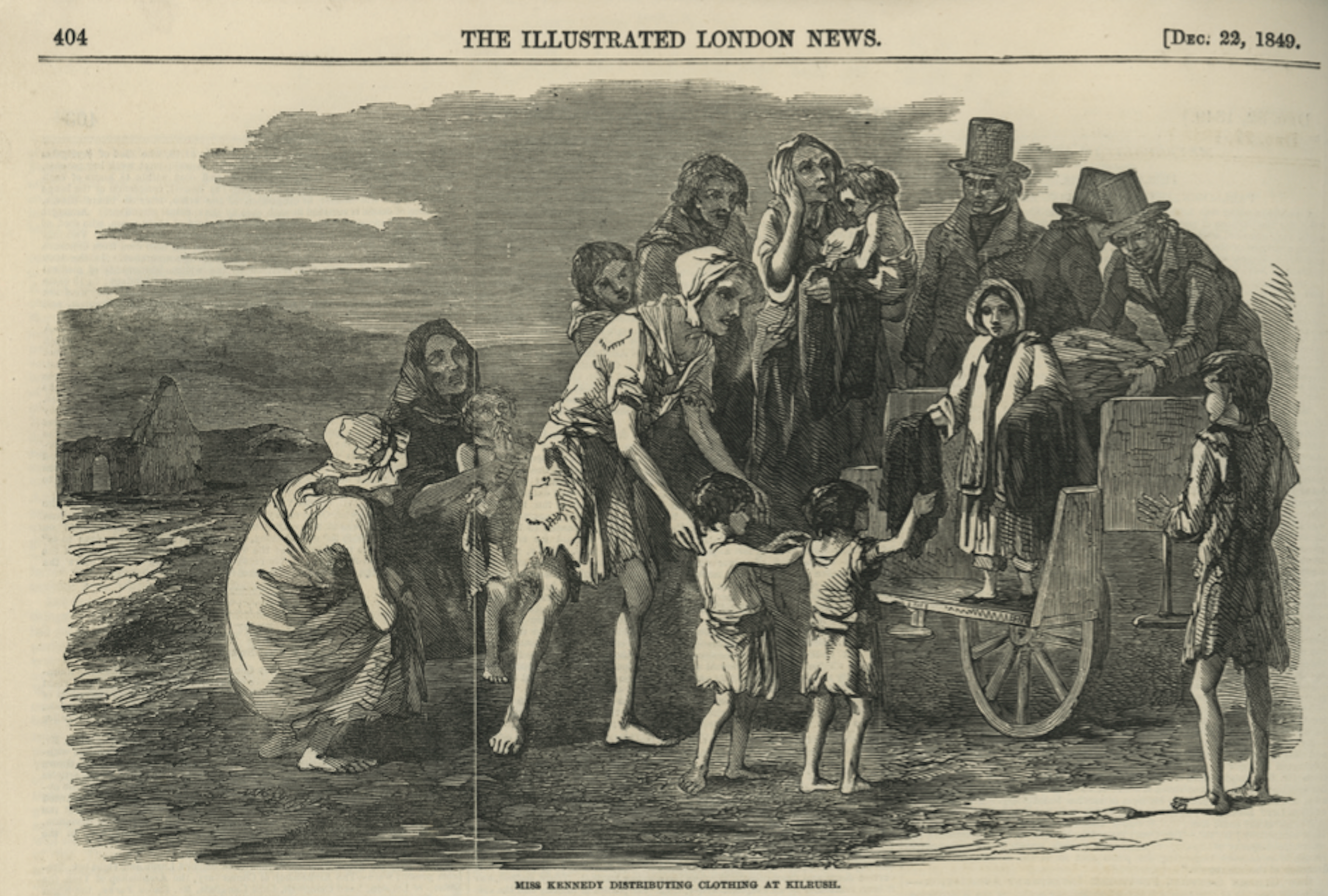
That December The Illustrated London News began a seven-part series called “Condition of Ireland: Illustrations of the New Poor-Law”, which ran from 15 December 1849 to 9 February 1850 and concentrated on the Kilrush Union.
The writer travelled the roads of west and north Clare counting roofless houses as he went, thirty-three on one seven-mile drive from Kilrush to Kilkee, and he printed a return of 2,891 houses levelled in the Union over the previous two years.
Neither the reporter nor the artist is named in the paper. The sketches are often attributed to the Cork artist James Mahony, who had drawn Skibbereen for the paper in 1847, but that attribution should be treated as likely rather than certain.
The series also carried the better-known portrait of Bridget O’Donnel and her children, published on 22 December 1849, which has become one of the defining images of an Gort Mór the Great Hunger.
Judy O’Donnel appeared a week later, in the issue of 29 December, on page 443.
Images from the Illustrated London News (December 22, 1849) pp. 404-05
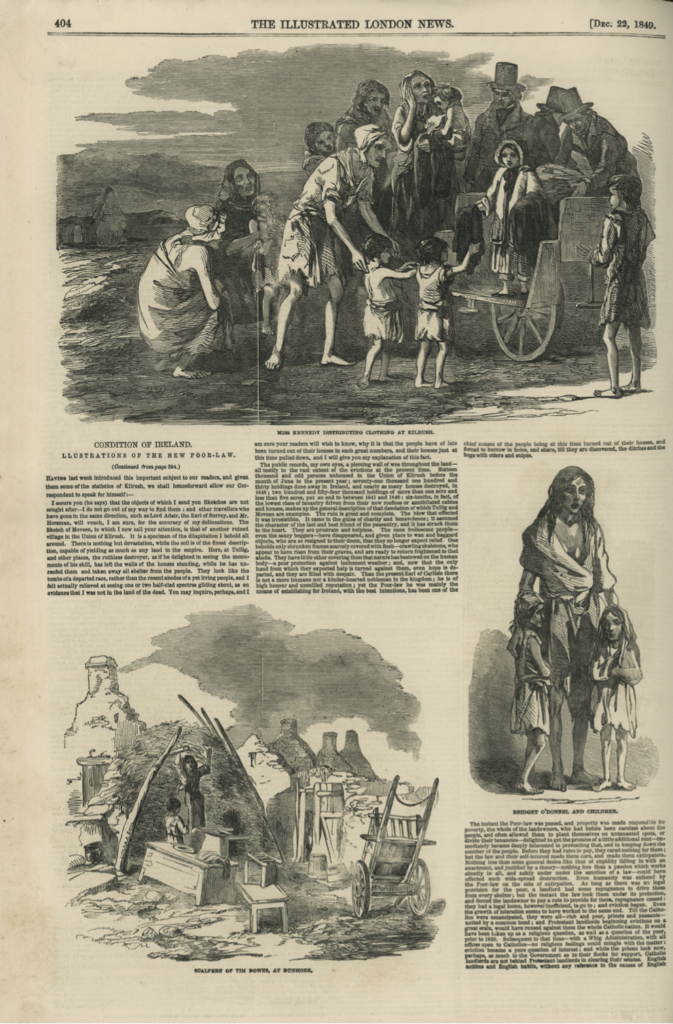
Left – Scalpken of Tim Downs, at Dunmore.
Right – Bridget O’Donnel and Children
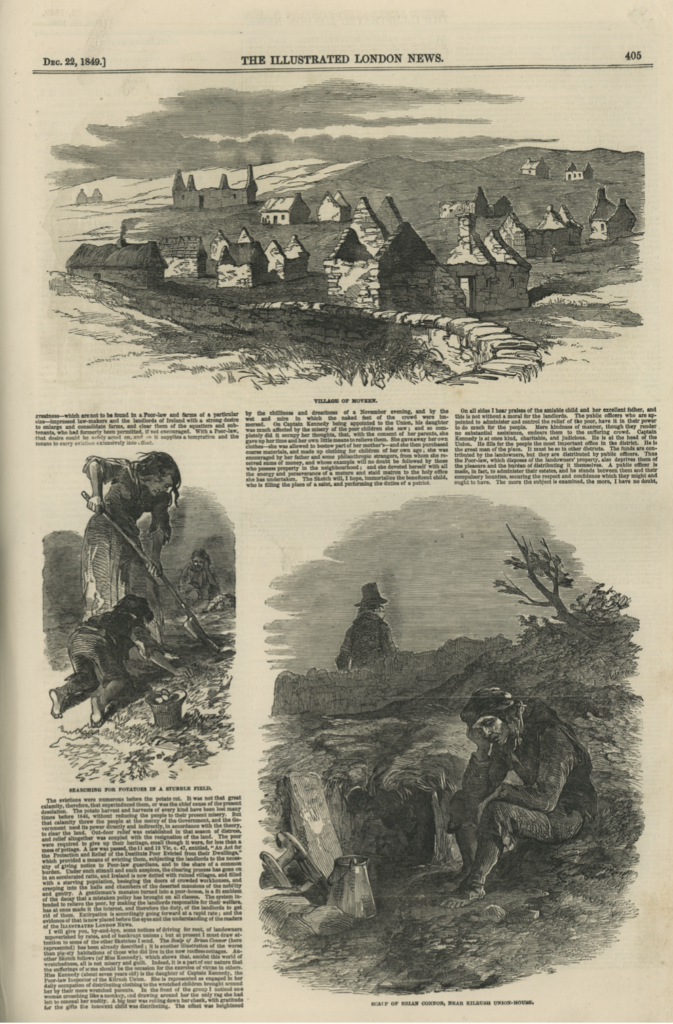
Left – Searching for Potatoes in a Stubble Field.
Right – Scalp of Brian Connor, Near Kilrush Union-House.
Judy O’Donnel’s Story
The reporter came to Doonbeg after passing through Killard, a village he described as completely cleared of its old inhabitants.
Doonbeg itself he found half destroyed by the landowners, the ruined houses standing with pointed gables and a few blackened rafters, while the surviving villagers were packed into whatever shelter was left.
Then he came to the bridge, and this is what he wrote.
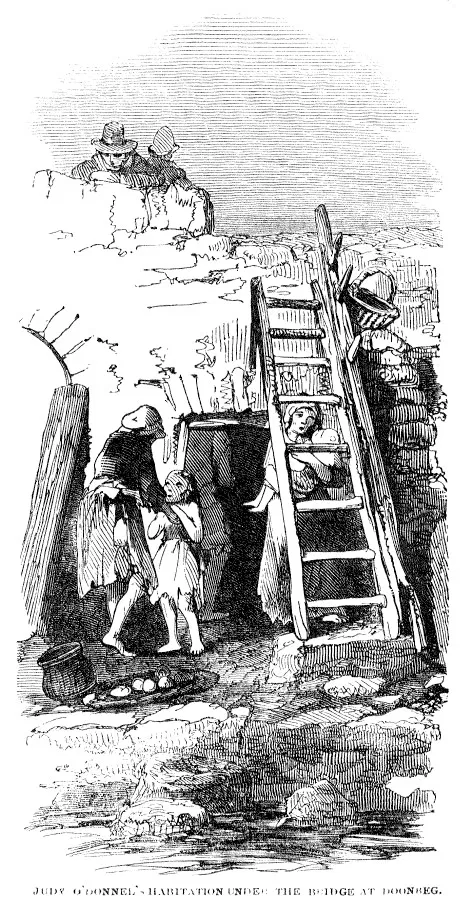
“Two wretched families have taken refuge under the bridge in a hole. They consist of two widows, one with three children, all ill of jaundice, and the other with five. The history of Judy O’Donnel, one of the widows, is worthy of being sketched. She had given evidence against a dishonest relieving officer whose relative was a driver upon the estate on which she lived, and Judy’s house was very soon afterwards levelled with the ground. The wreckers came upon it in her absence, when her son gallantly defended his home. He mounted on the roof with a bag of stones, and kept the enemy at bay till his ammunition was exhausted, when he was obliged to give in, and stand by to see the little furniture of his mother cast into the road and the house pulled down. Judy exhibited her receipts for the rent up to the last gale; and she declared the agent of the owner, to whom she had tendered what was due twice, had refused, and that she was ejected because she deposed against the dishonest public servant. Judy and Margaret O’Donnel, with their families, then retired to the hole under the bridge, represented in the sketch, and there they are now suffered to remain, holding their habitation at the mercy of the county surveyor. They are afraid of being ejected even from this spot, and dare not cross the stepping-stones shown in the Sketch lest they should be taken up for trespassing. Judy O’Donnel’s son is dying of dysentery.”
— The Illustrated London News, 29 December 1849, p. 443
What makes Judy’s case stand out is that she was not evicted for arrears.
She had her rent receipts in hand, up to the last gale day, and she said the agent had twice refused to accept the money she offered him.
Her account is that she was put out because she had testified against a corrupt relieving officer, a man whose relative worked as a driver on the estate.
If she was right, the eviction machinery of the estate was turned against a tenant who had spoken up about corruption in relief programs that were intended to help the most vulnerable and destitute.
Her son’s defence of the house is worth pausing on. He climbed onto the roof with a bag of stones and held off the wrecking party until he ran out, and then he had to stand and watch his mother’s few possessions thrown into the road.
By the time the reporter met the family, that same boy was dying of dysentery under the bridge.
The Terms in the Account
A few of the words in the passage carried precise meanings in 1849, and they sharpen the story considerably:
- Relieving officer. The Poor Relief (Ireland) Act of 1847 allowed outdoor relief to be given outside the workhouse, and relieving officers decided who received it in each district. It was a position with real power over who ate.
- Driver. An estate employee who enforced the landlord’s claims, impounding livestock for rent and serving notices. Drivers were often present at evictions.
- Gale. A periodic instalment of rent, usually paid twice yearly on gale days. Having receipts “up to the last gale” meant Judy was fully paid up.
- Deposed. She gave formal evidence, most likely as a sworn statement in an inquiry into the relieving officer.
- County surveyor. The official responsible for county roads and bridges. Because the chamber was part of a public bridge rather than estate land, the families sheltered there on his sufferance rather than the landlord’s.
- Trespassing. The stepping-stones in the sketch crossed the river below the bridge, and the families were afraid to use them in case they were arrested for trespass, presumably because the land on the far bank was private.
One detail is often repeated wrongly. The newspaper says one widow had three children and the other five, but it never says which was which, so retellings that give Judy three children are guessing. The other widow, Margaret O’Donnel, may well have been a relation by marriage, but the source does not say.
The Bridge and the Chamber Today
The National Inventory of Architectural Heritage dates it to around 1820 and describes it as a rubble-stone hump-back road bridge with cut-stone voussoirs and V-shaped cutwaters.
It has seven arches, five spanning the river and two standing on dry ground.
The chamber where the O’Donnels sheltered is set into the body of the bridge between two arches, and a doorway into it is visible in old photographs taken from the river.
Doonbeg bridge from the river, with the doorway of the chamber visible between the arches. National Library of Ireland.
The chamber did not fall out of use after the Great Hunger. When an elderly woman known locally as “Biddy Belfast” died in Kilrush hospital in December 1903, a newspaper report of her death noted that she had lived for years in a deep recess between two arches of the Doonbeg bridge. The same report mentioned another old woman, “Biddy Thunder”, who was then living high up in the tower of the ruined castle beside it.
Half a century on from the clearances, the bridge and the castle were still giving shelter to people with nowhere else to go.
The Kilrush and District Historical Society later erected a plaque at the bridge recording that the widows O’Donnel and their families lived there in 1849. In 2013, when Kilrush hosted the National Famine Commemoration, the Crack’d Spoon Theatre Company staged a re-enactment of Judy O’Donnel’s story at the bridge itself.
The chamber can still be seen from the eastern bank of the river, on the upstream side of the bridge, although the approach is through private land and permission should be sought. Nobody seems to know for certain what the chamber was originally built for. I have not found a source that settles the question, and if any reader knows of one, I would love to hear about it.
A Brehon Law Reflection
By 1849 the Brehon laws had been gone from Ireland for more than two centuries, and nothing in them would have saved Judy O’Donnel. Still, I find it useful to set her story beside the older Irish idea of what a lord owed the people on his land, because the contrast shows how alien the logic of the 1840s clearances was to the native tradition.
In early Irish law, the bond between a lord and his client, known as céilsine, was a contract with obligations running in both directions. The lord advanced a fief of stock or land, and the client repaid it with food-rent and labour, but the lord in turn owed protection, and ending the relationship carried defined consequences for either side.
Much land was also held as fintiu, kin-land that belonged to the family group across generations rather than to any one individual to dispose of. A tenant who could be put out on a notice from the agent even with her rent paid, had no equivalent in that world.
Fergus Kelly’s A Guide to Early Irish Law is the best place to follow up the details of clientship and kin-land if you want to test it for yourself.
Images
- Sketch of Judy O’Donnel’s habitation.
- Doonbeg bridge from the river. National Library of Ireland; Thomas Mason Photographic Collection c.1897.
- Pages 404-05 of The Illustrated London News, 22 December 1849.
Further Reading
- The Illustrated London News, “Condition of Ireland: Illustrations of the New Poor-Law”, 29 December 1849, transcribed by Clare County Library: clarelibrary.ie
- Clare County Library, overview of the full seven-part series: clarelibrary.ie
- Clare Libraries Local Studies, Illustrated London News 29 December 1849: clarelibraries.ie
- The Clare Herald, “Clare Facts: Family who lived under a bridge” (2015): lightholler.wordpress.com
- The Clare Herald, “Old Images of Clare: Doonbeg, 1897” (2014): lightholler.wordpress.com
- Kilkee Heritage, “Biddy Belfast”: kilkee.clareheritage.org
- National Inventory of Architectural Heritage, Doonbeg Bridge, Reg. No. 20404701: buildingsofireland.ie
- Captain Kennedy’s eviction returns for the Kilrush Union, Parliamentary Papers 1849, transcribed by Ireland Genealogy Projects: igp-web.com
- Michael Foley on the Bridget O’Donnel interview, via IrishCentral: irishcentral.com
- Fergus Kelly, A Guide to Early Irish Law (Dublin Institute for Advanced Studies, 1988)