Dublin offers one of the most striking examples in Irish place-name history, a capital city where the English name and the native Irish name describe two entirely different things. Most Irish place-names are straightforward transliterations, an anglicised version of the Gaelic sitting close to its original sound and sense. Dublin breaks that pattern entirely.
It bears no relationship to Baile Átha Cliath, the Irish name for the same city, and each name tells its own story about how the place came to be.
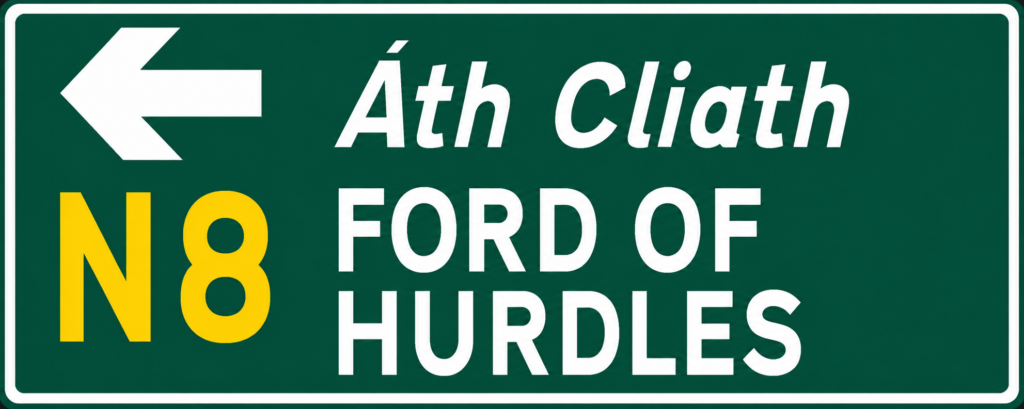
If Baile Átha Cliath had been transliterated the way most Irish place-names were, Ireland’s capital would be called something closer to Ballyaclee today. That it isn’t tells you that Dublin’s English name did not come from the Irish name at all. It came from somewhere else entirely.
Dublin’s story as a settlement begins with the Vikings, who established a fortified camp, or longphort, on the Liffey in 841 AD. They sailed up the river, known at the time as An Ruirthech, the ‘stampeding one’, a fitting name for a waterway prone to sudden floods, and made camp at a dark tidal pool where the River Poddle met the Liffey.
But the Irish already had a name for that pool: Duiblinn, or Dubh Linn, ‘black pool’, recorded in the Annals of Ulster in the very year the Vikings settled there. The Norse took this existing Irish name and adapted it to their own tongue as Dyflin, and it is this Norse rendering of an Irish name, not a Norse invention later borrowed into Irish, that eventually gave the city its English name.
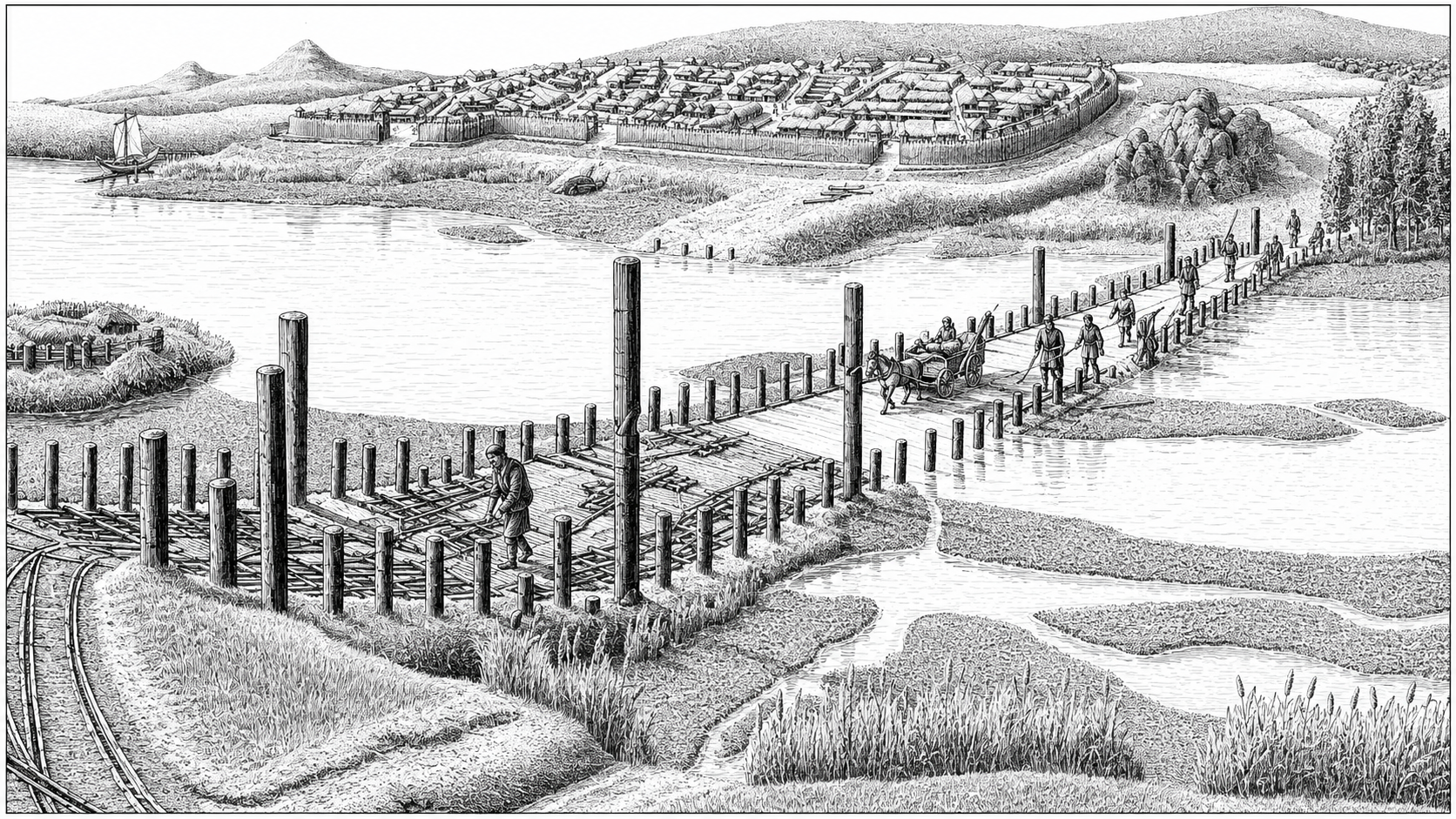
The native Irish, meanwhile, had a second name for the place, describing something quite different. They called it Baile Átha Cliath, the ‘town of the ford of hurdles’.
This was a working description of a real crossing point, close to where Father Mathew Bridge now stands. Four roadways, or slighe, converged there, meeting the Liffey at a spot shallow enough to cross at low tide by way of hurdles, woven panels of sapling branches laid across the riverbed.
Two names, then, for two features of the same place. One remembered the black pool. The other remembered the crossing.
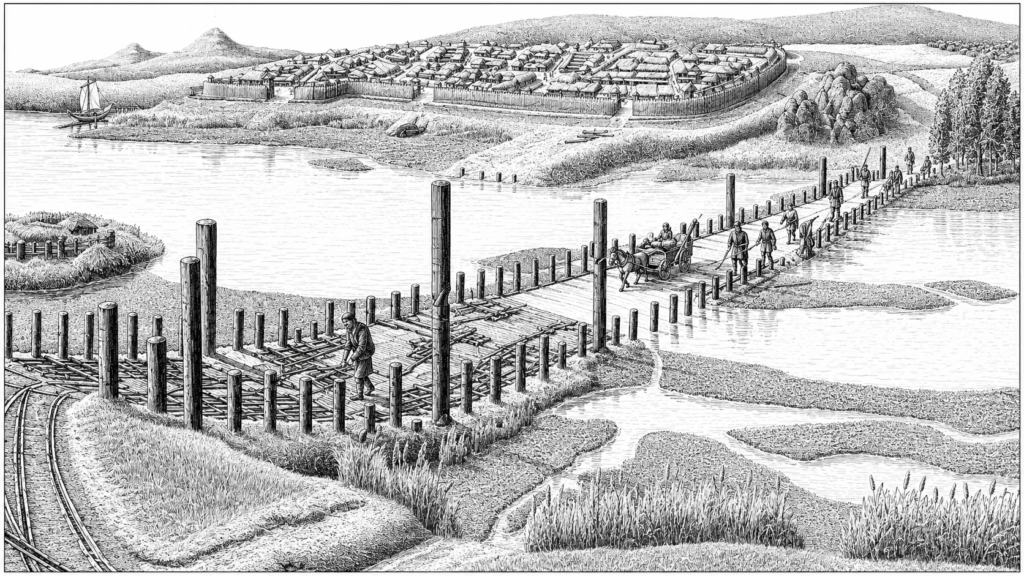
Enhanced sketch by illustrator Johnny Ryan depicting how the river-crossing may have looked in the past.
So why is it known as Dublin and not ‘Ballyaclee’ today?
The answer lies with the Anglo-Normans who took control of Dublin from the twelfth century onward. Anglo-Norman, led to English, and ultimately to British rule, which had little patience for anything overtly Gaelic, and rather than adopt Baile Átha Cliath, they kept the Norse name, anglicised it, and let it become the dominant form over time. It was during this same period that the area around Dublin came to be known as An Pháil Shasanach, the English Pale.

The Pale stretched as far north as Dundalk in County Louth and as far south as Dalkey in County Dublin, with an inland boundary running through Naas, Trim, and Kells and taking in parts of Meath and Kildare along the way.
The word itself comes from the Latin pālus, meaning a stake or a pole, and by extension a fence or a boundary. That is exactly what the Pale was, a marked boundary separating English law and English custom from Irish law and Irish custom beyond it.
The phrase this gave English has outlasted the boundary itself, though the link is looser than it’s often made out to be.
‘Beyond the pale’ is popularly traced to this exact boundary, English shorthand for anything judged uncivilised simply for existing outside that line, but the phrase’s documented history doesn’t pin it down so neatly, and the connection to the Irish Pale specifically is best read as a well-worn story rather than a settled fact.
Dublin stayed the seat of British rule in Ireland right up until the Irish Free State was established in December 1922, when it took on a new role as the seat of Dáil Éireann, the Irish parliament.
Air quality became Dublin’s next struggle, as the switch to cheap coal for home heating through the 1980s brought smog thick enough to darken the city by midday. The government answered it in 1990 with a straightforward ban on the sale of smoky coal, and the effect on Dublin’s air was immediate and lasting. This wretched smog problem earned Dublin its moniker as ‘the Big Shmoke’ that has stuck to the current day.